
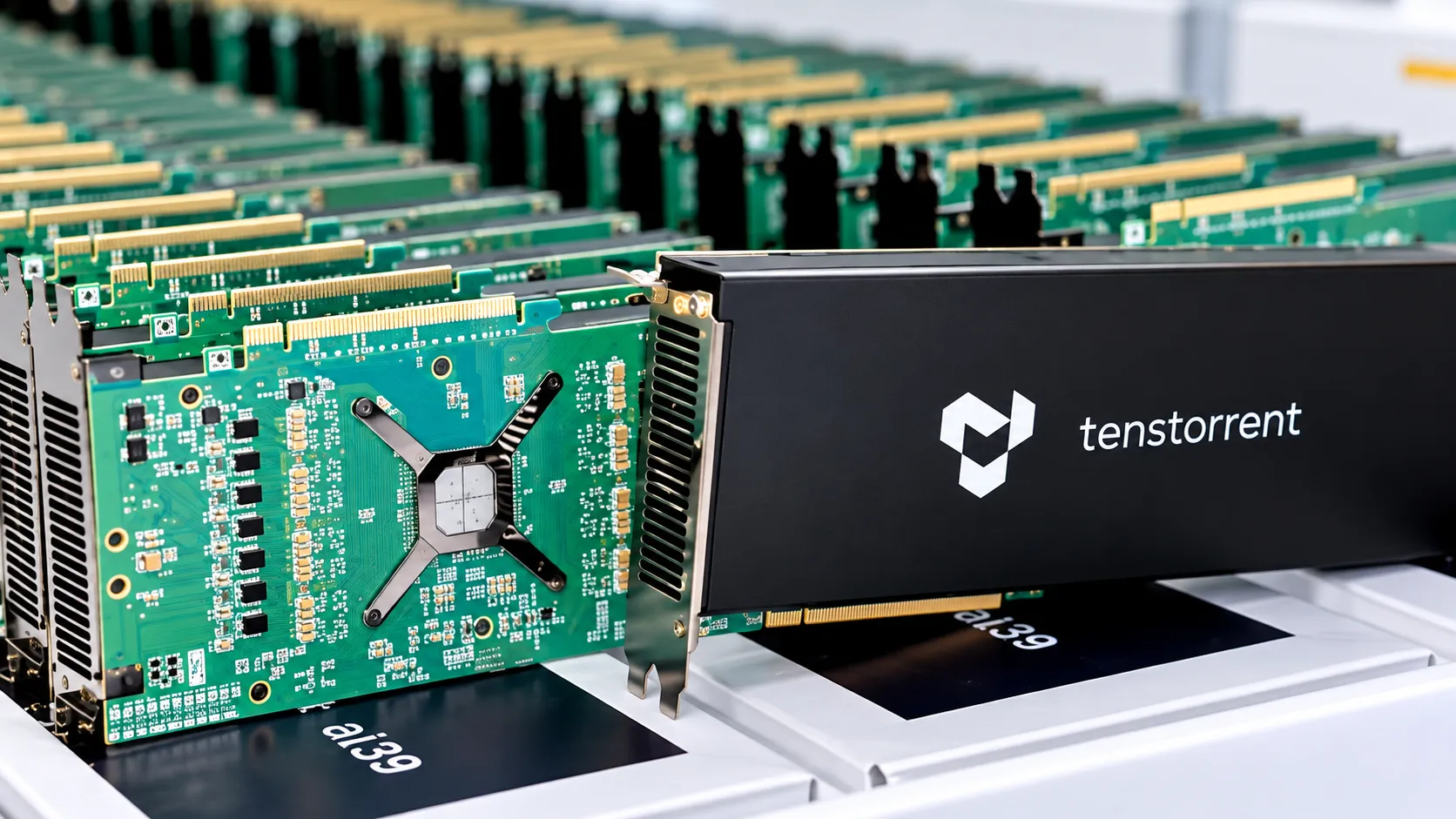
AI chip company Tenstorrent, led by veteran chip designer Jim Keller, has raised $1.5 billion in a Series E led by Trace Capital and Innovation X at a $6.2 billion post-money valuation, more than double its December 2024 level. ARK Invest, Fidelity, T. Rowe Price and Morgan Stanley joined the round.
<p>Even as investors question the economics of the artificial intelligence boom, one of the most closely watched challengers in AI hardware has secured a vast new war chest. Tenstorrent, the Santa Clara-based chip company led by legendary processor designer Jim Keller, has raised $1.5 billion in a Series E funding round, according to reports on October 19.</p><p>The round values Tenstorrent at $6.2 billion after the investment, more than double its valuation in a December 2024 financing. It was led by Trace Capital and Innovation X, with participation from ARK Invest, Fidelity Management & Research, Morgan Stanley, T. Rowe Price, SanDisk, Cadence Ventures, Tether Investments, Eclipse, Protagonist, Maverick Silicon and XTX Markets, among others.</p><p>Including this round, Tenstorrent has raised more than $2.19 billion across its latest two major financings. The company says it will use the new capital to scale volume manufacturing of its Galaxy server systems and expand its commercial operations.</p><h2>The Keller factor</h2><p>Tenstorrent's chief executive is one of the most celebrated figures in the semiconductor industry. Jim Keller has held senior chip-design roles at Apple, AMD, Tesla and Intel, and is widely credited with leading the development of processor architectures that revived AMD's fortunes and powered Apple's early mobile chips. His presence has given Tenstorrent unusual credibility among investors and customers.</p><p>Under Keller, Tenstorrent has built its business around RISC-V, an open-source instruction set architecture that anyone can use without paying licensing fees. That contrasts with proprietary architectures controlled by companies such as Arm, Intel and Nvidia.</p><p>The company develops AI processors, Galaxy server systems, RISC-V central processing units and licensable chip intellectual property. In addition to selling its own hardware, it licenses AI and CPU designs to companies that want to build their own custom silicon.</p><h2>Why customers want alternatives</h2><p>Tenstorrent's pitch rests on a growing desire among customers for more control over the chips, software and intellectual property behind AI infrastructure. Nvidia dominates the market for AI accelerators, and its CUDA software ecosystem has created powerful lock-in. Companies building AI data centres have faced long waits and high prices for Nvidia's most advanced chips.</p><p>That has created demand for alternatives. Large technology companies such as Google, Amazon, Microsoft and Meta have developed their own AI chips. Amazon, for instance, launched TorchNeuron on October 19, free software designed to make it easier to run AI code on its in-house Trainium chips. Startups including Cerebras, Groq and SambaNova have also raised large sums to build specialised AI processors.</p><p>Tenstorrent's approach is distinctive in combining open architecture with licensing. This is especially relevant to sovereign computing projects, in which governments seek to build national AI capacity without depending entirely on foreign proprietary technology, and to large enterprises that want to design chips tailored to their own needs.</p><img src="/api/files/1792482603248-ab778b712c619b83c9b8b4cd.webp" alt="4d11cf71-7045-4e3d-84f1-c151fd937707.png"><h2>A bet against the AI pessimists</h2><p>The timing of the round is striking. Global chip stocks have been through a turbulent period, with the Philadelphia Semiconductor Index enduring an eight-day losing streak, its longest since 2008, before rebounding on October 19. Investors have grown anxious about the vast sums being borrowed to build AI data centres, competition from Chinese memory makers and whether AI spending will generate sufficient returns.</p><p>The participation of large public-market investors such as Fidelity, T. Rowe Price and Morgan Stanley suggests that some of the world's biggest asset managers see long-term value in AI hardware beyond the current leaders. The presence of SanDisk and Cadence also points to strategic interest from companies across the semiconductor supply chain.</p><h2>The execution challenge</h2><p>For all its technical credibility, Tenstorrent faces a formidable challenge. It must translate its designs into server shipments, customer deployments, software adoption and sustainable economics. Building a competitive AI chip is only part of the battle; persuading developers to adopt a new software stack and customers to trust a new supplier is often harder.</p><p>Nvidia's lead is reinforced by its software, developer community and close relationships with cloud providers. Challengers must offer not just competitive performance but also compelling cost advantages and ease of use. Tenstorrent has invested heavily in open-source software to lower the barriers for developers.</p><p>Manufacturing at scale is another hurdle. Advanced chips depend on foundries such as TSMC and Samsung, whose capacity is in high demand. Securing production capacity and managing supply chains will be critical as Tenstorrent ramps up output of its Galaxy systems.</p><h2>Connections to India</h2><p>Tenstorrent's growth is relevant to India's semiconductor ambitions. The company has an engineering presence in Bengaluru, where many global chip companies employ thousands of design engineers. India's government has made semiconductors a strategic priority, offering incentives for manufacturing and design under the India Semiconductor Mission, and has emphasised the importance of open architectures such as RISC-V for domestic chip development.</p><p>Indian policymakers and startups have shown interest in RISC-V as a way to develop indigenous processors without dependence on proprietary licences. Peak XV Partners managing director Rajan Anandan has said India now has more than 100 semiconductor startups. A thriving ecosystem of open, licensable chip designs could help such companies accelerate their own products.</p><h2>Why RISC-V matters</h2><p>RISC-V began as an academic project at the University of California, Berkeley, in 2010 and has grown into a global standard backed by companies and governments around the world. Its open nature means that anyone can design processors based on it without paying royalties, allowing companies to customise chips for specific tasks.</p><p>That flexibility has made RISC-V attractive for applications ranging from small embedded devices to data centre processors. China has embraced RISC-V as a way to reduce reliance on Western-controlled architectures, while companies in Europe, India and the United States have used it to build specialised chips. Tenstorrent's success could help establish RISC-V as a serious option for high-performance AI computing, an area long dominated by proprietary designs.</p><h2>What comes next</h2><p>With $1.5 billion in fresh capital, Tenstorrent has the resources to scale manufacturing, expand its customer base and invest in software. The coming year will test whether it can turn technical promise into meaningful market share in an industry where Nvidia remains dominant.</p><p>For the broader AI industry, the round is a sign that investors still believe the market for AI computing is large enough to support multiple winners, and that open architectures could play a growing role in shaping it.</p>
“We are witnessing the birth of ‘Statist Silicon’—where the location of a transistor’s manufacture is as important as its clock speed.”
The Rise of Regional Fabric
