
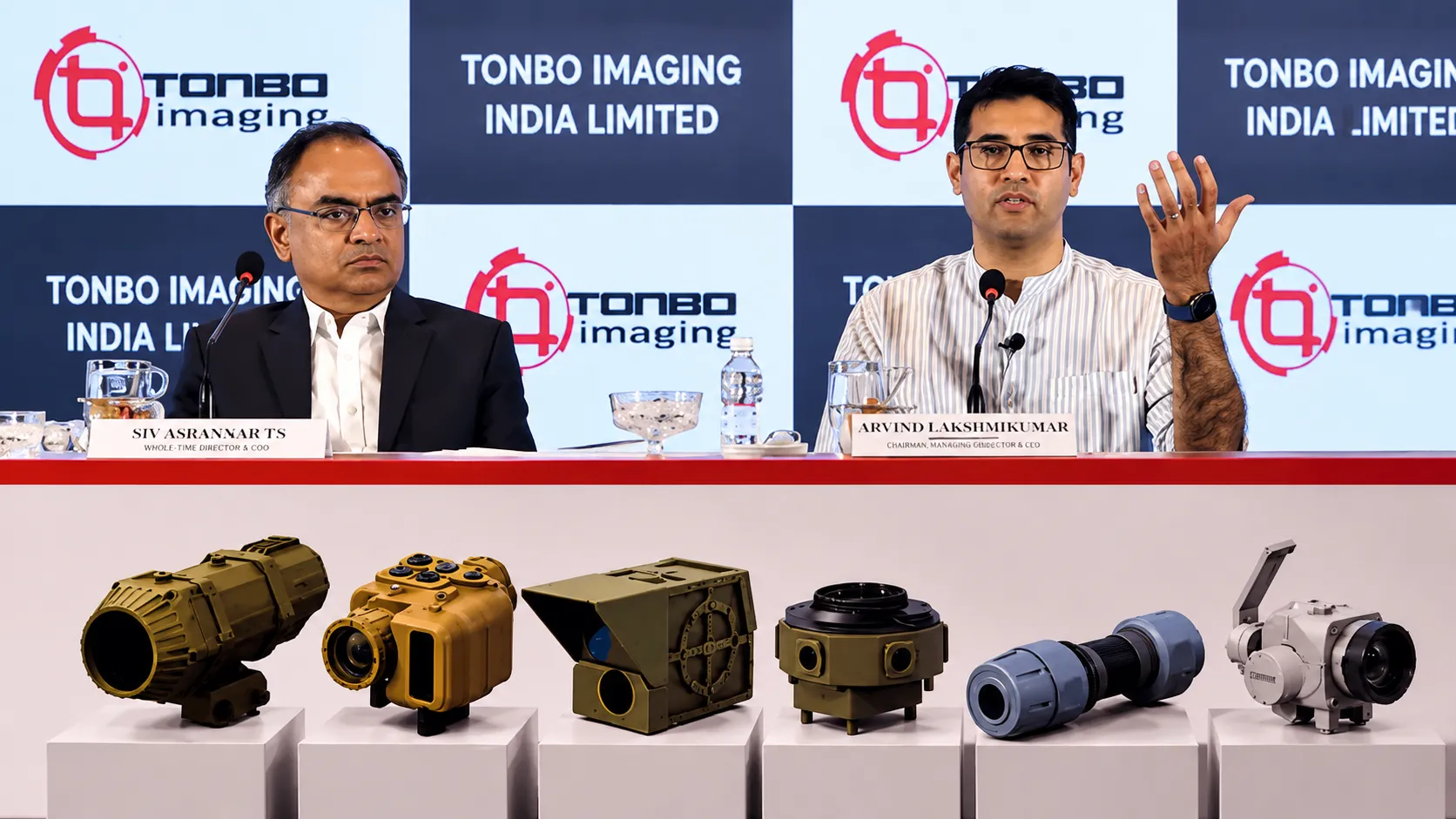
Bengaluru-based Tonbo Imaging's ₹852 crore IPO closed on October 19 with bids for nearly 136 times the shares on offer, led by qualified institutional buyers at 293.56 times. The thermal imaging and weapon-sight maker drew more than 55 lakh applications, despite a 22.7% fall in FY26 revenue blamed on delayed West Asia orders.
<p>Investors have delivered an emphatic verdict on India's defence-technology boom. The initial public offering of Tonbo Imaging India, a Bengaluru-based maker of thermal imaging systems, weapon sights and missile seekers, closed on Monday, October 19, with bids for nearly 136 times the shares on offer, according to exchange data reported by Business Standard.</p><p>The ₹852 crore issue, priced in a band of ₹665 to ₹700 per share, was subscribed 135.90 times overall. Demand was strongest among qualified institutional buyers, whose portion was subscribed 293.56 times. Non-institutional investors, typically wealthy individuals and corporates, bid 170.94 times their quota, while retail investors subscribed 31.07 times. The employee portion was subscribed 54.31 times.</p><p>The issue attracted more than 55 lakh applications, according to data from Chittorgarh, making it one of the most heavily subscribed IPOs of the year.</p><h2>Strong anchor support</h2><p>Ahead of the public offer, Tonbo allotted 36,48,013 shares to anchor investors, raising ₹255.36 crore. Participants included SBI Infrastructure Fund, ICICI Prudential Smallcap Fund, HDFC Mutual Fund, Kotak Mahindra Mutual Fund, HDFC Life, Goldman Sachs, BlackRock, Allianz Global Investors and Prudential Assurance.</p><p>Earlier secondary transactions in the company's shares, worth more than ₹413 crore, were carried out at ₹700 per share, implying a fully diluted valuation of about ₹4,000 crore. That price matches the top of the IPO price band.</p><p>The depth of institutional demand reflects a broader enthusiasm for Indian defence companies. Listed defence stocks have been among the market's best performers over the past few years, as the government has increased defence spending, prioritised domestic procurement and encouraged exports.</p><h2>What Tonbo makes</h2><p>Tonbo Imaging designs and develops electro-optical systems used by armed forces and security agencies. Its products include thermal imaging cameras that allow soldiers to see in darkness and through smoke, weapon sights, missile seekers that help guided weapons find targets, and fire-control systems.</p><p>The company supplies customers in 24 countries. It has owned 100% of its product intellectual property since FY24 and operates an asset-light model: design, development and testing are carried out in-house in Bengaluru, while manufacturing is outsourced to certified partners. That approach allows it to scale without heavy investment in factories, but it also makes it dependent on the quality and capacity of its manufacturing partners.</p><p>Its promoters are Arvind Kondangi Lakshmikumar, Ankit Kumar and Cecilia D'Souza.</p><h2>A difficult year in the numbers</h2><p>Investors were willing to overlook a weak financial year. Tonbo's revenue fell 22.69% to ₹362.65 crore in FY26 from ₹469.08 crore in FY25, and profit after tax declined to ₹50.88 crore from ₹72.76 crore. The company attributed the decline to delayed international orders linked to the conflict in West Asia, with some orders shifting into FY27.</p><p>The first quarter of FY27 was also weak, with revenue of ₹36.01 crore and a net loss of ₹17.74 crore. Defence companies often have lumpy revenue, as large orders are delivered and recognised in particular quarters, and investors appear to be betting that delayed orders will flow through later in the year.</p><h2>The defence-tech tailwind</h2><p>Tonbo's IPO comes at a moment of extraordinary momentum for Indian defence manufacturing. The government's push for self-reliance in defence has led to lists of items that must be procured from domestic suppliers, while defence exports have grown sharply over the past decade. Private companies, including startups, have been given a growing role in a sector once dominated by state-owned enterprises.</p><p>Global events have also raised the profile of defence technologies. Conflicts in Ukraine and the Middle East have demonstrated the importance of night vision, drones, precision-guided munitions and electronic systems on the modern battlefield. Demand for such products has risen worldwide, and Indian companies are increasingly competing for international orders.</p><p>For investors, defence-tech companies offer exposure to government spending that is relatively insulated from economic cycles, although it can be affected by procurement delays and policy shifts.</p><img src="/api/files/1792494647841-1e055543b129cded5224e49e.webp" alt="1f5fe6db-f167-4a53-825a-bb838bc04695.png"><h2>What the subscription means</h2><p>Heavy oversubscription typically signals strong demand for listing gains, and the grey market has been active for the issue. However, analysts caution that very high subscription numbers can sometimes lead to volatile trading after listing, as investors who received small allocations sell quickly.</p><p>The institutional portion's 293-times subscription is particularly notable because QIBs, including mutual funds, insurers and foreign institutions, are generally considered more discerning than retail investors. Their enthusiasm suggests confidence in the company's longer-term prospects despite its recent financial dip.</p><h2>The broader IPO market</h2><p>Tonbo's success adds to a busy period for India's primary market. Zetwerk's IPO closed with subscription of just over three times on the same day, and Jio Platforms, India's largest-ever IPO, opens on October 21 after a record anchor book. Despite heavy selling by foreign portfolio investors in the secondary market, domestic institutions and retail investors have continued to support new listings.</p><p>For deeptech and defence startups, Tonbo's offering is an important signal. Companies building complex hardware and intellectual property have historically found it harder to raise capital in India than consumer internet businesses. A successful listing could encourage more such companies to consider public markets.</p><h2>How Indian IPO subscriptions work</h2><p>Indian IPOs divide the shares on offer into categories. Qualified institutional buyers, including mutual funds, insurers, banks and foreign portfolio investors, typically receive about half of the issue in a book-built offering. Non-institutional investors, often high-net-worth individuals and corporates, receive a smaller portion, and retail investors applying for smaller amounts receive a fixed share. Anchor investors are allotted shares a day before the issue opens, and their participation is often seen as a signal of institutional confidence.</p><p>When an issue is oversubscribed, shares are allocated proportionately in the institutional and non-institutional categories, while retail allotments are often decided by lottery, meaning many applicants receive no shares at all. That dynamic helps explain why very heavily subscribed issues frequently see strong buying on listing day, as investors who missed out seek to acquire shares in the market.</p><h2>What comes next</h2><p>Share allotment and listing are expected in the coming days. The company's performance on debut, and its ability to convert delayed orders into revenue over the rest of FY27, will determine whether the enthusiasm of the IPO book translates into lasting value for shareholders.</p><p>For now, Tonbo Imaging has shown that investors are willing to pay a premium for Indian companies that own critical defence technology, and that India's defence-tech story has found a deep pool of capital ready to back it.</p>
“We are witnessing the birth of ‘Statist Silicon’—where the location of a transistor’s manufacture is as important as its clock speed.”
The Rise of Regional Fabric
