
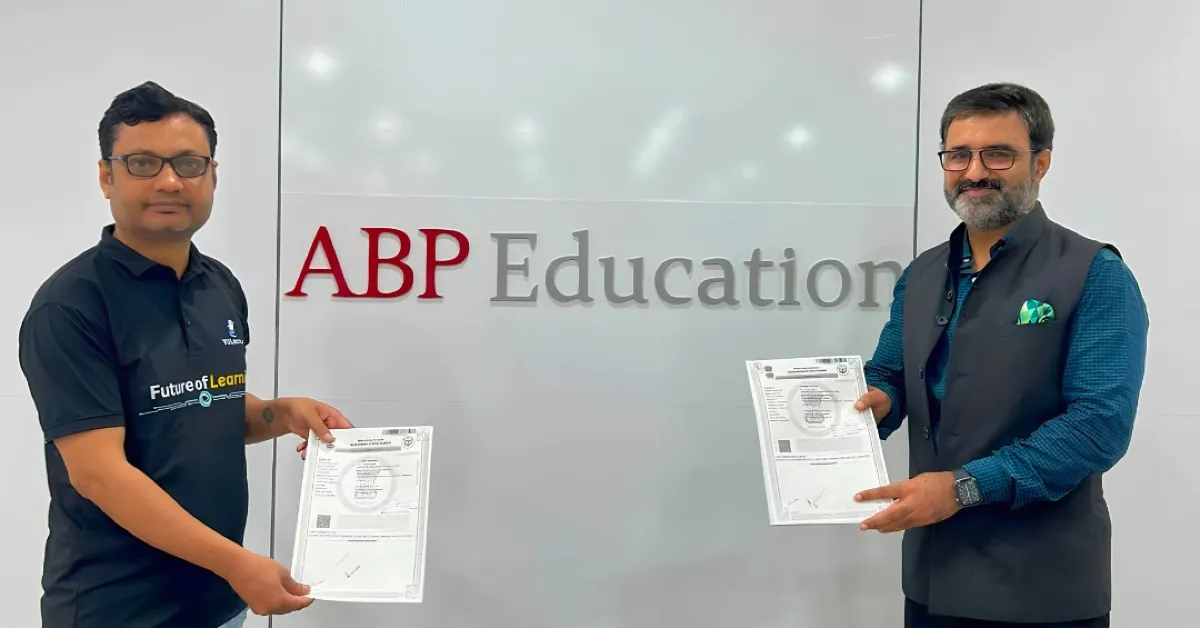
Noida-based edtech startup YoLearn.ai has raised an undisclosed seed round led by ABP Education, which will convert its school textbooks into AI tutors accessible in 22 Indian languages.
<p>YoLearn.ai, a Noida-based edtech startup building a voice-first artificial intelligence tutoring platform, has raised an undisclosed amount in a seed funding round led by ABP Education, the education arm of ABP Group. Beyond capital, the partnership carries strategic weight: ABP Education will support the startup with content, marketing and distribution, while its group companies Headword Publishing and KIPS Learning will convert their existing school textbooks into AI-accessible tutors, embedding the technology directly into classroom materials used across India.</p><p>Founded in January 2025 by Kirti Prakash Mishra, YoLearn.ai has built a platform that lets students scan a code printed in a physical textbook and immediately begin interacting with an AI tutor tied to that specific chapter and curriculum. The system currently supports 22 Indian languages, a deliberate design choice aimed at reaching students well beyond India's English-medium and Hindi-medium urban schools, into regional-language classrooms where personalised academic support has historically been scarcest.</p><p>The platform offers step-by-step problem solving, adaptive practice tests, and score predictions aligned to the country's three dominant school board curricula: CBSE, ICSE, and various state boards. That alignment is a critical detail for adoption at scale, since Indian parents and schools tend to be highly curriculum-sensitive, and edtech products that fail to map cleanly onto board-specific syllabi have historically struggled to gain traction beyond pilot programmes.</p><p>The tie-up with ABP Education is structured as more than a typical financial investment. By committing to convert its own publishing catalogue, spanning Headword Publishing and KIPS Learning's textbook libraries, into AI-tutor-enabled content, ABP Education is effectively building a proprietary distribution channel for YoLearn.ai's technology at the point where students already engage with learning material: the printed textbook itself, rather than a separate app that competes for a student's attention.</p><p>India's edtech sector has undergone a significant correction since the excesses of the pandemic-era funding boom, with several high-profile companies scaling back operations or seeking acquirers amid weaker unit economics and slower-than-expected paid conversion. Against that backdrop, YoLearn.ai's approach, anchoring its growth to an established publishing partner's existing textbook distribution rather than pursuing costly independent customer acquisition, reflects a more capital-efficient playbook that investors appear increasingly comfortable backing.</p><p>Voice-first interaction is central to the platform's design philosophy. Rather than requiring students to type queries, as many text-based AI tutoring tools do, YoLearn.ai allows learners to speak their questions naturally, an approach the company believes better serves younger students and those studying in regional languages where typing fluency may lag behind spoken fluency. The company has said this design choice is intended to lower the barrier to genuine engagement, particularly among first-generation smartphone users in smaller towns.</p><p>For ABP Group, the investment marks a deeper push into the technology layer of Indian education publishing, an industry that has traditionally generated revenue primarily through print sales and licensing. By embedding AI tutoring directly into its textbook ecosystem, the group is positioning itself to capture recurring digital engagement alongside its existing print business, a hybrid model that several legacy publishers globally have begun exploring as classroom technology adoption accelerates.</p><p>The scan-to-tutor mechanism also creates a natural pathway for usage data to flow back to both YoLearn.ai and ABP Education, offering insight into which topics and question types students most frequently struggle with. That data, over time, could inform not only product improvements to the AI tutor itself but also future editorial decisions in how ABP Group's textbooks are structured and revised.</p><p></p><img src="/api/files/1788508568478-da1d638826ab2b23c03b0e61.webp" alt="image.png"><p>As AI-enabled tutoring tools proliferate across the Indian edtech landscape, YoLearn.ai's bet is that the winning products will be those most tightly integrated into a student's existing academic materials and language of comfort, rather than standalone platforms competing for discretionary screen time. The company's next milestones will likely be measured not in app downloads, but in how many of ABP Education's textbook titles are successfully converted into functioning AI tutors across its 22 supported languages.</p><p>India's edtech investors have grown notably more disciplined in evaluating new opportunities since the sector's earlier funding excesses, placing greater weight on clear paths to sustainable unit economics and genuine curriculum alignment over raw user acquisition metrics. YoLearn.ai's distribution-first partnership model with ABP Education directly addresses these more rigorous evaluation criteria, offering a lower customer acquisition cost pathway than platforms reliant on paid digital marketing alone.</p><p>The 22-language support embedded in YoLearn.ai's platform also positions the company to capture demand in India's vast non-metro and regional-language school markets, segments that have historically been underserved by English-first edtech products designed primarily for urban, affluent families. That underserved market represents a substantially larger addressable student population than the segment most existing well-funded Indian edtech companies have prioritised.</p><p>As the partnership with ABP Education matures, the volume of textbook titles successfully converted into AI-tutor-enabled content will serve as the clearest quantitative marker of the collaboration's progress, offering both companies, and prospective future investors, a concrete measure of execution against the ambitious vision of embedding AI tutoring directly within India's mainstream school curriculum materials.</p><p>Looking ahead, YoLearn.ai's founders have indicated that further expansion, both in terms of additional publishing partnerships beyond ABP Education's own catalogue and deeper geographic penetration across India's state education boards, remains a core priority for the company's next growth phase. Should the model prove successful, it could offer a template not only for other Indian edtech companies but for publishers globally seeking to extend the useful life and engagement value of printed textbooks in an increasingly AI-native learning environment.</p><p>For India's edtech observers, YoLearn.ai's model, anchoring AI adoption to existing textbook distribution rather than competing for standalone app downloads, offers a genuinely differentiated playbook worth watching closely as the sector continues recovering from its earlier funding excesses. Publishers and edtech founders elsewhere in the world facing similar questions about how to extend printed content into the AI era may find useful lessons in how this specific partnership evolves over its first full academic year.</p><p>It is also worth situating YoLearn.ai's raise within the broader arc of India's edtech funding recovery, which has been notably more selective and structurally cautious than the sector's earlier boom years. Investors across the category increasingly favour companies with clear, defensible distribution advantages and curriculum-aligned product design over those pursuing broad consumer acquisition strategies, a shift that has rewarded YoLearn.ai's textbook-embedded approach relative to competitors still reliant on standalone app-based customer acquisition models.</p>
“We are witnessing the birth of ‘Statist Silicon’—where the location of a transistor’s manufacture is as important as its clock speed.”
The Rise of Regional Fabric
