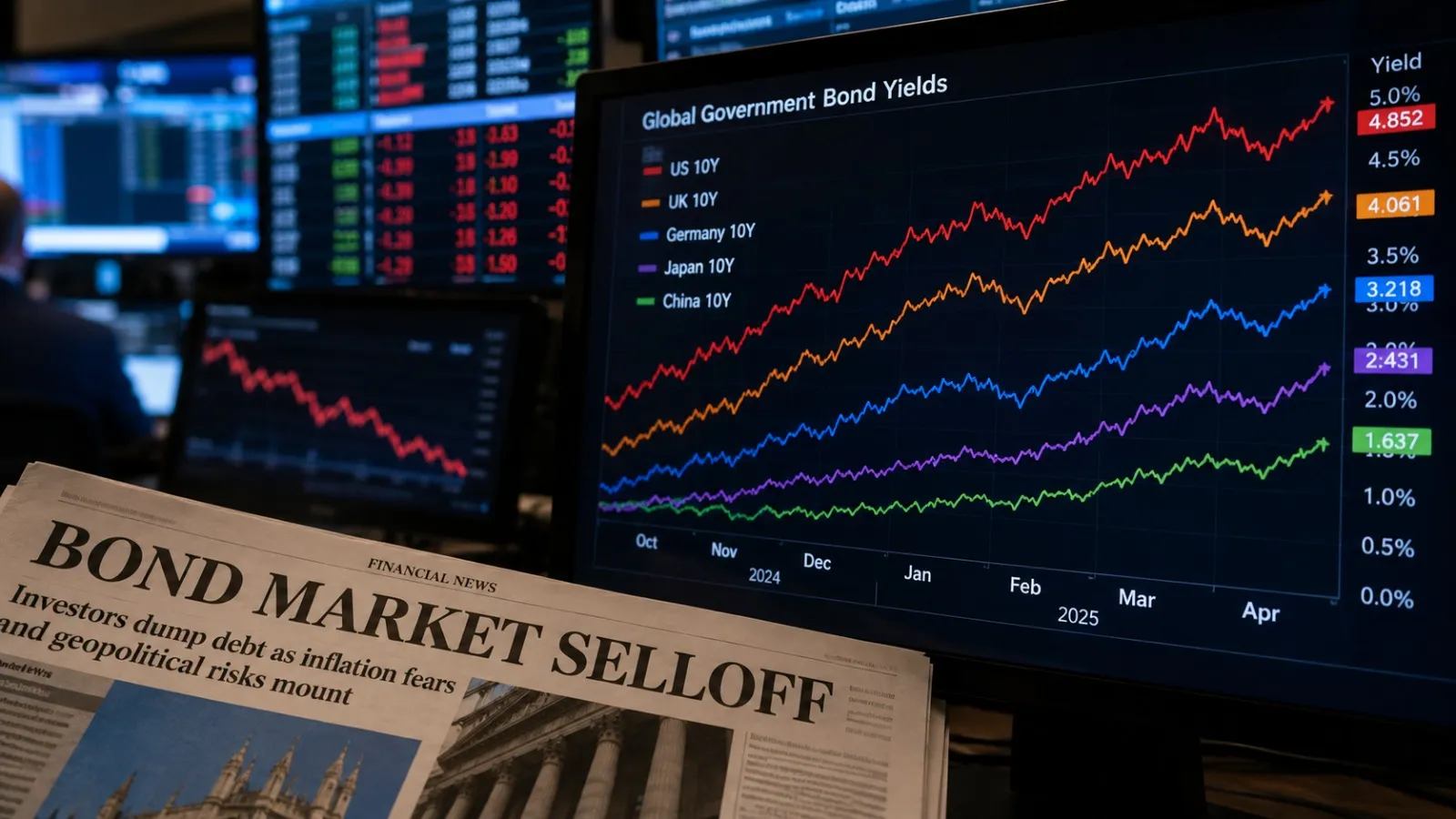
The yield on the benchmark 10-year US Treasury note briefly pushed above 5% for the first time since 2007, as inflation worries intensified ahead of the Federal Reserve's closely watched policy decision, a significant milestone that triggered a broad selloff across global bond and equity markets as investors repriced expectations for how long elevated interest rates might persist. The yield move added roughly 8 to 10 basis points in early trading, continuing a sustained upward trajectory that has pushed Treasury yields to levels not seen in nearly two decades, a development with substantial implications for borrowing costs across the US economy and, by extension, for global capital markets given the Treasury market's role as the foundational benchmark for pricing risk across nearly all other global fixed-income and equity asset classes. The milestone arrived amid a challenging combination of persistent inflation data and growing market uncertainty about the Federal Reserve's policy path under Chairman Kevin Warsh, with markets increasingly divided over whether the central bank would proceed with an anticipated rate move or hold steady given the competing pressures of still-elevated inflation readings against signs of moderating economic growth momentum.
Global bond markets reacted in tandem with the US Treasury selloff, with yields on government bonds issued by the United Kingdom, France, Germany and Japan all moving higher during the same trading session, illustrating how directly the US Treasury market's movements continue to influence global fixed-income pricing even as individual countries face their own distinct domestic monetary policy and inflation dynamics. Japan's 30-year government bond yield surged particularly sharply, adding roughly 8 basis points, while the UK's 20-year gilt yield and French and German 30-year bond yields each recorded smaller but still meaningful increases, reflecting a broadly synchronised global repricing of long-duration fixed-income risk rather than a purely US-specific market development. Equity markets responded negatively to the Treasury yield surge, with US equity-index futures declining broadly and Asian markets set to open lower as trading moved into the subsequent session, extending a period of elevated market volatility that had already been under pressure from separate concerns about the pace of AI industry development following cautionary commentary from prominent technology leaders. The combination of rising yields and AI sector uncertainty created a particularly challenging environment for growth-oriented technology equities specifically, given that higher discount rates implied by elevated Treasury yields mechanically reduce the present value of the more distant future earnings that growth stock valuations typically depend upon more heavily than value-oriented equities.
For borrowers across the US economy, a 10-year Treasury yield above 5% translates directly into higher borrowing costs across numerous categories of debt that reference or move in tandem with the benchmark rate, including mortgage rates, corporate borrowing costs and, notably, the US government's own cost of servicing its substantial existing debt burden, a dynamic that has drawn increasing attention from fiscal policy analysts concerned about the compounding budgetary implications of sustained higher interest rates on US government debt service costs over the medium term. Mortgage rates in particular tend to move closely in tandem with 10-year Treasury yields, meaning this latest yield milestone is likely to translate into further upward pressure on US home borrowing costs at a moment when housing affordability has already remained a significant economic and political concern across much of the country, potentially further dampening housing market activity that has already shown signs of moderation amid the broader higher-rate environment that has characterised much of 2026.
The Federal Reserve's upcoming policy decision, occurring against this backdrop of surging Treasury yields and persistent inflation concerns, presents what market analysts have characterised as a genuine dilemma for Chairman Warsh and the broader Federal Open Market Committee, given the difficult balance between addressing still-elevated inflation readings through continued monetary tightening and the risk that further rate increases could meaningfully slow an economy already showing signs of moderating growth momentum, a tension that has left market participants genuinely divided in their expectations for the Fed's ultimate policy decision heading into the announcement. As markets await the Federal Reserve's decision, the 10-year Treasury yield's breach of the psychologically significant 5% level is likely to remain a focal point for investors across asset classes globally, given both the direct borrowing cost implications and the broader signal the milestone sends about market expectations for how long the current period of elevated inflation and interest rates may persist before giving way to the kind of sustained monetary easing cycle that markets had, at various points earlier in 2026, more optimistically anticipated. Corporate borrowers across multiple sectors have already begun reporting the practical impact of rising benchmark yields on their own financing costs, with several companies reportedly delaying or reconsidering planned bond issuances in anticipation that borrowing costs could moderate somewhat once the current period of yield volatility resolves, a wait-and-see approach that has itself contributed to somewhat reduced corporate bond issuance volume during the period of most acute yield volatility, further illustrating how directly Treasury market movements ripple through into real economy financing decisions well beyond the government bond market itself. Emerging market currencies and bond markets have also shown sensitivity to the US Treasury yield surge, given how directly rising US yields typically affect global capital flows, often drawing investment capital toward higher-yielding US assets and away from emerging market fixed income, a dynamic that has added further complexity for emerging market central banks, including India's Reserve Bank, as they navigate their own domestic monetary policy considerations against the backdrop of this globally significant US interest rate environment shift. Currency markets have shown a comparatively muted response to the Treasury yield surge relative to the sharper moves in equities and bonds, with the dollar index holding relatively steady, suggesting foreign exchange traders view the yield move as primarily a domestic US rate story rather than a broader dollar strength signal. Federal Reserve officials have offered somewhat mixed public commentary in the days surrounding the yield milestone, with some regional Fed presidents emphasising continued vigilance on inflation while others have pointed to emerging signs of labour market softening as a reason for caution before committing to further policy tightening, a divided public commentary that has itself contributed to market uncertainty about the coming decision.