StartupsUnicorns Tech5 MIN READ

German Energy Unicorn 1KOMMA5° Raises €70 Million at a $1.35 Billion Valuation to Scale Its AI Virtual Power Plant

Hamburg-based 1KOMMA5° has raised about €70 million in a round led by b2venture, at a pre-money valuation of $1.35 billion, to expand Heartbeat AI, a platform that controls more than 100,000 home energy systems and trades their power on electricity exchanges.

By Nisha Omkumar · Author14 October 2026New
German Energy Unicorn 1KOMMA5° Raises €70 Million at a $1.35 Billion Valuation to Scale Its AI Virtual Power Plant

1KOMMA5°, one of Europe's fastest-growing clean-energy companies, has raised about €70 million ($78 million) in a new funding round. It plans to pour the capital into artificial intelligence software that turns households' solar panels, batteries and heat pumps into a single, centrally optimised power plant.

The round, announced on October 13, was led by Swiss investor b2venture. Marunouchi Innovation Partners, a Japanese cleantech growth fund, joined as a new shareholder, while existing investors including the California State Teachers' Retirement System (CalSTRS), eCapital, G2 Venture Partners and Eurazeo also participated. The deal values the Hamburg-based company at $1.35 billion before the new money, a 35% increase from its valuation in July 2025.

The company plans to invest more than €100 million in its Heartbeat AI platform in 2027, combining the new equity with about €35 million from its own operating cash flow.

From installer to energy software company

1KOMMA5° was founded in 2021 by Philipp Schröder, a former head of Tesla's business in Germany, together with co-founders Micha Grüber, Jannik Schall and others. It grew rapidly by acquiring and integrating established electrical installation businesses that fit solar panels, batteries, heat pumps and electric-vehicle chargers in homes. Within 23 months of its founding, it had reached a valuation of €1 billion, becoming one of Germany's fastest climate-tech unicorns.

The company has since repositioned itself around software. Hardware installation remains the entry point, but the real value, in its view, lies in controlling those devices intelligently once they are installed. 1KOMMA5° says it has installed more than 300,000 decentralised, controllable energy systems.
3ad2ac39-8b20-4a94-8bf2-351d633159b0.png

How Heartbeat AI works

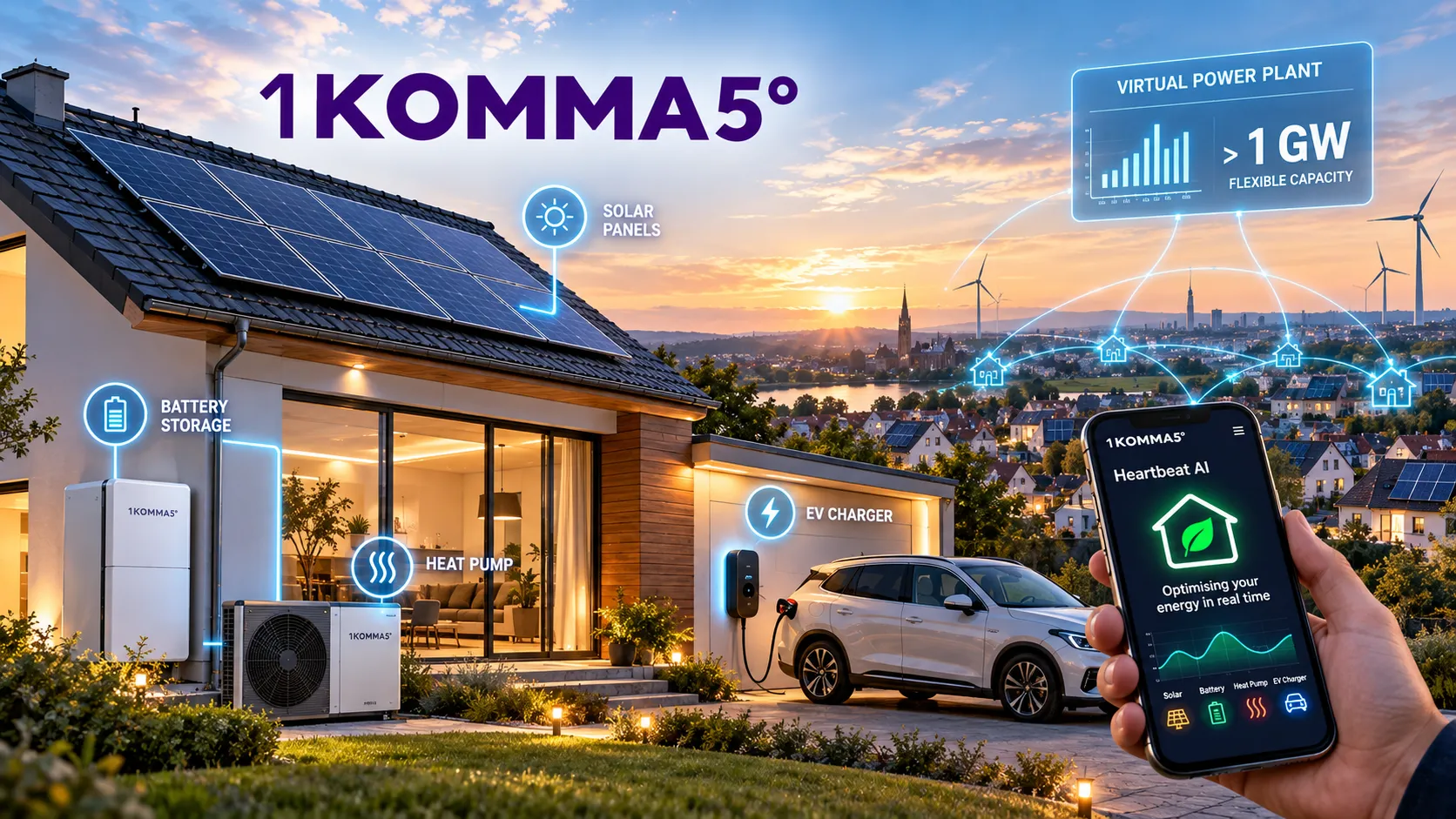
Heartbeat AI connects and controls a household's energy assets, including solar panels, batteries, heat pumps, EV chargers and air conditioners. Using forecasts of weather, consumption and electricity prices, it decides when each home should draw power from the grid, store energy in its battery or sell surplus electricity. The platform sells electricity on the power exchange on customers' behalf, aiming to cut their bills while earning revenue from wholesale markets.

Aggregated across many homes, these individual systems form a virtual power plant: a network of small, distributed assets that can be coordinated to behave like a single large generator or storage facility. Heartbeat AI already aggregates more than 1 gigawatt of flexible capacity across five markets and optimises more than 100,000 energy systems. The company describes it as one of Europe's largest virtual power plants serving residential customers.

That flexibility is increasingly valuable. As more renewable power enters the grid, electricity supply becomes more variable, and prices swing sharply between periods of abundance and scarcity. Assets that can shift consumption or release stored energy at the right moments help stabilise the system and can earn substantial returns in volatile markets.

Why Germany is fertile ground

1KOMMA5°'s home market offers ideal conditions for this kind of business. Germany has one of the world's largest fleets of rooftop solar systems, and the number of home batteries, heat pumps and electric vehicles has grown rapidly. Since January 2025, German electricity suppliers have been required to offer dynamic tariffs, which pass wholesale price movements through to households, and the rollout of smart meters is expanding.


“The next battleground in clean energy is not the hardware on the roof but the software that decides when to use, store or sell every kilowatt-hour.”
— TIGI Startups Desk

At the same time, periods of negative wholesale electricity prices have become increasingly frequent in Germany, as solar generation floods the grid on sunny days. For a household with a battery and an intelligent controller, those moments are an opportunity: charge the battery or run the heat pump when power is cheapest, then use or sell the stored energy when prices rise. Multiplied across tens of thousands of homes, those small optimisations add up to meaningful savings for customers and trading revenue for the platform.

Capital for growth, at scale

Alongside the equity round, 1KOMMA5° has recently secured bank financing facilities of up to €1.5 billion (about $1.7 billion). That debt capacity is important for a business that often finances customers' energy systems or offers them on subscription-style arrangements, which require significant upfront capital.

The investor line-up reflects the company's maturity. CalSTRS, one of the world's largest pension funds, became a major investor in a pre-IPO round in late 2024, when 1KOMMA5° said it was preparing for a possible stock market listing. Reports around the latest round indicate that the company is eyeing further international expansion, including in the United States, and continues to weigh an eventual initial public offering.

The new money will fund AI development, software capabilities and market expansion. The arrival of a Japanese cleantech investor may also open doors in Asia, where interest in distributed energy and virtual power plants is growing.

Defying a funding slump

The raise stands out against a difficult backdrop for clean-energy startups. Venture funding for solar companies fell 40% year on year to about $1.5 billion in the first half of 2026, according to Mercom Capital Group, even as the number of deals rose slightly. Investors have become more selective, favouring companies with proven revenue, profitability or differentiated technology.

1KOMMA5°'s ability to raise at a higher valuation suggests investors see its software and trading capabilities as more defensible than the installation business alone. Residential solar installation is highly competitive and exposed to swings in demand and subsidies. A platform that controls energy assets and earns recurring revenue from optimising them offers a more durable model.

Lessons for India's energy transition

The model has clear relevance for India, which has set ambitious targets for rooftop solar, including through the PM Surya Ghar scheme aimed at installing solar panels on millions of homes. As rooftop systems, batteries and electric vehicles spread, India will face the same challenge Europe is now addressing: how to coordinate millions of small, distributed assets so they support rather than strain the grid.

Indian regulators and power distribution companies are beginning to explore demand response and time-of-day tariffs, which are the building blocks of virtual power plants. Companies that can combine hardware installation with intelligent software, as 1KOMMA5° has done, may be well positioned as India's distributed energy market matures.

For 1KOMMA5°, the task now is to prove that its AI can keep delivering savings for customers and revenue for the business as it scales into new markets. If it succeeds, it will strengthen the case that the future of clean energy belongs not only to the companies that make solar panels and batteries, but also to those that write the software deciding how every kilowatt-hour is used.

Tags1KOMMA5°Heartbeat AIvirtual power plantb2ventureCalSTRSclimate techenergy AIsolarheat pumpsbattery storageunicornGermanyEuropecleantechPhilipp Schröderdistributed energyenergy transitionstartup fundingsustainabilitygrid flexibility

Reader reviews

Sign in to rate and review this article.
Loading reviews…
