FundingAnalysis5 MIN READ

ABB Agrees to Buy German Fan Maker Ziehl-Abegg From Its Founding Family in a $2.7 Billion Deal to Expand Its Motion Business

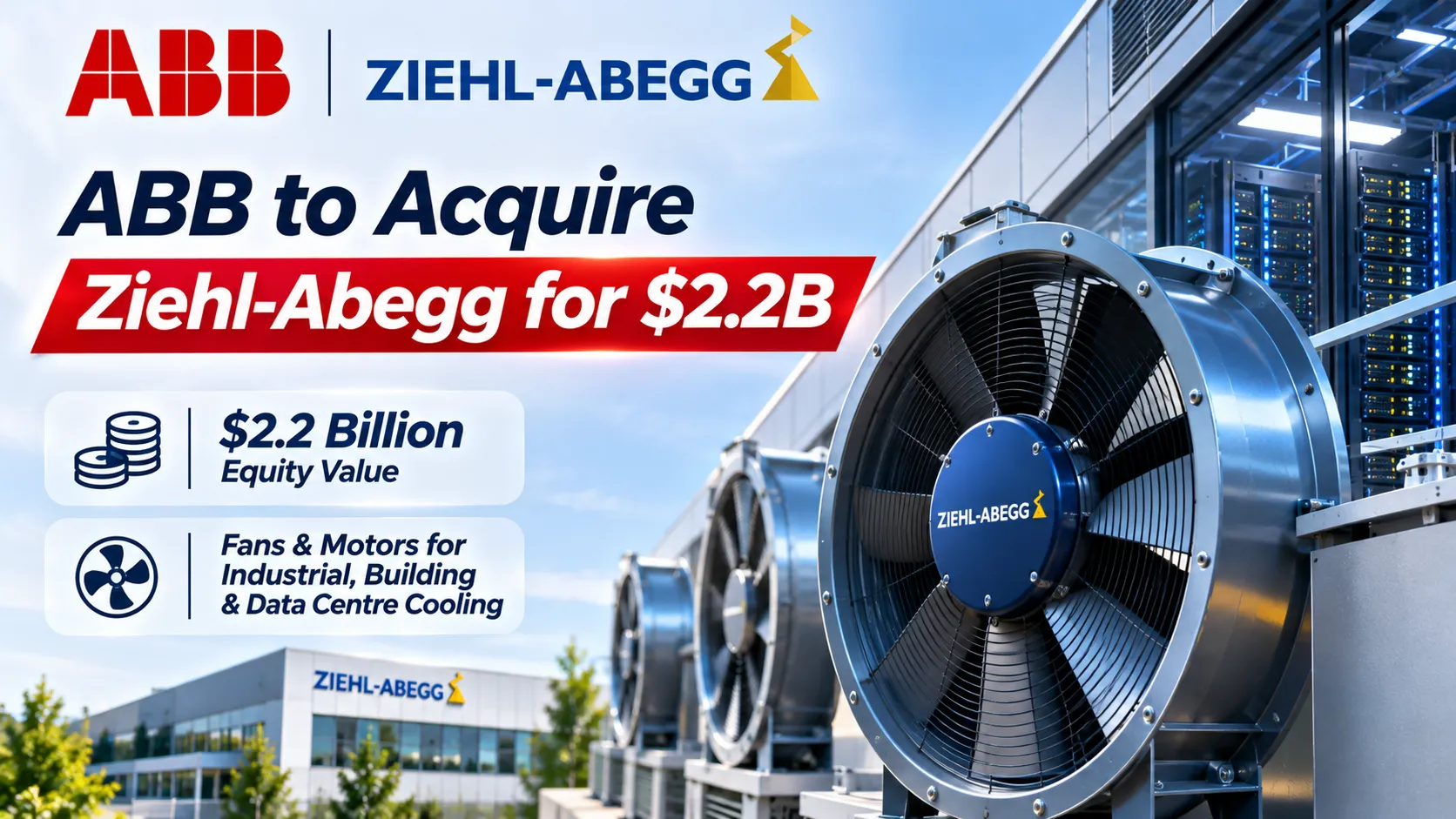
Swiss engineering group ABB has signed an agreement to acquire Ziehl-Abegg, the family-owned German maker of fans and motors, at an equity value of $2.2 billion and an enterprise value of $2.7 billion, MarketScreener reported on November 23. Ziehl-Abegg is expected to generate about $1.4 billion in revenue in 2026. The deal is expected to close in the second half of 2027.

By Shaym Kumar · Author24 November 2026New
ABB Agrees to Buy German Fan Maker Ziehl-Abegg From Its Founding Family in a $2.7 Billion Deal to Expand Its Motion Business

One of Europe's largest engineering groups is making a major bet on the technology that keeps air moving through buildings, factories and data centres.

ABB has signed an agreement to acquire Ziehl-Abegg SE from its founding family, according to MarketScreener, which reported the deal on Monday, November 23. The transaction values Ziehl-Abegg at an equity value of $2.2 billion and an enterprise value of $2.7 billion.

The deal is expected to close in the second half of 2027, subject to regulatory approvals and other customary conditions. UBS acted as ABB's financial adviser and Latham & Watkins as legal counsel.

Who Ziehl-Abegg is

Ziehl-Abegg is a German manufacturer of fans and electric motors, headquartered in Künzelsau in the state of Baden-Württemberg. Founded more than a century ago, the company is a classic example of Germany's Mittelstand, the family-owned, often highly specialised industrial companies that form the backbone of the German economy.

Its products are used in ventilation, air conditioning and refrigeration systems, as well as in cleanrooms, agricultural buildings and other applications that require efficient air movement. Its motors are also used in lifts.

Ziehl-Abegg is expected to generate about $1.4 billion in revenue in 2026, with an operational EBITA margin in the mid-single digits, according to MarketScreener. ABB intends to keep the headquarters in Künzelsau.

The financial terms

The enterprise value of $2.7 billion implies a multiple of 1.9 times 2026 sales and 18.6 times EBITDA, according to MarketScreener. ABB expects the EBITDA multiple to fall towards the low double digits once mid-term synergies are included.

ABB said it expects the transaction to generate a return on invested capital well above its weighted average cost of capital. It also expects Ziehl-Abegg's margin to reach roughly the average of its Motion business area within three years of closing.

Why ABB wants it

ABB's Motion business area makes electric motors, drives and related products used across industry and infrastructure. Adding Ziehl-Abegg's fans and motors would expand its portfolio in air-movement applications, an area with strong long-term growth driven by energy efficiency regulations, building automation and cooling demand.

The rapid growth of data centres, particularly those built for artificial intelligence, has created enormous demand for cooling systems. AI chips generate large amounts of heat, and data centres need efficient fans, pumps and cooling equipment to keep them running. Although the announcement did not single out data centres, industrial groups across Europe and the US have been expanding their exposure to data centre infrastructure.

The margin opportunity

Ziehl-Abegg's mid-single-digit margin is well below the margins of ABB's Motion business. ABB's plan to raise Ziehl-Abegg's profitability to the Motion average within three years implies significant operational improvement, potentially through procurement savings, manufacturing efficiencies, pricing and access to ABB's global sales network.

Achieving this would substantially increase the value of the acquisition. However, integrating a family-owned company with its own culture and practices into a large multinational group can be challenging.

The Mittelstand in transition

The sale of Ziehl-Abegg reflects a broader trend in German industry. Many Mittelstand companies face succession challenges as founding families decide whether to continue running their businesses, bring in professional management or sell. At the same time, these companies face pressures from high energy costs, competition from China, the energy transition and the need to invest in digitalisation.

“Every data centre, hospital and factory needs air to move efficiently. ABB is betting that the companies that move it will become more valuable.”
— TIGI Markets Desk

Selling to a larger group can provide the capital and scale needed to compete globally, though it often raises concerns about jobs and the preservation of local identity. ABB's commitment to keep the headquarters in Künzelsau may help address such concerns.

5a43fb6b-fd72-472e-9b12-b46e404e82a3.png

ABB's strategy

Under chief executive Morten Wierod, ABB has focused on electrification and automation, positioning itself to benefit from trends such as the energy transition, industrial automation and data centre growth. The company has made a series of bolt-on acquisitions to strengthen its portfolio in these areas.

The Ziehl-Abegg deal is one of its larger recent acquisitions and signals confidence in the growth of energy-efficient air-movement technologies.

Energy efficiency as a driver

Fans and motors account for a significant share of global electricity consumption. Regulations in Europe, the US and other regions increasingly require higher energy efficiency, encouraging the replacement of older equipment with more efficient models. Electronically commutated motors, a specialty of companies such as Ziehl-Abegg, offer significant energy savings compared with older technologies.

This regulatory push, combined with rising energy costs, supports long-term demand for efficient fans and motors.

What it means for India

ABB has a large presence in India through ABB India, a listed company that manufactures motors, drives, electrical equipment and automation systems. India's rapidly growing data centre market, expanding manufacturing sector and rising demand for air conditioning create opportunities for energy-efficient air-movement technologies. Ziehl-Abegg also has operations in India, and the combination could strengthen ABB's offering in the Indian market.

A wave of industrial deals

The Ziehl-Abegg acquisition is part of a broader wave of deals in industrial technology, as companies seek to position themselves for growth in electrification, automation, data centres and energy efficiency. Large groups such as Schneider Electric, Siemens and Eaton have also made acquisitions to strengthen their offerings in these areas.

Data centre cooling in particular has attracted significant investment, as the power density of AI computing pushes the limits of traditional air-cooling technologies.

What it means for employees

Family-owned German industrial companies are often major employers in their regions, and their sale to multinational groups can raise concerns about jobs and local investment. ABB's commitment to keep Ziehl-Abegg's headquarters in Künzelsau may reassure employees and the local community.

Integration plans, including any changes to manufacturing footprint, will be closely watched by employee representatives, who play an important role in German corporate governance.

Financing the deal

ABB has a strong balance sheet and generates substantial cash flow, giving it flexibility to fund acquisitions of this size. The long timeline to closing, expected in the second half of 2027, also gives the company time to plan integration and secure the necessary approvals.

Investors will watch for any updates on how the deal will be financed and its expected impact on earnings per share.

What comes next

The deal will now go through regulatory reviews, which may take time given its size and the companies' positions in certain markets. Investors will watch for details of ABB's integration plans and progress towards its margin targets once the deal closes in 2027.

TagsABBZiehl-AbeggacquisitionfansmotorsventilationHVACdata centre coolingMotion businessKünzelsauGerman Mittelstandfamily businessindustrial M&Aelectrificationenergy efficiencySwitzerlandGermanyengineeringinvestorsmergers

Reader reviews

Sign in to rate and review this article.
Loading reviews…

