FundingIPO Watch6 MIN READ

Snapdeal Parent AceVector Makes Its Market Debut as SoftBank-Backed Investor Exits at a Steep Loss

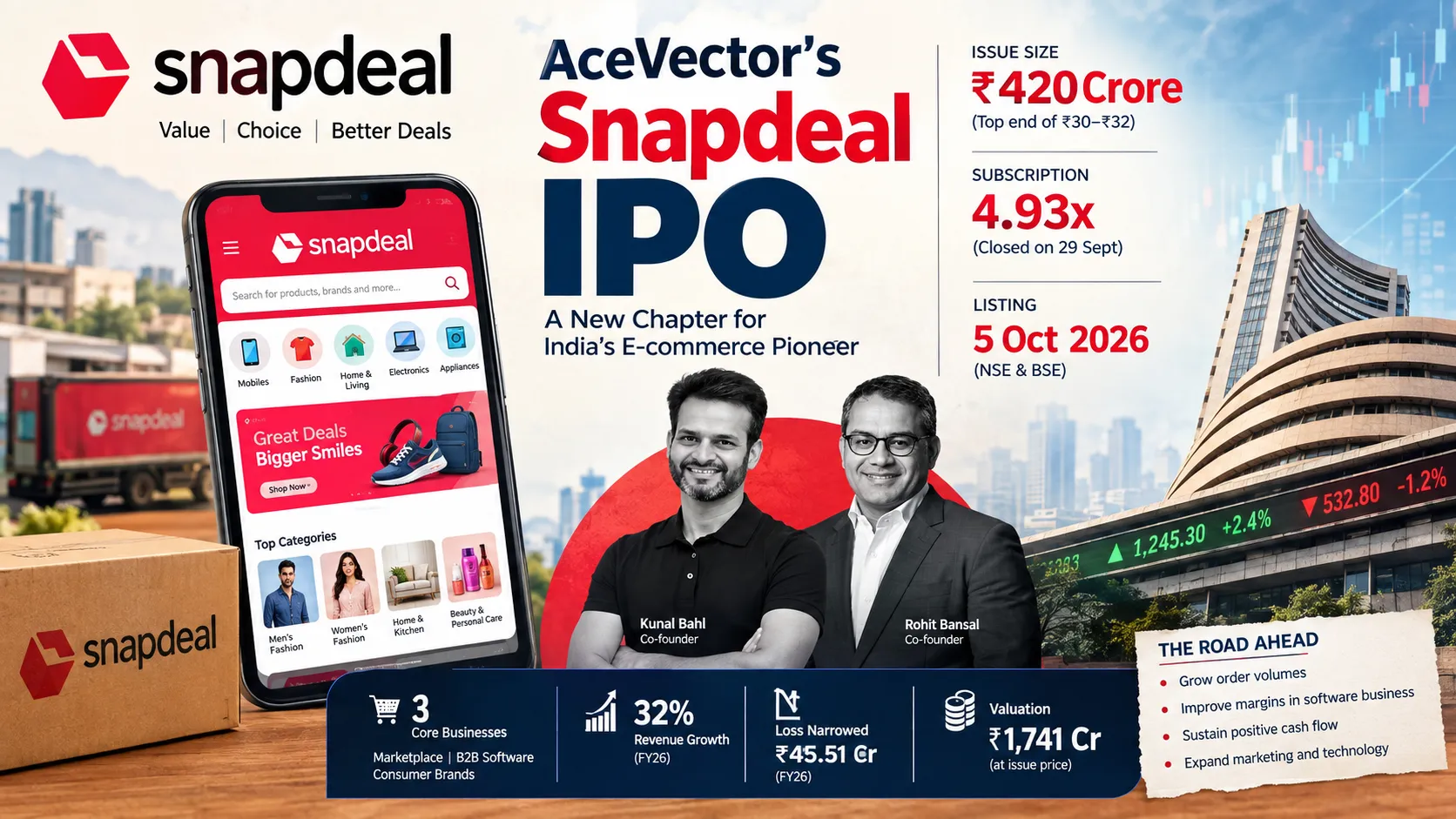
AceVector lists on 5 October after a ₹420 crore IPO subscribed 4.93 times. SoftBank-backed Starfish sold shares worth ₹88.3 crore at about 0.08 times its investment.

By Prathista Lazar · Author5 October 2026Breaking
Snapdeal Parent AceVector Makes Its Market Debut as SoftBank-Backed Investor Exits at a Steep Loss

AceVector, the parent of value e-commerce marketplace Snapdeal, makes its stock market debut on Monday, 5 October, after an initial public offering that drew moderate demand and gave several early backers an exit at a fraction of what they once invested.

The ₹420 crore issue, priced at the top of its ₹30 to ₹32 range, closed on 29 September with subscription of 4.93 times. Trading on the NSE and BSE begins after a special pre-open session that determines the opening price. Grey market indicators ahead of the debut pointed to a muted listing. The unofficial premium stood at 60 paise, or about 1.9% above the issue price, on 4 October.

Who sold, and at what price

The offer comprised a fresh issue of ₹287 crore and an offer for sale of about ₹133 crore. Analysis of the selling shareholders, published by Inc42, shows how far valuations have fallen since Snapdeal's peak as one of India's most heavily funded e-commerce companies.

Starfish I Pte Ltd, the SoftBank-backed entity that is among AceVector's promoters, was the largest seller. It sold about 2.76 crore shares for roughly ₹88.3 crore, a return of about 0.08 times its investment. SoftBank was among Snapdeal's largest investors during the e-commerce funding race of the mid-2010s.

Nexus Venture Partners, an early backer, sold about 86.9 lakh shares across three vehicles, with outcomes that varied by entry point. Nexus India Direct Investments II roughly broke even at 1.03 times, while Nexus Opportunity Fund and Nexus Ventures III recorded returns of 0.14 times and 0.07 times respectively.

Not every seller lost money. Among individuals, Kenneth Stuart Glass sold shares worth about ₹4.2 crore at a return of roughly 5.4 times, and Laurent Bernard Amouyal earned about 4.4 times. Former Snapdeal executive Jason Ashok Kothari, by contrast, sold at about 0.78 times.

Demand: steady rather than spectacular

The book was led by non-institutional investors, whose portion was subscribed 8.16 times. Retail investors bid 4.62 times their allocation and qualified institutional buyers 3.38 times.

By the standards of 2026, that is a lukewarm response. One tracker ranked AceVector 65th among 97 mainboard IPOs to close this year, well below the median subscription level. It stands in contrast to digital lender Moneyview, whose offering was subscribed about 100 times and which listed at a premium of more than 60% on 1 October.

A smaller, leaner business

The company going public today looks very different from the Snapdeal of a decade ago. AceVector operates three businesses: the Snapdeal marketplace, which targets price-conscious shoppers in smaller cities and served 18,972 pin codes in FY26; a B2B software arm that includes Uniware, Convertway and Shipway, used by online sellers to manage orders and logistics; and Stellaro Brands, a portfolio of value consumer brands.

Financially, the trend is improving but the company remains loss-making. Total income rose about 32% to ₹537.67 crore in FY26. The net loss narrowed to ₹45.51 crore from ₹126.31 crore in FY25, and the operating loss shrank to ₹22.17 crore from ₹107.79 crore. The company has also reported positive adjusted free cash flow of about ₹10.82 crore for the year.

At the issue price, AceVector is valued at about ₹1,741 crore. With a net asset value of ₹2.21 per share, the ₹32 issue price implies a price-to-book multiple of roughly 14.5 times, a valuation that depends on future earnings rather than current assets.

“AceVector's listing is less a celebration of a comeback than a reckoning with the price of the last boom.”
— TIGI Analysis

Of the fresh capital, about ₹132 crore is earmarked for marketing and business promotion for the Snapdeal marketplace and about ₹50 crore for technology. Post-issue, the promoter group, which comprises co-founders Kunal Bahl and Rohit Kumar Bansal and Starfish, will hold just under 50% of the company, down from about 65.9%.

The Snapdeal story in one listing

For India's startup ecosystem, AceVector's listing closes a long chapter. Snapdeal was once valued in the billions of dollars and was seen as a challenger to Flipkart and Amazon. A failed merger with Flipkart in 2017 forced a strategic reset, after which the founders shrank the company, cut costs and refocused on value shoppers outside the largest cities. ## A difficult moment for new-age stocks

AceVector also lists at a time of weak sentiment towards recently listed technology companies. Several new-age stocks have fallen sharply in recent weeks, including insurance distribution platform Turtlemint, which slumped about 20% in a single week amid concerns over proposed caps on insurance commissions.

That backdrop matters because many investors treat newly listed internet companies as a single group, buying and selling them together as sentiment shifts. AceVector's relatively small size and modest subscription mean it may be more exposed to those swings than larger, more heavily traded peers.

There is one point of reference for investors. Unicommerce, the e-commerce software business that grew out of the Snapdeal group and in which AceVector has a significant interest, listed separately in 2024. Its experience as a listed company gives investors a benchmark for valuing the software side of AceVector's portfolio, even though the marketplace remains the larger and more volatile part of the business.

The IPO is a validation of that survival strategy. It is also a reminder of how much capital was written down along the way. The sub-1x returns for SoftBank and several Nexus vehicles illustrate the gap between peak private valuations and what public markets are willing to pay for a business that is still working towards profitability.

9e804af8-f83a-4be6-adc6-a492eb23dcb4.png

What to watch after listing

Several factors will shape how the stock trades after its debut. Investors will watch whether Snapdeal can grow order volumes without heavy discounting, whether the software business can lift margins, and whether the company sustains positive cash flow while increasing marketing spend.

For retail investors who received allotments, the opening price will determine whether the IPO delivers a quick gain. With retail demand at 4.62 times, roughly one applicant in five is estimated to have received shares, so the number of small investors exposed to early trading is relatively modest.

Market conditions are a further consideration. AceVector lists into a weak market, after eight consecutive weekly declines in Indian benchmark indices and heavy foreign portfolio selling. Grey market premiums are an unofficial and often unreliable guide, but on the eve of listing they pointed to a modest debut.

Whatever happens on day one, AceVector's IPO gives public investors their first direct stake in one of the original Indian e-commerce stories, and gives the ecosystem a sobering data point on what a turnaround is worth.

TagsAceVectorSnapdealIPOSoftBankKunal BahlRohit BansalUnicommerceStellaro BrandsNexus Venture PartnersIndian Stock MarketE-commerceListing DayGrey Market PremiumStartup IPO

Reader reviews

Sign in to rate and review this article.
Loading reviews…