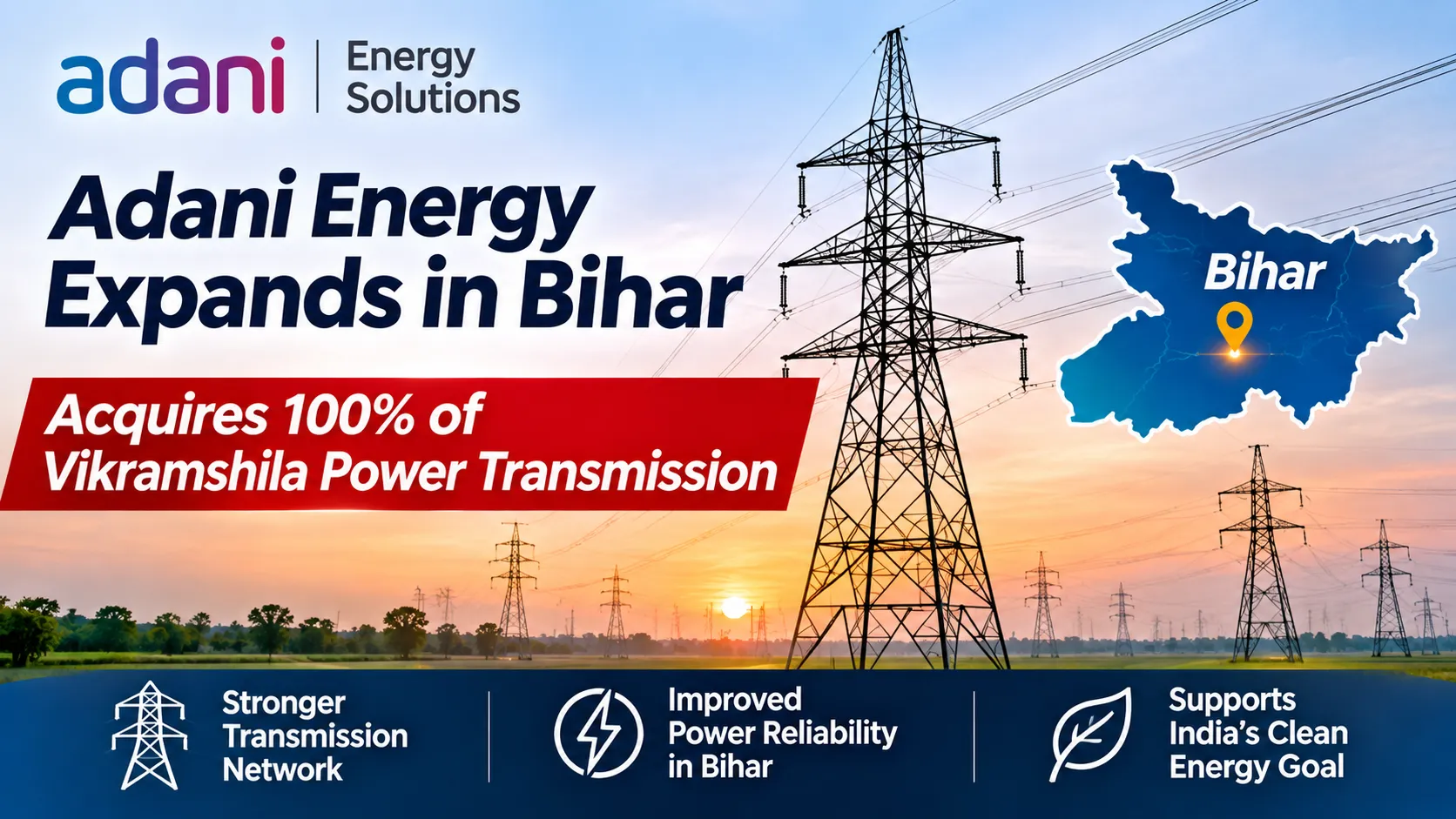
Adani Energy Solutions Ltd, India's largest private power transmission company, is acquiring 100% of the equity of Vikramshila Power Transmission Ltd. The deal expands its infrastructure footprint in Bihar, according to an update on November 22.
The company did not disclose the price of the acquisition. Transmission companies in India typically acquire project special purpose vehicles (SPVs) after winning them through competitive bidding, with the acquisition price usually reflecting the development costs incurred by the bid process coordinator rather than a market valuation.
How transmission projects are awarded in India
Under India's tariff-based competitive bidding (TBCB) framework, new inter-state transmission projects are bid out to private and public companies. A government-designated bid process coordinator, often a subsidiary of a state-owned power company, sets up a project-specific company, completes early surveys and approvals, and then invites bids.
The company that offers the lowest annual transmission charge over the project's life, usually 35 years, wins the project. It then acquires the special purpose vehicle and takes on responsibility for building, owning, operating and maintaining the transmission infrastructure.
Acquiring Vikramshila Power Transmission follows this pattern. The name refers to the ancient Vikramshila university near Bhagalpur in Bihar, reflecting the project's location in the state.
Adani Energy Solutions' growth
Adani Energy Solutions, formerly known as Adani Transmission, has grown into India's largest private transmission and distribution company. It operates transmission networks across multiple states and runs electricity distribution in Mumbai through Adani Electricity Mumbai Ltd. It has also expanded into smart metering, cooling solutions and other energy services.
The company has been one of the most active bidders for new transmission projects in recent years, winning a significant share of projects awarded through competitive bidding. Its order book has grown rapidly as India's transmission expansion has accelerated.
Each new project adds to the company's regulated asset base. Transmission projects typically offer stable, long-term revenues because transmission charges are fixed for decades and paid regardless of fluctuations in electricity demand or prices. That makes them attractive to investors seeking predictable cash flows.
Why Bihar matters
Bihar is one of India's most populous states and among its least electrified historically, although access to electricity has improved dramatically over the past decade. Electricity demand in the state has been growing rapidly as households, businesses and agriculture use more power.
Bihar has limited generation capacity of its own and relies heavily on power from other states and central generating stations. Strong transmission links are therefore essential to deliver electricity reliably and to manage peak demand.
New transmission infrastructure in Bihar can improve power reliability, reduce outages and support economic development. It can also enable the state to draw on renewable energy generated elsewhere in India, particularly solar power from the west and north.
The transmission imperative
India's power sector is undergoing a major transformation. The government aims to reach 500 GW of non-fossil fuel generating capacity by 2030. Much of that capacity will be solar and wind, which are concentrated in states with the best resources, such as Rajasthan, Gujarat, Karnataka and Tamil Nadu.
Moving that power to where it is needed requires a large expansion of the transmission network. The government's national electricity plan envisages hundreds of thousands of circuit kilometres of new transmission lines and substantial new substation capacity over the coming years.
Transmission has often been described as the bottleneck of India's energy transition. Renewable projects can be built relatively quickly, but transmission lines take longer, due to land access, right-of-way issues and environmental approvals. Delays in transmission can leave renewable capacity stranded, unable to deliver power to the grid.
Competition in the sector
Adani Energy Solutions faces competition from state-owned Power Grid Corporation of India, which remains the dominant transmission company, as well as private players such as Sterlite Power, Tata Power and others. Infrastructure investment trusts (InvITs) have also become active buyers of operating transmission assets.
Competition for TBCB projects has been intense, with bidders offering aggressive tariffs. Winning companies must execute projects efficiently to earn adequate returns. Cost overruns and delays can significantly reduce profitability.
Investor considerations
Adani Group companies have been closely watched by investors since the Hindenburg Research report in January 2023, which alleged governance issues and stock manipulation. The group denied the allegations. Since then, Adani companies have worked to reduce debt, raise equity from global investors and strengthen governance disclosures.
Adani Energy Solutions has raised significant capital to fund its growth, including from international investors. Investors will continue to monitor its leverage, execution record and the returns it earns on new projects.
The company has reported steady growth in its transmission order book and operational network. The Vikramshila acquisition adds to that pipeline, although its contribution to revenue will only begin once the project is commissioned.
The bigger picture
For The Impactful Global Indian's readers, the acquisition is a small but meaningful step in India's ongoing build-out of energy infrastructure. Transmission rarely makes headlines, but it is essential to delivering reliable, affordable and increasingly clean electricity to India's growing economy.
Bihar's transmission upgrade also has a development dimension. Reliable electricity supports small businesses, irrigation, education and healthcare, and it can help attract investment to a state that has historically lagged behind others in industrialisation.
As India continues to expand its renewable energy capacity, companies like Adani Energy Solutions will play a central role in connecting new power sources to consumers. The Vikramshila project adds another link in that national chain.
Execution will be the test
The value of any transmission project depends on timely completion. Transmission lines often pass through farmland, forests and populated areas, and securing right-of-way can take longer than expected. Compensation for landowners whose land is crossed by towers and lines has been a recurring source of disputes in many states. Adani Energy Solutions has argued that its experience and scale allow it to manage these challenges more efficiently than smaller players. Bihar, with its dense population and fertile agricultural land, will test that capability. Investors will watch for updates on construction milestones and commissioning dates once the project moves into execution.