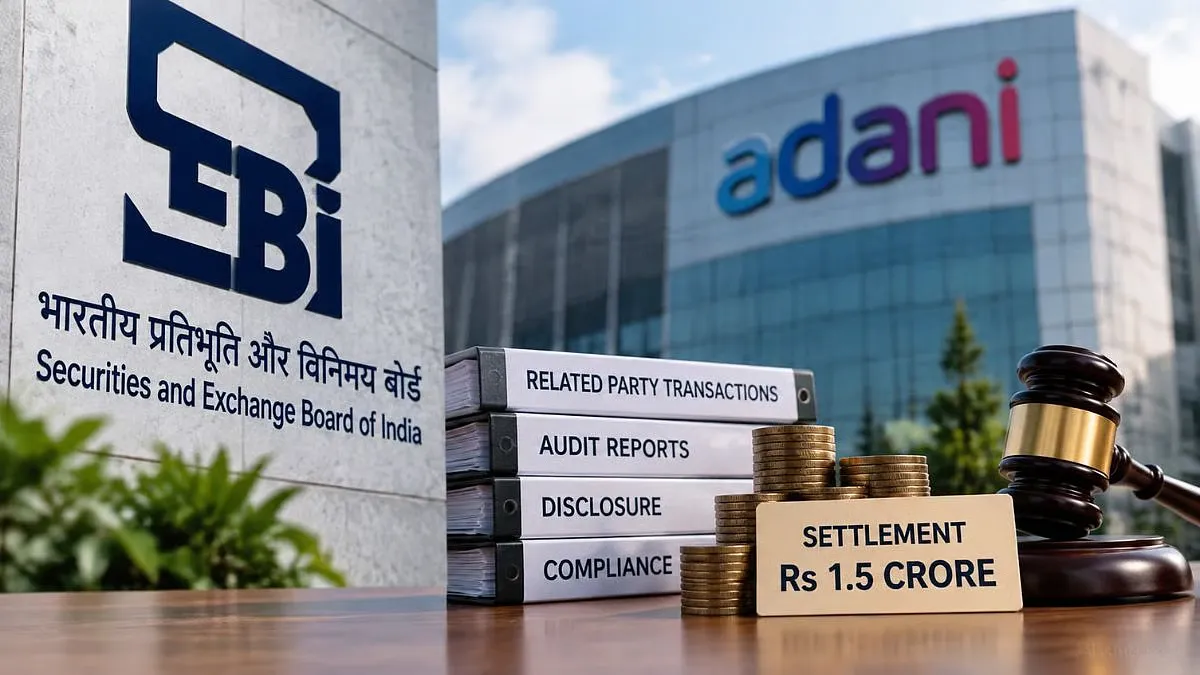
The Securities and Exchange Board of India (SEBI) has settled adjudication proceedings against five Adani Group companies over alleged lapses related to the disclosure of related-party transactions and to audit and limited-review reports, with the companies collectively paying about ₹1.5 crore.
The settlement order, reported on 22 September 2026, covers Adani Enterprises Ltd, Adani Total Gas Ltd, AWL Agri Business Ltd (formerly Adani Wilmar Ltd), Adani Green Energy Ltd and Adani Energy Solutions Ltd (formerly Adani Transmission Ltd). The companies settled without admitting or denying the findings of fact and conclusions of law.
Under the terms, Adani Enterprises paid ₹76.05 lakh and Adani Green Energy paid ₹45.50 lakh, while the three other companies paid ₹9.75 lakh each.
What the proceedings were about
The proceedings stemmed from SEBI's examination of allegations and corporate governance issues highlighted in the January 2023 report by Hindenburg Research, the US short seller that has since shut down. They related to possible violations of the listing regulations and the erstwhile listing agreement.
According to the order, the allegations fell into two broad categories. The first concerned the disclosure of related-party transactions. The second concerned limited-review or audit reports for certain reporting periods that were signed by an audit firm that did not hold a valid peer review certificate, a requirement under SEBI's rules for auditors of listed companies. Adani Total Gas, AWL Agri Business, Adani Green Energy and Adani Energy Solutions faced proceedings on the audit-report issue.
How the settlement unfolded
The companies proposed to settle the proceedings while adjudication was pending. SEBI's High Powered Advisory Committee considered the revised settlement terms on 29 June 2026, and its recommendations were accepted by the regulator's Panel of Whole Time Members on 13 August 2026. SEBI issued a notice of demand on 20 August, and the companies informed the regulator on 5 September that the amounts had been remitted. With the payments received, SEBI disposed of the adjudication proceedings under its settlement provisions.
Understanding SEBI's settlement mechanism
Settlement is a well-established route in Indian securities regulation. Under SEBI's settlement framework, entities facing proceedings can apply to resolve them by paying a settlement amount and, in some cases, agreeing to other conditions, without the regulator making a final finding of guilt or innocence. The approach allows SEBI to conclude cases more quickly and conserve enforcement resources, while giving companies certainty and avoiding prolonged litigation.
Settlements are not available for all violations. SEBI's rules exclude certain serious offences, such as those involving fraudulent and unfair trade practices that have caused substantial harm to investors, from the settlement route. The fact that these proceedings were settled indicates that they fell within the category of matters the regulator considers suitable for such resolution.
For investors, it is important to understand what a settlement does and does not mean. It does not constitute an admission of wrongdoing, nor does it represent an exoneration. It is a negotiated conclusion to specific proceedings.
The long shadow of the Hindenburg report
The Hindenburg report, published in January 2023 just as Adani Enterprises was conducting a large follow-on public offer, alleged stock manipulation and accounting irregularities across the group. The Adani Group rejected the allegations. The report triggered one of the most dramatic sell-offs in Indian corporate history, wiping out a very large amount of market value from group companies at the trough, and led the group to withdraw its follow-on offer.