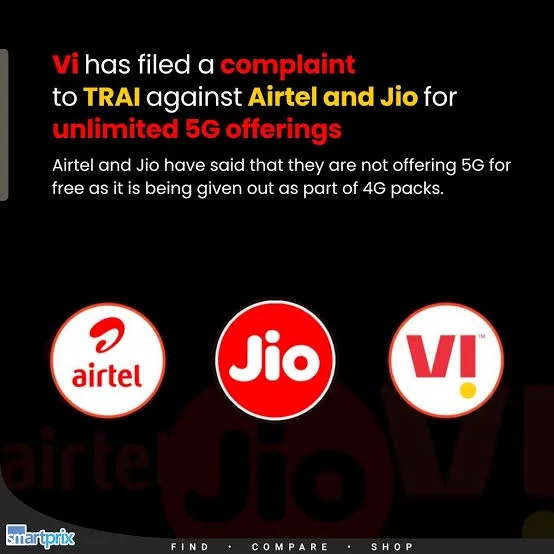
Bharti Airtel and Reliance Jio, India's two largest telecom operators, have jointly accused smaller rival Vodafone Idea of unfair customer-acquisition practices and formally requested that the Telecom Regulatory Authority of India investigate the allegations, marking a notable escalation of competitive tensions within India's already consolidated three-player telecom market. The joint complaint from Airtel and Jio, competitors that rarely coordinate publicly on regulatory matters given their own intense rivalry for market share, underscores the seriousness with which both companies appear to view whatever specific practices Vodafone Idea is alleged to have engaged in, sufficient to bring the two largest operators into unusual alignment against their smaller competitor.
India's telecom sector has operated under significant financial strain for Vodafone Idea specifically over recent years, as the company has struggled under a substantial debt burden accumulated partly through statutory dues owed to the government, a financial position that has left the operator with considerably less capital available for network investment and subscriber acquisition spending compared with the better-capitalised Airtel and Reliance Jio. Industry observers have periodically speculated about what competitive tactics a financially constrained operator like Vodafone Idea might pursue to retain or grow its subscriber base without the capital resources to compete purely on network quality or promotional spending at the same scale as its larger rivals, and the specific customer-acquisition practices now under complaint may reflect exactly this kind of resource-constrained competitive strategy. TRAI's investigation process, once formally initiated, would typically involve examining the specific marketing, sales and customer-onboarding practices alleged in the complaint against the regulatory framework governing fair competition and consumer protection within India's telecom sector, a process that can extend over several months depending on the complexity of the allegations and the evidence both the complainants and Vodafone Idea submit during the investigation.
The complaint arrives at a sensitive moment for Vodafone Idea, which has continued to lose subscriber market share to both Airtel and Jio over successive quarters even as the company has pursued various capital-raising and restructuring efforts aimed at stabilising its financial position sufficiently to invest in network upgrades and competitive subscriber retention. Any regulatory finding against Vodafone Idea stemming from this complaint could further complicate the company's already challenging competitive position, particularly if the investigation results in penalties, mandated changes to customer-acquisition practices, or reputational damage that makes it harder for the operator to attract new subscribers through legitimate channels going forward. For Airtel and Jio, pursuing a joint regulatory complaint against Vodafone Idea, rather than each company filing separately or simply competing more aggressively in the market directly, suggests both companies view the alleged practices as a sector-wide integrity issue warranting formal regulatory intervention rather than a competitive dynamic that market forces alone would correct. This framing, if accepted by TRAI, could result in broader regulatory guidance affecting customer-acquisition practices across India's entire telecom sector, extending beyond just the specific practices alleged against Vodafone Idea in this particular complaint.
India's telecom market has consolidated substantially from a much larger field of operators a decade ago down to effectively three major private players alongside state-run BSNL, a consolidation driven significantly by the intense price competition Reliance Jio's 2016 market entry triggered across the sector. That consolidated market structure has left Vodafone Idea as the clear third player by subscriber base and financial strength, a position that has made the company's long-term competitive viability a recurring subject of industry and policy discussion, given the broader importance of maintaining at least three viable private operators for sustained competitive dynamics within India's telecom market. As the TRAI investigation proceeds, the broader question of whether India's telecom sector can sustain three financially healthy private operators over the long term, or whether further consolidation eventually becomes necessary, will likely continue to shape how regulators, investors and the companies themselves approach competitive strategy within the sector. The outcome of this specific complaint, while narrower in scope than that broader structural question, will nonetheless offer an important signal about how aggressively India's telecom regulator is prepared to police competitive practices among operators as the market's competitive intensity continues to test the boundaries of what constitutes fair versus unfair competition for subscribers. Vodafone Idea has not publicly detailed a formal response to the specific allegations at the time the joint complaint was filed, though the company has previously emphasised its ongoing efforts to stabilise its subscriber base and improve network quality as part of a broader turnaround strategy following a period of sustained financial pressure. Any formal response Vodafone Idea does provide during TRAI's investigation process will likely need to directly address the specific customer-acquisition practices alleged by Airtel and Jio, given that regulatory investigations of this kind typically require the accused party to substantively engage with the specific evidence presented rather than responding only in general terms. For consumers, TRAI's eventual findings could have practical implications extending beyond the immediate competitive dispute between operators, particularly if the investigation surfaces broader patterns of misleading marketing or subscriber-switching practices that regulators determine warrant new consumer protection guidance applicable across the telecom sector generally rather than measures narrowly targeted at Vodafone Idea's specific alleged conduct alone. TRAI's past investigations into telecom sector conduct have occasionally resulted in financial penalties against operators found to have violated consumer protection or fair competition norms, precedents that both Airtel and Jio are likely aware of in framing their complaint, and that could shape how aggressively Vodafone Idea contests the allegations through the regulatory process. TRAI has not publicly confirmed a timeline for concluding its review, and people familiar with the regulator's typical process note that investigations of this nature, involving competing claims between major operators, often extend across multiple quarters before a formal determination is issued. Vodafone Idea's own public statements since the complaint became known have focused primarily on the company's ongoing network investment plans rather than directly addressing the specific allegations, a response pattern telecom sector analysts describe as consistent with a company preferring to let the regulatory process run its course before offering a detailed public rebuttal.