Alphabet's cloud business has entered a phase of extraordinary growth, more than doubling its revenue as demand for artificial intelligence computing soars. Yet investors focused instead on the cost of that growth, as the Google parent's spending pushed its free cash flow into negative territory.
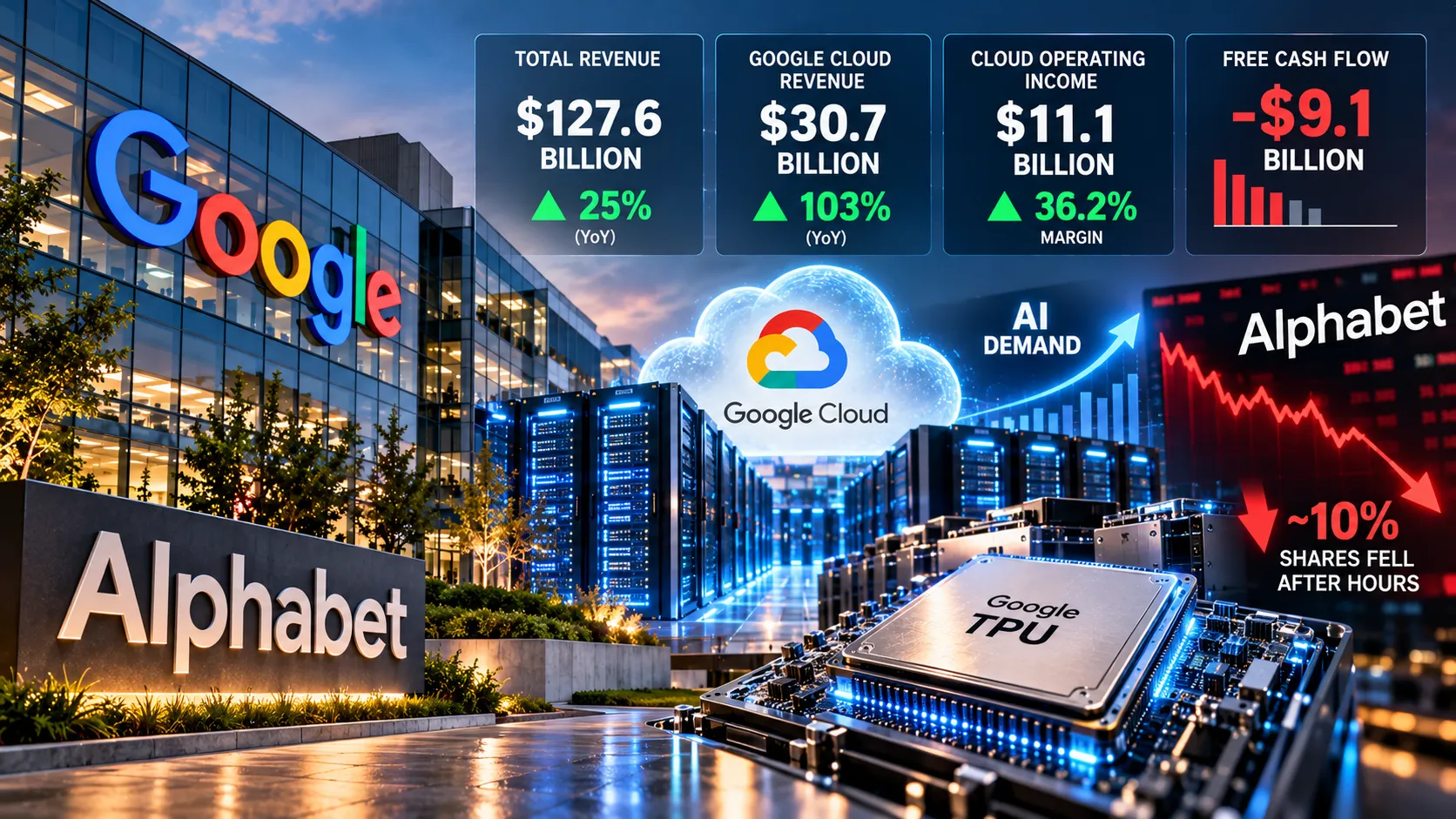
Alphabet reported revenue of $127.6 billion for the third quarter, up 25% from a year earlier, marking its 13th consecutive quarter of double-digit growth and an annualised run rate of about $500 billion, according to BigGo Finance. The figure was slightly below some analysts' estimates.
Shares fell sharply in after-hours trading on Wednesday, October 28, with some reports citing a drop of around 10% after the results, according to an Investing.com earnings call summary.
Cloud's breakout quarter
Google Cloud was the standout. Revenue jumped 103% to $30.7 billion, and operating income reached $11.1 billion, with the operating margin rising to 36.2% from 23.7% a year earlier. The cloud backlog, which represents contracted future revenue, stood at $561 billion.
"Google Cloud revenues grew 103%," chief executive Sundar Pichai said. "Our AI infrastructure and solutions are the major drivers for Cloud growth."
A key contributor was demand for Google's Tensor Processing Units (TPUs), the custom AI chips it designs in-house. Nearly 100 customers now use TPUs, and Alphabet expects more system sales through 2027. TPUs have emerged as one of the few credible alternatives to Nvidia's graphics processors for training and running AI models, and reports this week said OpenAI is considering buying them.
The spending problem
Alphabet's capital expenditure reached $51.4 billion in the quarter, more than double the $24 billion of a year earlier. Operating cash flow was $42.3 billion, leaving free cash flow at minus $9.1 billion.
The company kept its 2026 capital spending guidance at $195 billion to $205 billion but said spending is expected to rise significantly in 2027. That outlook raised questions among investors about how long Alphabet will continue to spend more than it generates in cash.
Profit hit by SpaceX
Net income and earnings per share declined, driven by an $8.2 billion unrealised loss on Alphabet's investment in SpaceX, according to BigGo Finance. Alphabet has been a long-time investor in Elon Musk's space company, and changes in the value of that stake flow through its reported profit. The Motley Fool reported GAAP earnings of $2.12 a share, down from $2.87, with an $8.7 billion loss on equity securities.
Search slows
Google's core search business, the company's largest source of profit, grew 12% to $63.3 billion, slower than in the previous quarter. Management cited currency movements, changes to EU rules on low-value imports and lower monetisation of queries in AI Mode, Google's AI-powered search experience.
The slowdown highlights a central tension for Alphabet: as it integrates AI into search, AI-generated answers may reduce the number of ads shown or clicked, at least initially. Investors are watching closely for signs that AI is eroding Google's search economics.
YouTube advertising revenue rose 9% to $11.2 billion, while subscriptions, platforms and devices grew 11% to $14.3 billion. Google Services overall grew 11% to $96.3 billion, with a 40.7% operating margin.
Accelerating AI development
Pichai said AI is helping Google develop AI faster. "We are at the point where AI is helping us increase our training and launch velocity," he said. "I would expect the next 12 months to see continued acceleration because of RSI," he added, referring to what the company describes as recursive self-improvement.
Microsoft comparison
Alphabet's results came on the same evening as Microsoft's, which showed Azure growth of 48% and capital spending below expectations. Microsoft's shares rose after hours while Alphabet's fell, suggesting investors are rewarding cloud growth combined with spending discipline.
What it means for India
Google is one of the largest technology investors in India, with plans for major data centre and AI infrastructure investments and a large engineering presence in Bengaluru and Hyderabad. Its cloud growth supports demand for Indian technology talent and partners, while its search and YouTube businesses are central to India's digital advertising market.
Changes in search monetisation affect Indian advertisers and publishers, many of whom depend on Google for traffic and revenue. The shift towards AI-generated answers could reshape how Indian businesses reach customers online.
The capex debate
The scale of AI spending by Alphabet, Microsoft, Amazon and Meta has become a central question for markets. These companies are collectively investing hundreds of billions of dollars a year in data centres and chips. Supporters argue that strong cloud growth and large backlogs justify the investment. Sceptics worry about overbuilding and the risk that returns will fall short.
Alphabet's negative free cash flow brings that debate into sharper focus, since it means the company is funding its build-out partly from its cash reserves.
The cloud race
Google Cloud's growth of 103% stands out against its larger rivals. Amazon Web Services remains the largest cloud provider by revenue, and Microsoft Azure is second, but Google Cloud has been growing faster than both as it wins AI workloads. Its custom tensor processing units (TPUs), designed in-house, give it an alternative to Nvidia's chips and have attracted customers seeking to train and run large AI models at lower cost.
The $561 billion backlog provides unusual visibility into future revenue. Backlog represents contracted revenue that has not yet been recognised, and much of it comes from large, multi-year commitments by companies building AI applications. Converting that backlog into revenue depends on Google's ability to build enough data centre capacity, which explains its heavy capital spending.
Investor reaction
Investors have been weighing Google's strong cloud growth against the cost of building the infrastructure to support it. Negative free cash flow of $9.1 billion in the quarter is unusual for a company that has long been one of the world's most consistent generators of cash. The debate centres on whether the investments will produce returns in line with Alphabet's historical profitability, or whether the AI race will permanently increase capital intensity across the industry.
What comes next
Investors will watch whether Google Cloud can sustain its growth, how quickly the backlog converts into revenue, and whether search growth stabilises. Alphabet's 2027 spending plans, expected to be detailed in its fourth-quarter results, will be a key factor for the stock in the months ahead.