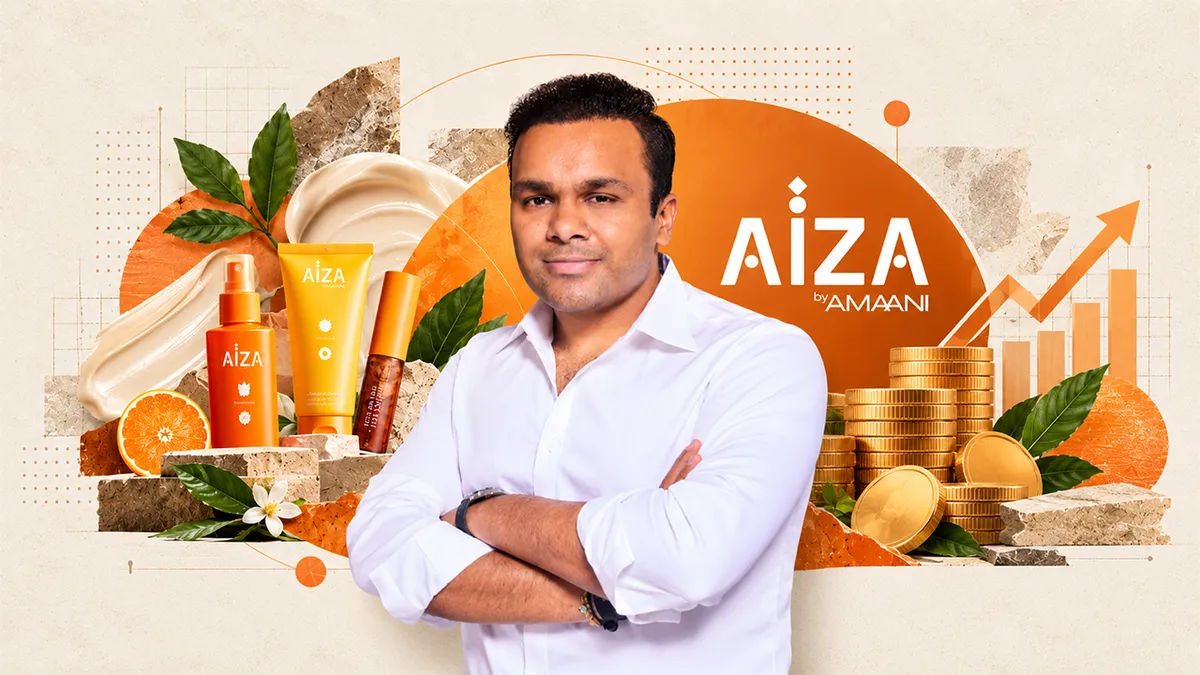
The Middle East is one of the world's most enthusiastic markets for beauty products. Shoppers in Dubai, Riyadh and Kuwait City spend heavily on skincare, fragrance and haircare, and global brands treat the region as a priority. Yet few of the brands on those shelves are built around the region's own beauty traditions. Amaani is betting that this is about to change.
The Dubai-based company, which owns the beauty brand AÏZA, has raised $5 million in a Series A round led by BECO Capital, with participation from Homegrown Ventures and Surge, the early-stage programme of Peak XV Partners. The round, announced on 28 September 2026, takes Amaani's total funding to $8 million.
A brand rooted in Arab ingredients
Amaani was founded in 2023 by Shubham Poddar, who serves as chief executive. It launched AÏZA in December 2024 as a skincare and haircare brand whose formulations draw on ingredients and rituals associated with the Arab world: dates, black seed, frankincense, rose and fragrances inspired by bakhoor, the scented wood chips traditionally burned in homes across the Gulf.
The products are alcohol-free and cruelty-free, and the formulas are vegan with the exception of those containing honey or milk-derived ingredients. They are developed in laboratories in South Korea, Japan and Italy, pairing regional ingredients with manufacturing expertise from three of the world's leading beauty markets.
Poddar explained the gap he saw in the market.
"The Middle East had become one of the world's most sophisticated consumers of global beauty, but too few globally ambitious brands were built around the region's own beauty culture," he said.
Rapid growth in the UAE
AÏZA's early performance has been strong. The company says its net revenue grew nine-fold year on year in the first half of 2026. It ranks among the top 10 brands across more than 300 global and regional beauty brands in the UAE, and it was named to BeautyMatter's NEXT50 list, becoming the first Middle Eastern brand to be included.
The brand sells through its own website, aiza.co, and through leading regional retailers. It is available on Ounass, the Gulf's luxury e-commerce platform, and through Ulta Beauty in the UAE.
Saudi Arabia next
The new funding will support expansion into Saudi Arabia, the largest consumer market in the Gulf. AÏZA is launching in Ulta Beauty stores in the Kingdom in September, and opening at Red Sea Mall in Jeddah and Riyadh Park in Riyadh in late September. Kuwait and Qatar are scheduled for the fourth quarter of 2026.
Saudi Arabia is a natural priority. Its population is larger than that of the other Gulf states combined, it has a young and increasingly affluent consumer base, and social reforms over recent years have expanded women's participation in the workforce and public life, contributing to rapid growth in beauty and personal-care spending. Retail development in major cities has also expanded the number of premium malls and beauty destinations.
What the investors see
BECO Capital, one of the UAE's most active early-stage venture investors, said it had been searching for a brand with regional roots and global ambitions.
"We examined the beauty and wellness category in the Gulf, looking for brands built here with the operating discipline to scale beyond the region," said Abdulaziz Shikh Al Sagha of BECO Capital.
Nader Amiri of Homegrown Ventures highlighted the originality of the approach.
"Rather than importing an established global playbook into the Middle East, Shubham and the team are building one from here," he said.
Peak XV's Surge programme backs early-stage companies across India, Southeast Asia and the Middle East. Its participation connects AÏZA with a network of founders and investors that has helped several consumer brands expand across emerging markets.
Why regional brands are having a moment
Across the world, consumers have become more interested in beauty brands with a clear cultural identity. Korean beauty became a global phenomenon by building on local skincare traditions and innovation. Indian brands have gained ground by highlighting Ayurvedic ingredients and formulations suited to South Asian skin. In the Middle East, a similar opportunity exists for brands that celebrate regional ingredients, scents and rituals rather than imitating Western or Asian models.
Ingredients such as frankincense and black seed have long histories of use in the region, and fragrance occupies a central place in Gulf culture. Bakhoor, oud and rose are part of daily life in many households. A brand that translates those traditions into modern skincare and haircare can offer something that global competitors cannot easily replicate.
The strategy also has potential beyond the Gulf. Arab communities around the world, as well as consumers attracted by Middle Eastern aesthetics and fragrances, represent a wider international market.
The challenges of scaling a beauty brand
Beauty is a crowded and expensive category. Brands must invest heavily in marketing, retail presence and product development, and they compete against global giants with enormous advertising budgets. Retail partnerships can bring visibility but also require inventory investment and pressure on margins.
Expanding across countries adds complexity. Each Gulf market has its own regulatory requirements for cosmetics registration, and consumer preferences vary even within the region. Maintaining quality while manufacturing in three different countries requires careful supply-chain management.
AÏZA's nine-fold revenue growth shows strong early demand, but the real test will be whether the brand can maintain growth as it moves into larger markets and faces more direct competition.
Relevance for India's consumer founders
Amaani's model will resonate with Indian consumer entrepreneurs. The Gulf is home to one of the largest Indian diasporas in the world and is often the first international market for Indian brands. At the same time, AÏZA's success illustrates a point that Indian founders have learned at home: consumers respond to brands that reflect their own culture, rather than versions of foreign products adapted for local markets.
For Indian investors and founders looking at the Gulf, the lesson is that the region is not only an export destination but a place where original consumer brands can be created and scaled.
What to watch
The immediate milestones are AÏZA's launches in Saudi Arabia, Kuwait and Qatar and the brand's performance in those markets. Longer term, the question is whether a beauty brand built on Arab traditions can become a genuinely global label.
If it can, Amaani will have proven that the Middle East can export beauty ideas as well as import them.