Amazon has delivered the clearest evidence yet that the artificial intelligence boom is flowing through to its cloud business, reporting a sharp acceleration in growth at Amazon Web Services that answers months of investor concern that it was losing ground to Microsoft and Google.
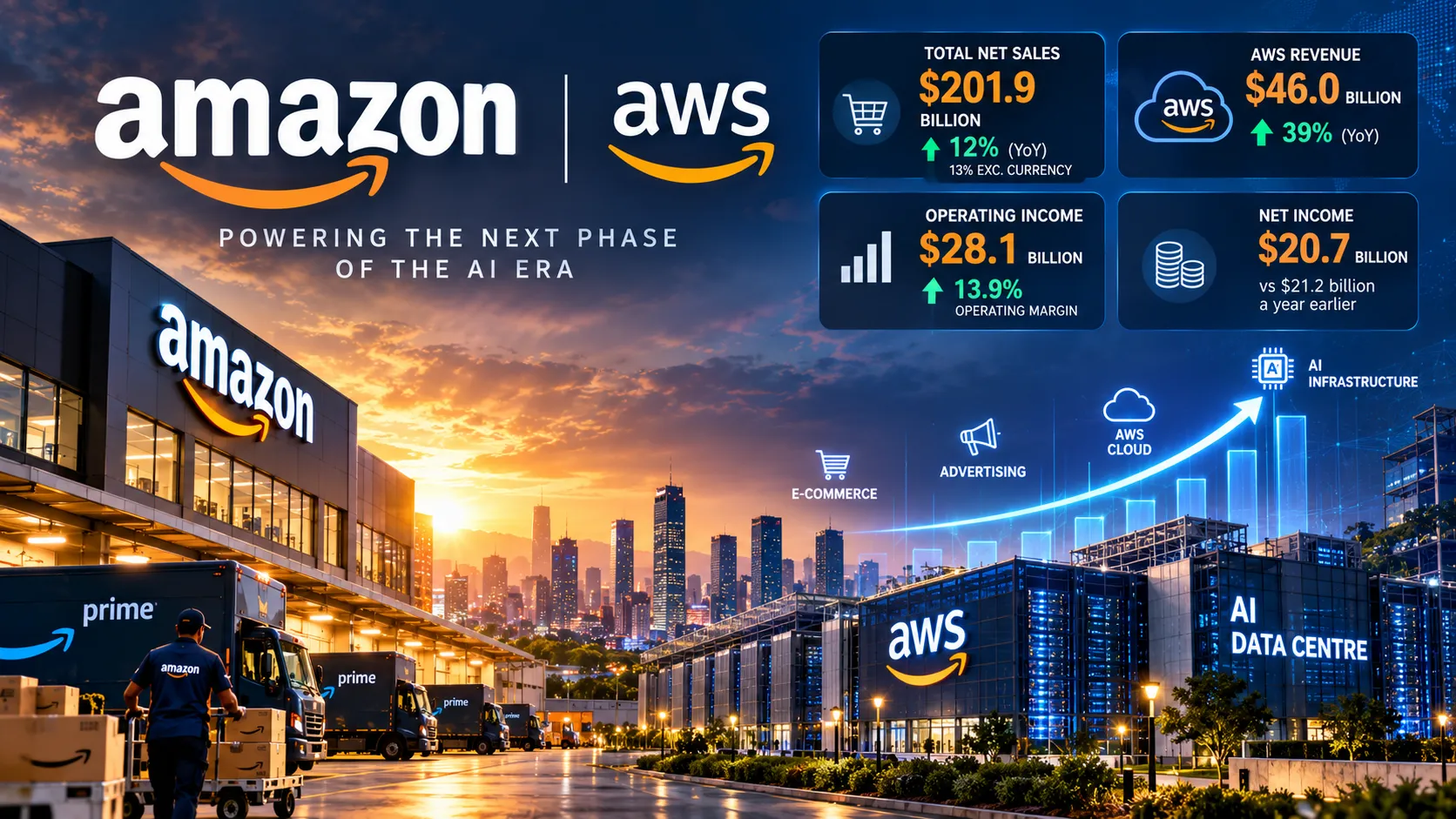
The Seattle-based company said on Thursday, October 29, that net sales for the July-September quarter rose 12% to $201.9 billion, or 13% excluding the effect of currency movements. Amazon Web Services (AWS), its cloud computing division, grew 39% to $46.0 billion, according to the company's earnings release filed with the US Securities and Exchange Commission.
Operating income rose to $28.1 billion from $17.4 billion a year earlier, lifting the operating margin to 13.9%. Net income edged down to $20.7 billion from $21.2 billion, and diluted earnings per share fell to $1.89 from $1.95. The decline in net profit reflected an unusually high comparison: a year earlier, Amazon booked $9.5 billion in pre-tax gains from its investment in AI developer Anthropic.
"There has never been a trillion dollar revenue business, and we may have two of them in the next 5-10 years," Andy Jassy, Amazon's president and chief executive, said in the release.
AWS returns to the fast lane
The headline number for investors was AWS. A year ago, the cloud unit reported revenue of about $33 billion and growth of roughly 20%, a pace that was respectable but slower than its two largest rivals. Microsoft's Azure and Google Cloud had been growing faster, fuelled by demand from companies building and running AI models, and some analysts questioned whether AWS had been slow to respond.
Growth of 39% on a far larger base changes that narrative. AWS added about $13 billion of quarterly revenue in a year, an increase larger than the total quarterly revenue of most software companies. The acceleration suggests that the investments Amazon has made in data centre capacity, custom chips and AI services are now translating into sales.
The comparison with peers remains instructive. Microsoft said this week that Azure revenue grew 48% to $33.2 billion, while Alphabet reported that Google Cloud revenue more than doubled to $30.7 billion. AWS remains the largest of the three by revenue, and its acceleration indicates that the cloud market is expanding fast enough for all three to grow rapidly at the same time.
The capacity race
Cloud growth in the AI era is increasingly constrained not by demand but by supply. Training and running large AI models requires vast amounts of computing power, specialised chips, electricity and cooling, and every major provider has said that demand has at times exceeded the capacity it can bring online.
Amazon has responded with one of the largest capital spending programmes in corporate history. A year ago it raised its 2025 capital expenditure estimate to $125 billion and said spending would rise further in 2026. Most of that money goes into data centres, servers and networking equipment for AWS.
A key part of Amazon's strategy is its own silicon. Its Trainium chips, designed in-house for training and running AI models, offer customers an alternative to Nvidia's graphics processing units and give Amazon more control over costs and supply. Anthropic, in which Amazon has invested billions of dollars, is one of the largest users of Trainium, and Amazon has built dedicated clusters of the chips to train its models.
Retail and advertising
While AWS dominated the headlines, Amazon's retail operations remain the bulk of its revenue. The company's online stores, third-party seller services, subscriptions such as Prime and physical stores together generate the majority of net sales, though at far thinner margins than the cloud business.
Advertising has become one of Amazon's most important profit engines. Brands pay to promote their products in Amazon's search results and on its streaming services, including Prime Video, and the business has grown into one of the largest digital advertising operations in the world, behind only Google and Meta. Because advertising carries high margins, its growth has contributed significantly to the improvement in Amazon's operating profit over the past several years.
Efficiency gains in logistics have also helped. Amazon reorganised its US fulfilment network into regional hubs, reducing the distance packages travel and speeding up deliveries, while increasing the use of robotics in its warehouses.
A record holiday quarter in view
Amazon's guidance points to a strong end to the year. The company expects fourth-quarter net sales of $240 billion to $247 billion, representing growth of 12% to 16%, and operating income of $28.5 billion to $33.5 billion. The holiday quarter is traditionally Amazon's largest, driven by Black Friday, Cyber Monday and the end-of-year shopping season.
The outlook comes despite a challenging environment for consumers. Oil prices above $100 a barrel have pushed up fuel and transport costs, and inflation remains elevated in many economies. Amazon's guidance suggests it expects consumers to keep spending, particularly on essentials and discounted goods.
The trillion-dollar ambition
Jassy's comment that Amazon may have two trillion-dollar revenue businesses within five to ten years is striking. No company has ever reached $1 trillion in annual revenue. Amazon's total annual revenue is currently on a run rate of more than $800 billion, with the bulk coming from retail. AWS, on its current trajectory, is on a run rate of more than $180 billion a year.
For AWS to reach $1 trillion in annual revenue within a decade would require sustained growth of more than 20% a year, a pace that would depend on AI adoption continuing at the current rate. The retail business, already enormous, would need steady growth in e-commerce, advertising and services. The remark signals how confident Amazon's leadership is in the long-term demand for both cloud computing and online commerce.
What it means for India
India is one of Amazon's most important growth markets for both e-commerce and cloud services. Amazon competes with Walmart-owned Flipkart and a growing number of quick commerce players, including Blinkit, Swiggy Instamart and Zepto, in a market where consumers increasingly expect delivery within minutes. Amazon has launched its own rapid delivery service in Indian cities in response.
AWS has a large presence in India, with data centre regions in Mumbai and Hyderabad, and serves government agencies, banks, startups and large enterprises. Amazon has announced plans for substantial further investment in India across cloud infrastructure, logistics and digital services, and it is one of the largest employers of technology professionals in the country. Strong AWS growth is also positive for India's technology services industry, as Indian IT companies are major partners helping enterprises migrate to the cloud and adopt AI.
The capex question
The central debate for investors across Big Tech is whether the extraordinary sums being spent on AI infrastructure will generate adequate returns. Microsoft, Alphabet, Amazon and Meta are together investing hundreds of billions of dollars a year, and some investors worry that the spending could outpace revenue for years. Alphabet's negative free cash flow this quarter and Meta's plan to raise up to $95 billion in stock have sharpened those concerns.
Amazon's results offer a partial answer. A 39% increase in AWS revenue, alongside rising operating income, suggests that its spending is producing growth and profits. Investors will look for continued evidence that capacity additions translate into revenue at healthy margins.
Competition for AI customers
The fight for AI workloads is intensifying. Microsoft benefits from its close partnership with OpenAI, while Google offers its own Gemini models and custom tensor processing units. Amazon's strategy is to offer customers a broad choice of models through its Bedrock service, including Anthropic's Claude models, Meta's Llama and its own Nova models, along with the infrastructure to build their own.
Large enterprises often spread their workloads across several cloud providers, so winning AI business is not always a zero-sum game. However, AI projects can be large and long-term, and providers that offer the best price and performance can lock in significant revenue for years.
What comes next
Amazon's fourth-quarter results, due early next year, will show whether AWS can sustain its acceleration and whether the holiday season delivers the strong sales the company expects. Investors will also watch for updates on Amazon's capital spending plans for 2027, the progress of its Trainium chips and the growth of its advertising business.
For now, the results suggest that Amazon has regained momentum in the cloud race at a crucial moment. With AI demand still outpacing supply across the industry, the companies that can build capacity fastest are likely to capture the largest share of one of the most valuable technology markets ever created.