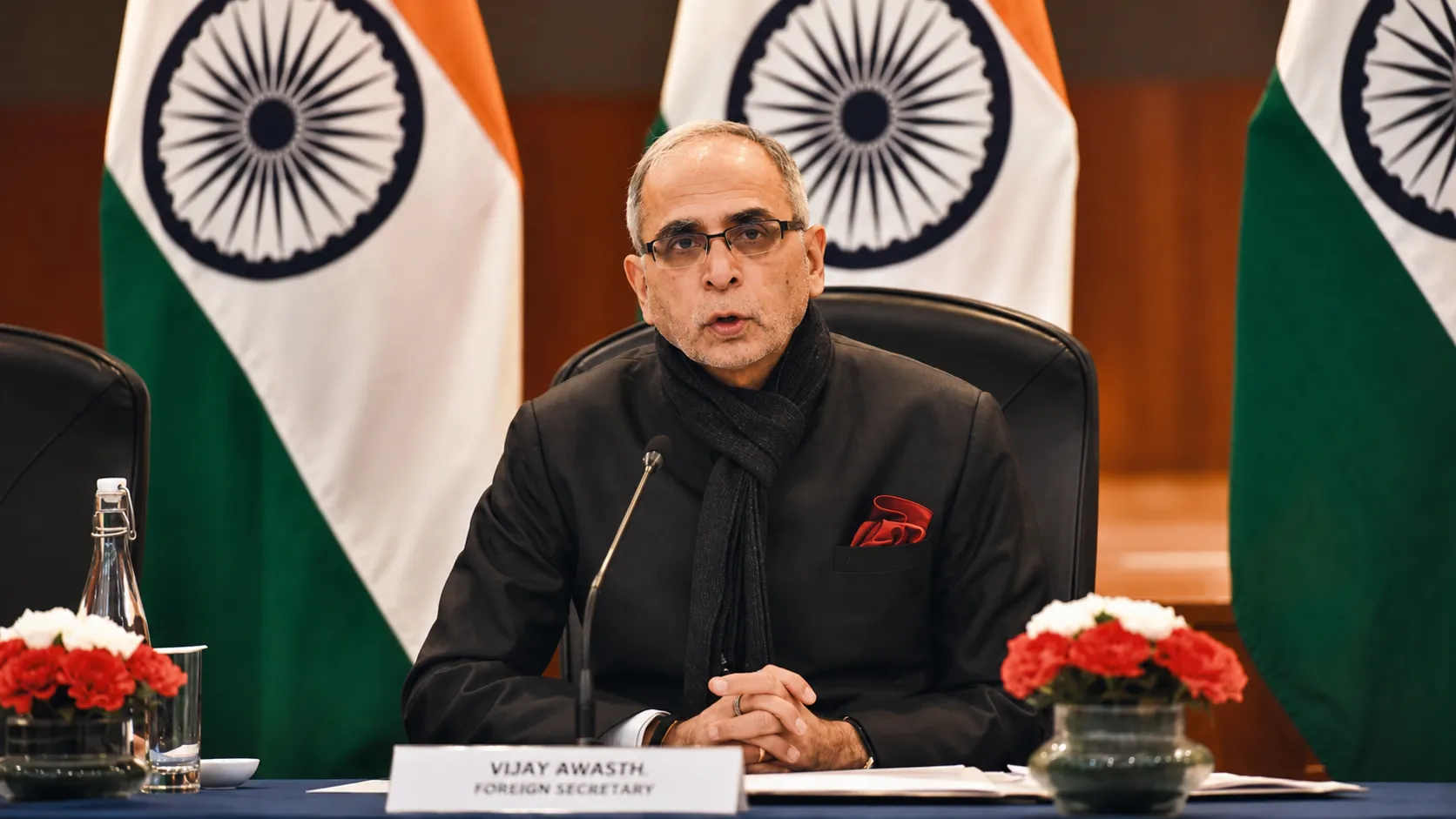
India's Ambassador to the United States, Vinay Mohan Kwatra, concluded a three-day visit to Atlanta this week that organisers and participants describe as one of the most substantive regional engagements the Indian mission has undertaken in the Southeastern United States in recent memory. Structured deliberately across three distinct constituencies — the Indian-American community, higher education leadership and the corporate sector — the visit offered a compact illustration of how India's diplomatic establishment is attempting to deepen the bilateral relationship with the United States at a moment when the two countries have publicly committed to expanding the Comprehensive Global Strategic Partnership beyond the traditional axes of Washington and Silicon Valley.
The visit opened with a community reception attended by roughly two hundred prominent members of Atlanta's Indian diaspora, a gathering that set the tone for what followed by explicitly framing the community itself as infrastructure for the broader relationship rather than merely its beneficiary. Addressing the gathering, Ambassador Kwatra spoke to the contributions Indian-Americans have made both to the United States and to India, describing the diaspora as an important connective bridge between the two nations at a time when bilateral trade, technology cooperation and people-to-people exchange are all expanding simultaneously.
The reception also carried a notable honorific dimension. The event recognised Padma Bhushan awardee Jagdish Sheth, the internationally regarded marketing scholar whose academic career has spanned more than six decades and helped shape how business schools around the world teach consumer behaviour and strategic marketing. Sheth's recognition at the event served as a pointed reminder that the Indian-American community's contribution to the bilateral relationship extends well beyond the technology and finance sectors that typically dominate diaspora success narratives, reaching deep into American academia and management thought leadership as well.
The second day of the visit shifted register entirely, moving from community celebration to institutional diplomacy. The Consulate General of India in Atlanta hosted an education roundtable bringing together leadership from nearly twenty universities across the Southeastern United States, including the Georgia Institute of Technology, Emory University, Vanderbilt University and the University of Florida — a roster that reflects the region's growing weight as a hub for research, engineering and life sciences education in the American higher education landscape. Ambassador Kwatra used the session to outline specific avenues for expanded collaboration, including joint research initiatives, faculty and student exchange programmes, dual-degree arrangements and innovation partnerships spanning both countries.
Central to the discussion was an invitation for American institutions to explore opportunities created by India's National Education Policy 2020, which for the first time opened a formal pathway for foreign universities to establish standalone campuses within India. The policy shift represents one of the more significant liberalisations of India's higher education sector in decades, and Southeastern American universities — several of which have invested heavily in expanding their international research footprints — were positioned during the roundtable as natural early movers given their existing research strengths in engineering, biosciences and data-intensive disciplines that align closely with India's own priority sectors under its innovation and manufacturing policy agenda.
The framing of education as a strategic pillar of the relationship is not incidental. India continues to send the largest cohort of international students to American universities of any nationality, and the flow of talent, research collaboration and eventual workforce participation that follows from student mobility has become one of the more durable structural links between the two economies. University administrators who participated in the roundtable are understood to have raised questions about visa predictability, research funding mechanisms and the practicalities of establishing degree-granting operations on Indian soil — issues that will likely require sustained follow-up well beyond a single diplomatic visit, but which the roundtable format allowed to surface directly to India's most senior diplomatic representative in the country.
Kwatra's engagements on the second day extended beyond the university system. He met separately with Georgia Governor Brian Kemp, using the meeting to congratulate the state on its recent economic growth trajectory and to thank Georgia's leadership for its continued support of the state's Indian-American community, which has grown substantially over the past two decades alongside the broader expansion of the metro Atlanta economy into logistics, technology, film production and advanced manufacturing. Georgia has increasingly positioned itself as a magnet for foreign direct investment, and the state's political leadership has been notably proactive in courting Indian corporate investment as part of that broader strategy.
That courtship was on full display during the business reception that closed out the second day, jointly hosted by the Consulate General of India in Atlanta and the U.S.-India Strategic Partnership Forum. The event drew more than thirty-five senior executives representing some of the most recognisable names in American corporate life, including The Home Depot, UPS, Delta Air Lines, The Coca-Cola Company and AGCO — companies whose combined operations touch logistics, retail, aviation, consumer goods and industrial manufacturing, four sectors in which India-US trade and investment linkages have grown steadily over the past several years.
Ambassador Kwatra used the business reception to highlight existing Indian corporate investment in the Southeastern United States, pointing specifically to Novelis and Birla Carbon as examples of Indian-origin companies that have already established significant operational footprints in the region. Both companies represent long-standing Indian industrial presence in American manufacturing — Novelis, a subsidiary of Hindalco Industries, operates as one of the world's largest producers of rolled aluminium products, while Birla Carbon maintains manufacturing operations that feed into the broader industrial supply chain. Their presence in the Southeast was cited as evidence that Indian capital is not merely flowing into the United States through portfolio investment or technology sector acquisitions, but is also embedding itself directly into American industrial infrastructure.
The ambassador's remarks connected these individual examples to the two countries' publicly stated ambition of reaching five hundred billion dollars in bilateral trade, a target that has been reiterated at multiple levels of the relationship over the past two years but which will require sustained expansion across manufacturing, services, technology and energy sectors to achieve. Regional engagement of the kind conducted in Atlanta is increasingly viewed within India's diplomatic establishment as a necessary complement to the high-level, Washington-centred diplomacy that typically dominates public coverage of the bilateral relationship, on the theory that trade targets of this magnitude cannot be met through federal-level engagement alone and require active cultivation of state-level economic relationships across the American South, Midwest and other regions where Indian investment has historically been less visible than on the coasts.


