Peter Mo, a former executive at AI voice-recorder maker Plaud, has raised $26 million for Ambi, an artificial-intelligence assistant that can listen in the background throughout the day and act on what it hears.
The funding, raised across multiple rounds, was led by Luminous Ventures, with participation from Huaqin Technology, the Chinese electronics original design manufacturer. Ambi is developed by Mistlabs, a San Francisco-headquartered company that describes its technology as cross-platform ambient intelligence. A press release described the latest tranche as a Pre-A round, with funds earmarked for developing a standalone AI wearable.
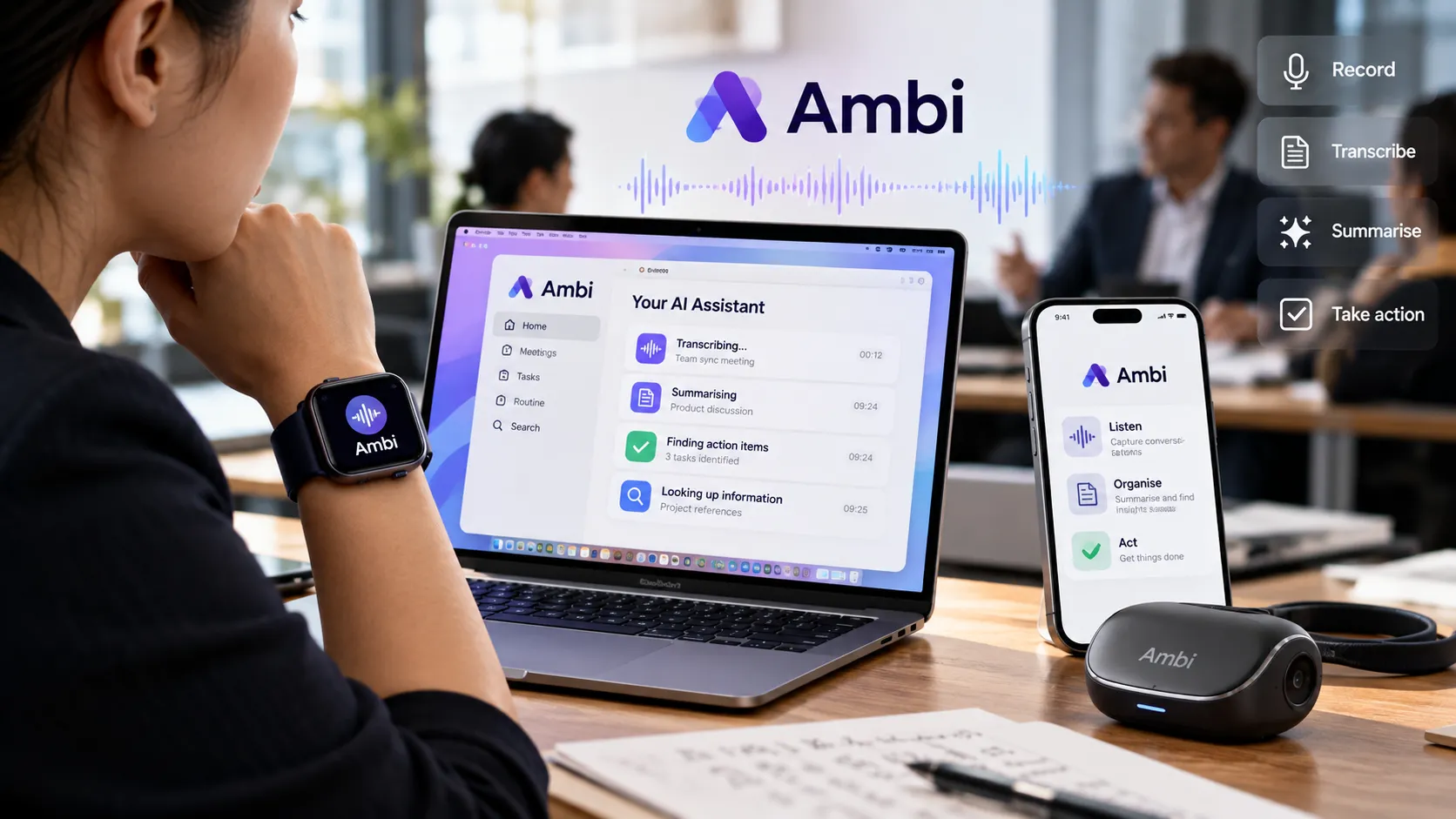
Ambi is now available on Apple devices, including iPhone, Apple Watch, Mac and MacBook, having moved out of beta. It requires iOS 18 or later on the iPhone.
From note-taker to proactive agent
At its simplest, Ambi works like the AI meeting note-takers that have become common in workplaces: it records, transcribes and summarises conversations. But users can choose to let it listen all day, building a continuous understanding of their work, relationships and priorities.
Its AI agent can begin working during a meeting, offering suggestions or surfacing relevant information drawn from the user’s calendar, past meetings, knowledge base and the web. A feature called Routine runs multiple agents on recurring tasks, such as analysing and fact-checking a meeting as it happens. Ambi’s memory follows the user across devices, so a task started on an Apple Watch can be continued on a Mac.
Mistlabs plans to add a desktop app that observes on-screen work and stores important elements in memory for more personalised suggestions. In the coming months, it also intends to launch agent-to-agent communication, in which assistants representing different users share relevant context, identify aligned priorities and surface disagreements during meetings, within permissions users grant.
“The way we interact with intelligence is limited,” Mo told TechCrunch, framing Ambi as an attempt to make AI assistance continuous instead of something users summon on demand.
Hardware on the horizon
Ambi’s software-first launch is a stepping stone. Mistlabs is building a dedicated wearable device with a screen, speaker, camera and microphones, which it expects to release later this year.
“While we’re starting with the iPhone, Apple Watch, MacBook and Mac, our move into standalone hardware sets the stage for Ambi’s intelligence to extend across entirely new device types in the future,” Mo said in the company’s announcement.
Huaqin’s involvement is strategically significant. As one of the world’s largest original design manufacturers, producing smartphones, tablets, wearables and laptops for major global brands, it brings deep hardware design and manufacturing expertise. Luminous Ventures has also backed Chinese food-delivery giant Meituan and robotics maker Unitree, according to TechCrunch.
The privacy question
Always-listening AI raises obvious concerns, and Mo acknowledges them. Ambient capture is off by default, and users can turn it off at any time. Mistlabs says it does not store users’ recordings and encrypts data, though it has not specified the encryption method. Audio is not stored by default, according to the company.
The harder question is consent from other people. It remains unclear whether Ambi’s apps or future device will alert third parties that they are being recorded. Mo said the responsibility for disclosure falls on users. “We have to inform our users that they have to tell others about ambient capture,” he said. “We, as an industry, haven’t solved this problem.”
That candour highlights a genuine gap. Recording laws vary widely: some US states require the consent of all parties to a conversation, and the European Union’s data-protection rules impose strict conditions on processing personal data. Several AI meeting note-taking apps have faced lawsuits over recording without consent. Apple’s own Voice Intelligence feature has prompted privacy debates.
A crowded field
Ambi enters a fast-growing market. Plaud, where Mo previously worked, built a successful business selling AI voice-recording devices that clip onto phones or are worn as pendants. Startups such as Littlebird and Minimi offer similar capture of computer context, and the large platforms are integrating ambient features directly into operating systems and devices.
The appeal is clear. Large language models are increasingly capable of acting as agents, but their usefulness depends on context. An assistant that already knows what was said in yesterday’s meeting, who is responsible for what and what the user is working on can act far more effectively than one that must be briefed each time.
The Plaud lineage
Mo’s background at Plaud is relevant to Ambi’s strategy. Plaud built a fast-growing business selling compact AI recording devices that capture meetings, calls and conversations and turn them into transcripts and summaries, demonstrating that professionals will pay for hardware that makes capturing spoken information effortless. Its success helped establish a new category of AI-first recording gadgets.
Ambi reverses the order. Instead of starting with a device, Mistlabs launched software on hardware people already own, the iPhone, Apple Watch and Mac, and plans to follow with its own wearable. The approach lets the company gather users and refine its AI before committing to the costs and risks of manufacturing, while Huaqin’s involvement gives it a credible manufacturing partner when it does.
The agent-to-agent feature, if it works as described, could be the most distinctive part of the product. Meetings are full of information asymmetry: participants arrive with different context and priorities. Assistants that can exchange relevant context in advance, within permissions, could make meetings shorter and decisions faster. It also raises new questions about what information is shared, with whom, and who controls it.
What it means
Ambi’s raise reflects investor conviction that the next interface for AI will be ambient and proactive instead of conversational and reactive. The bet is that people will trade some privacy for an assistant that truly understands their work, if they trust the company handling their data.
That trust will be hard won. Mistlabs will need clear privacy controls, robust security and transparent policies on how data is used, especially as its hardware device brings cameras into the picture.
For Indian professionals and enterprises, ambient AI tools raise practical questions under India’s Digital Personal Data Protection Act, which requires consent for processing personal data. Indian IT services and global capability centres, where meetings with international clients are constant, are likely to be early testing grounds for such tools and the policies governing them. Ambi’s launch is an early marker of a debate that every workplace, in India and worldwide, will soon have to settle: how much listening is too much.