Advanced Micro Devices (AMD) delivered a record quarter on Tuesday, November 3. Data Center revenue nearly doubled from a year earlier, giving investors fresh evidence that demand for artificial intelligence computing remains strong despite weeks of anxiety over the sustainability of the AI boom.
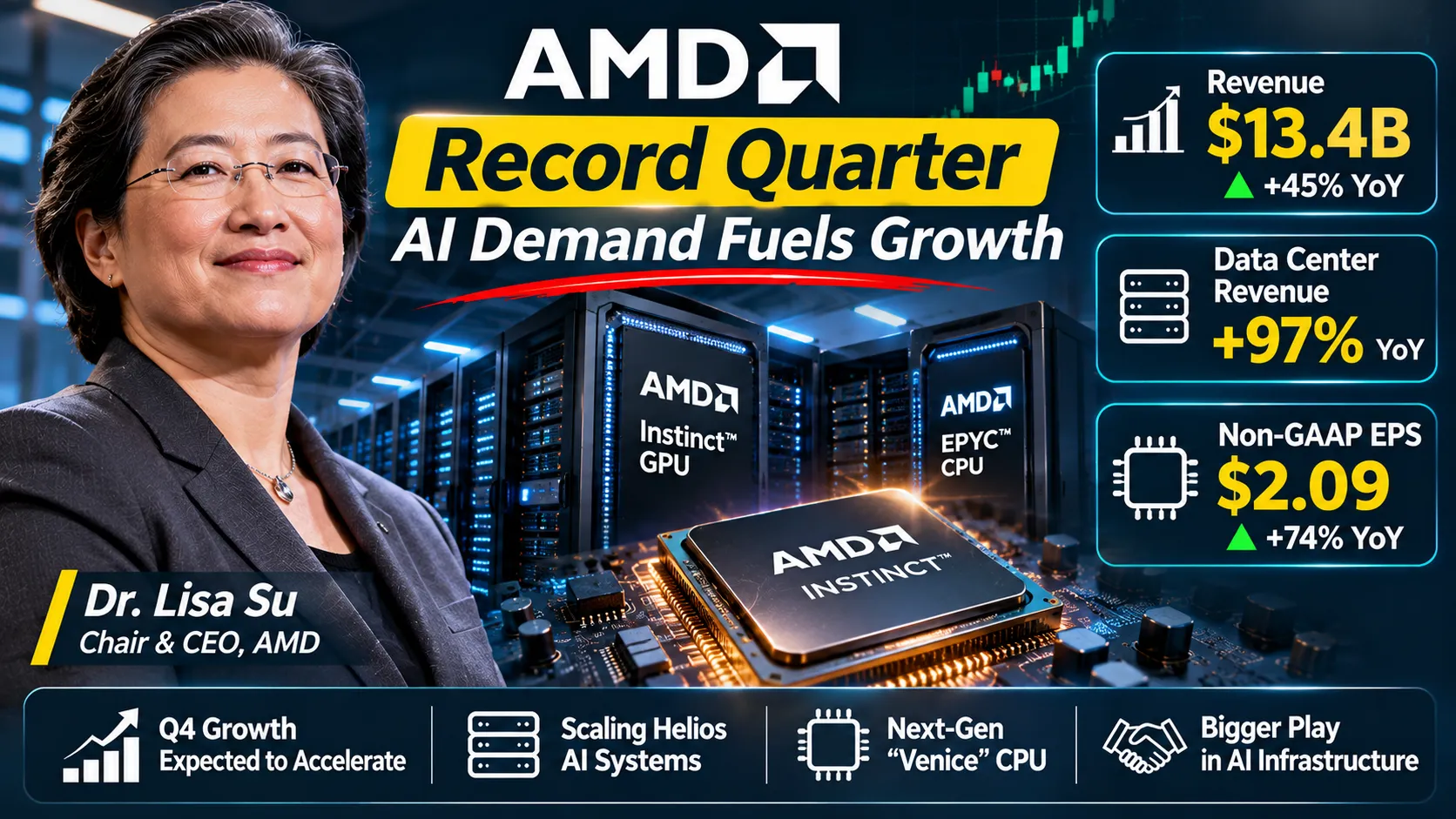
Third-quarter revenue rose 45% year on year to a record $13.4 billion, exceeding the high end of the company's own guidance, AMD said in its earnings release. Data Center segment revenue grew 97%, driven by record sales of its Instinct GPUs (graphics processing units used to train and run AI models) and EPYC server CPUs.
AMD shares jumped in after-hours trading after the results. The stock had already gained more than 3% during the regular session as chip stocks rallied ahead of the report.
The numbers
On a GAAP basis, AMD reported gross margin of 54%, operating income of $2.8 billion, net income of $2.4 billion and diluted earnings per share of $1.46. On a non-GAAP basis, which excludes items such as stock-based compensation and acquisition-related costs, gross margin was 56%, operating income $3.9 billion, net income $3.5 billion and earnings per share $2.09. Non-GAAP earnings per share grew 74% year on year.
"We delivered a record quarter with revenue exceeding the high end of our guidance as Data Center segment sales nearly doubled year-over-year," said Dr. Lisa Su, AMD's chair and chief executive. She said demand for its Instinct and EPYC products continued to strengthen and that the company expects growth to accelerate further in the fourth quarter as it scales production of Helios, its rack-scale AI system, and "Venice", its next-generation EPYC server processor.
Chief financial officer Jean Hu said the results demonstrated "significant operating leverage" in AMD's business model as the Data Center business drives scale. She added that the company's fourth-quarter outlook reflects accelerating revenue and earnings growth.
How far AMD has come
The scale of AMD's growth becomes clear against its recent history. In the third quarter of 2025, AMD reported revenue of $9.2 billion, then a record, with Data Center revenue of $4.3 billion. In the second quarter of 2026, revenue was $11.5 billion, with Data Center accounting for 58% of the total.
The latest quarter's $13.4 billion represents growth of about $4 billion in revenue in a single year. That is an extraordinary expansion for a company that was struggling to survive little more than a decade ago.
Lisa Su is widely credited with that transformation. She took over as chief executive in 2014, when AMD was losing money and market share, and she rebuilt the company around high-performance computing. AMD first won back share from Intel in PC and server CPUs and then made a determined push into AI accelerators to challenge Nvidia. Su, who was born in Taiwan and trained as an electrical engineer at MIT, is one of the most prominent women leaders in the global technology industry. She is widely regarded as one of the most successful turnaround CEOs of her generation.
Why this quarter mattered so much
The results arrived at a delicate moment for technology markets. In the days before the report, investors had been selling technology stocks amid concerns about elevated valuations, the enormous capital spending required to build AI infrastructure, and whether that spending would generate adequate returns. On Monday, November 2, the Nasdaq Composite had fallen about 1.1%, and the Nasdaq-100 was in correction territory, down roughly 10% from its recent high.
AMD's numbers offered a counterweight. Data Center revenue nearly doubling, and management guiding for faster growth in the fourth quarter, suggested that hyperscale cloud providers, AI labs and enterprises are still buying computing capacity at a rapid pace. Asian markets rose early on Wednesday as the results eased some concerns about the durability of the AI trade, Reuters reported, before broader market moves linked to the US midterm elections took over.
The competitive picture
Nvidia remains the dominant force in AI accelerators, with a far larger share of the market and a deep software ecosystem built around its CUDA platform. AMD's strategy has been to offer a credible, competitively priced alternative, supported by its ROCm software stack and close partnerships with major customers.
Large AI buyers have strong incentives to support a second supplier. Doing so improves their negotiating leverage, diversifies supply chains and reduces dependence on a single vendor. AMD has signed significant partnerships in recent years, including a 2025 agreement under which OpenAI said it would deploy up to 6 gigawatts of AMD GPUs over multiple years.
The Helios rack-scale system is important in this context. AI customers increasingly buy complete systems, combining GPUs, CPUs, networking and software, rather than individual chips. Scaling Helios production would allow AMD to compete for larger deployments at the system level, where Nvidia has been particularly strong.
Risks remain
Investors will watch several risks. AI infrastructure spending is concentrated among a handful of very large customers, so changes in their budgets can move results significantly. Export restrictions on advanced chips to China continue to constrain sales in that market. The supply of advanced manufacturing capacity and high-bandwidth memory remains tight across the industry, and memory costs have been rising sharply.
There is also the broader question that has unsettled markets: whether the trillions of dollars being committed to AI data centres will generate returns that justify the investment. AMD's results show that demand is strong today, but sentiment towards the sector can turn quickly if investors start to doubt the economics.
What it means for India
For Indian investors and technology professionals, AMD's growth has direct relevance. The company operates major engineering and design centres in India, notably in Bengaluru and Hyderabad, and has announced large investments in its Indian operations in recent years. Its chip design teams in India contribute to products across its portfolio.
As India pursues its own semiconductor ambitions, with fabrication, assembly and design projects backed by government incentives, global chip companies' growth translates into demand for Indian engineering talent and potential partnerships with local ecosystems.
For now, the message from AMD's record quarter is simple: the AI hardware build-out is still accelerating, and Lisa Su's company is capturing a growing share of it.


