Anduril Industries, the US defence technology company founded by Oculus creator Palmer Luckey, is allowing current and former employees to sell up to about $1.3 billion of their shares in a tender offer that values the company at roughly $90 billion, according to Bloomberg, as reported by Tech Funding News on 15 October.
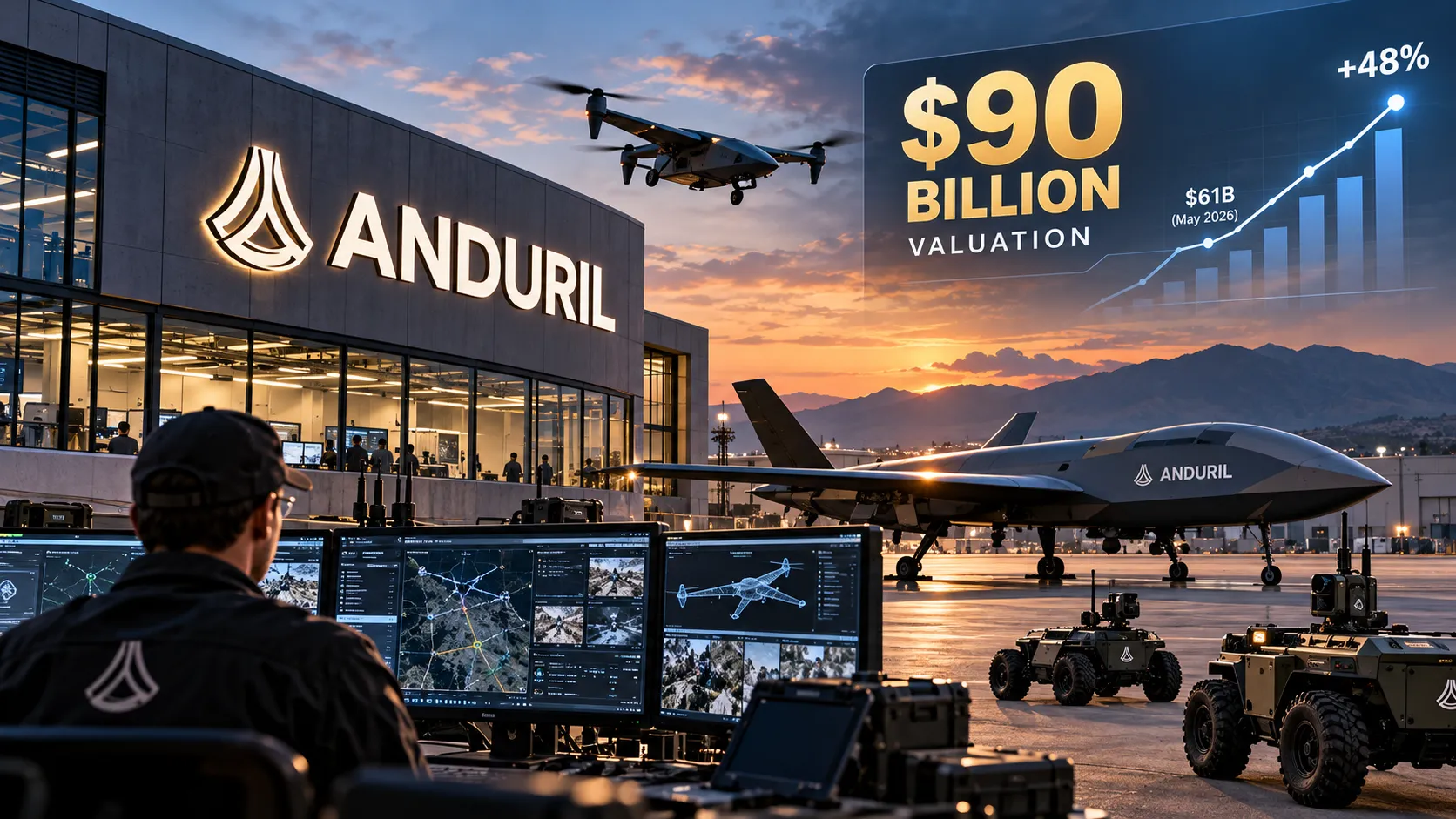
The offer, priced at $94.80 a share, opened on 13 October and closes on 9 November. Employees in 16 countries are now eligible to participate, up from staff in the United States, the United Kingdom and Australia in earlier offers.
The implied valuation represents a 48 per cent increase from the $61 billion at which Anduril raised a $5 billion Series H round, led by Thrive Capital and Andreessen Horowitz, in May.
A Share Sale, Not a Fundraise
A tender offer allows employees and early shareholders to sell existing shares to investors while the company remains private. Anduril itself does not receive new capital; instead, the transaction gives staff a way to turn some of their equity into cash without waiting for an initial public offering.
Tender offers have become a common tool for highly valued private companies that are in no hurry to list. They help retain employees, whose compensation is heavily weighted towards stock, and they allow companies to set a reference price for their shares between funding rounds.
A Steep Valuation Curve
Anduril's valuation has risen rapidly. The company was valued at $30.5 billion in June 2025 after a $2.5 billion round led by Founders Fund. Reports in March 2026 said it was seeking about $4 billion at a valuation near $60 billion, and the Series H in May priced it at $61 billion.
At the tender price, Anduril is valued at about 41 times its reported 2025 revenue of $2.2 billion, up from roughly 28 times at the Series H, according to Tech Funding News calculations. That is a rich multiple for a company that makes hardware as well as software, and it reflects investors' expectations of very rapid growth.
What Anduril Does
Founded in 2017 by Luckey, Brian Schimpf, now chief executive, Trae Stephens, a partner at Founders Fund, Matt Grimm and Joe Chen, Anduril builds autonomous systems for defence, including unmanned aircraft and surveillance systems. Its core software platform, Lattice, links sensors, AI models and vehicles so that operators can manage large numbers of autonomous systems.
The company positions itself as a challenger to traditional defence contractors such as Lockheed Martin, RTX and Boeing, arguing that it can develop and field new capabilities faster and at lower cost by investing its own money in products rather than relying on government-funded development programmes.
A String of Contract Wins
Investor enthusiasm has been fuelled by significant contract wins. In June 2026, Anduril beat Lockheed Martin for the US Army's common data layer baseline. In March, it secured an Army deal worth up to $20 billion over a decade. On 5 October, it won an Army contract worth up to $1.8 billion over five years to roll out its Next-Generation Command and Control system to I Corps, although only $162.8 million is in the base period, with the rest in options.
Anduril is also investing heavily in manufacturing. It is building Arsenal-1, an approximately $1 billion facility near Columbus, Ohio, funded with its own money, and Arsenal-2, a $3.7 billion shipyard at Sparrows Point in Maryland intended to produce components for Virginia-class submarines and begin operations by 2030.
The Defence Tech Boom
Anduril's rise is part of a broader surge in investment in defence technology. Global military spending reached $2.887 trillion in 2025, up 2.9 per cent in real terms, according to the Stockholm International Peace Research Institute, as conflicts and geopolitical tensions push governments to rearm.
Venture investors who once avoided defence have poured billions into the sector. In Europe, Germany's Helsing raised $1.8 billion at an $18 billion valuation in July, and Portugal's Tekever raised $580 million at a $6.4 billion valuation in September. In the United States, Shield AI raised $2 billion at $12.7 billion and Saronic raised $1.75 billion at $9.25 billion earlier this year.
Implications for India
The defence technology boom has relevance for India, which is seeking to reduce its dependence on imported weapons and build a domestic defence industry. Indian defence startups working on drones, surveillance, space systems and electronics have attracted growing investor interest, helped by government procurement reforms and initiatives to encourage private participation in defence manufacturing.
Anduril's model, in which a venture-backed company invests its own capital to develop products and then sells them to governments, offers a template that some Indian founders are studying, although India's procurement systems and budgets differ substantially from those of the United States.
Silicon Valley Meets the Pentagon
Anduril's rise has helped change attitudes in Silicon Valley towards defence work. For much of the past two decades, many technology companies and venture investors kept their distance from military contracts, wary of employee opposition, slow procurement processes and reputational risk. Anduril was founded on the opposite premise: that the US military needed the speed and engineering culture of commercial technology companies, and that defence could be a large and profitable market for startups.
Its success has encouraged a wave of new defence technology companies and drawn some of the most prominent venture firms into the sector. At the same time, critics have raised questions about the role of autonomous weapons, the concentration of influence among a small number of well-connected companies, and the ethics of applying artificial intelligence to warfare. Those debates are likely to intensify as companies like Anduril take on larger and more consequential roles in national security.
The Risks Behind the Valuation
Anduril's valuation rests on assumptions of continued rapid growth and large government contracts. Defence budgets are subject to political decisions, and many contracts, including several of Anduril's recent wins, are structured with small base periods and large optional extensions that may or may not be exercised.
The company is also taking on significant capital commitments with its manufacturing facilities, which carry execution risk. And at 41 times revenue, the valuation leaves little room for disappointment.
For now, the tender offer signals that investors remain willing to pay a premium for what they see as the defining defence company of a new era, and that Anduril's employees will have a chance to capture some of that value before any eventual public listing.