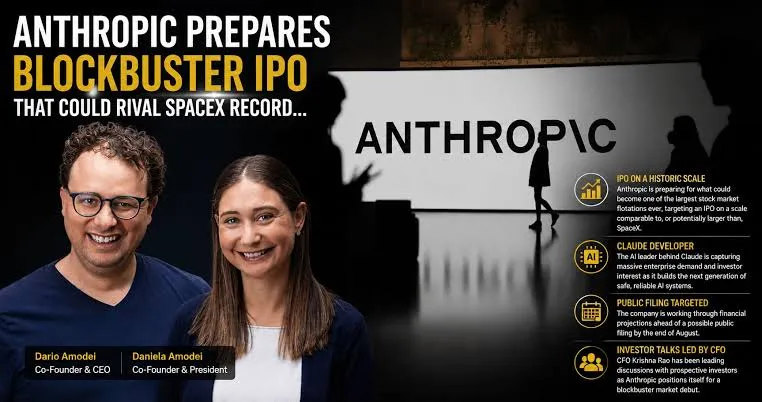
Anthropic, the San Francisco-based AI company behind the Claude family of models, is preparing for what could become one of the largest initial public offerings in history, with the company's leadership reportedly working toward an IPO that could match or exceed the scale of SpaceX's record-setting public debut. People familiar with the preparations say Anthropic could file its registration documents as soon as the end of August, positioning the company for a listing that would represent a defining moment for the broader frontier-AI industry.
The scale of the numbers underpinning the preparations is striking even by the standards of an industry accustomed to extraordinary growth trajectories. Anthropic's annualised revenue reportedly reached roughly $65 billion by the end of July, a sharp jump from where the company stood at the close of 2025, driven by surging enterprise spending on Claude and on the AI agents increasingly built around it. That growth rate, if it holds through to listing, would place Anthropic among the fastest-scaling companies ever to approach public markets.
The timing reflects how dramatically the economics of frontier AI have shifted over a remarkably short period. Only a few years ago, leading AI labs were characterised primarily by enormous compute costs and comparatively modest, uncertain revenue; today, at least for the small number of companies operating at Anthropic's scale, enterprise demand for AI models and AI agents has begun to generate revenue growth rates that rival or exceed those of the fastest-scaling software companies in previous technology cycles.
A public listing of the scale being discussed would give Anthropic another significant source of capital to fund the compute, data-centre and chip commitments that have become existential requirements for any company competing at the frontier of AI model development. The company has already secured substantial infrastructure commitments through partners including Google, whose TPU supply deal with Anthropic is worth tens of billions of dollars, and Broadcom, which has been arranging tens of billions of dollars in debt financing to support AI infrastructure tied to Anthropic's compute needs.
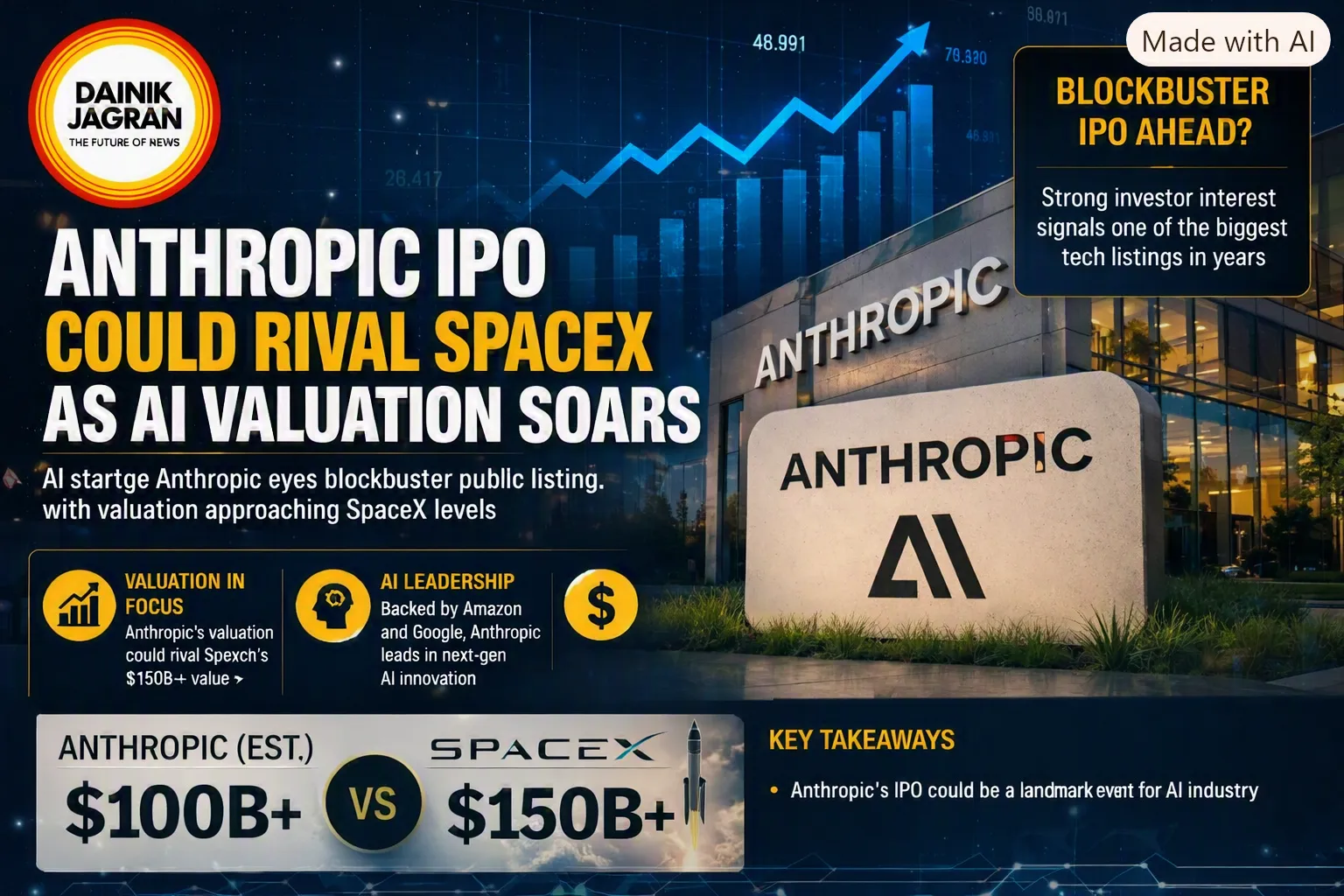
An IPO of this magnitude would also put considerably more public scrutiny on questions that have so far been debated largely in private: Anthropic's actual spending and margins, the durability of its enterprise revenue growth, its governance structure, and — perhaps most consequentially for a company that has built much of its public identity around AI safety — its ability to demonstrate that extraordinary revenue growth can coexist with the careful, safety-conscious approach to model development the company has consistently emphasised since its founding in 2021 by former OpenAI researchers, including current CEO Dario Amodei and president Daniela Amodei.
The scale of the anticipated offering inevitably invites comparison to SpaceX, whose public-market debut has served as a reference point for what an exceptionally large, closely watched technology listing can look like. Should Anthropic's IPO match or exceed that scale, it would set a new benchmark for how public markets value frontier AI companies — a benchmark that competitors, including OpenAI, will be watched against as they weigh their own eventual paths to public markets.
For now, the preparations remain just that: preparations. A formal registration filing, if it comes as soon as reported, would mark the beginning rather than the end of a process that will likely stretch over months, subject to regulatory review, roadshow scheduling and prevailing market conditions for large technology offerings. But the scale of the numbers already being discussed — a potential valuation and offering size in the same conversation as SpaceX's record debut — underscores just how central Anthropic has become to the broader AI infrastructure economy in a remarkably compressed period of time.