
Beijing Qujing Technology, the Chinese artificial intelligence infrastructure company that operates under the Approaching.AI brand, has raised more than ¥1.3 billion (roughly $180–195 million) in a Series B funding round, as investors in China pour money into the systems that run AI models at scale.
The round, reported on 26 October, was led by a group of investors including Zhejiang Finance Capital, Xiaoshan Capital, ICBC Investment, Zhongguancun Science City, Xinglian Capital and Qianjiang Century City. Other participants included Yunchuang Capital, Hunan Hi-Tech Zongheng, CCB Huake, Shenwan Innovation Investment, CITIC Juxin, AI company SenseTime and content delivery network provider Wangsu Science & Technology. Existing backer Shangshi Capital increased its stake.
The financing follows a Pre-A round in May and an A round in July, bringing the company's total fundraising this year to about $330 million, according to Dealroom.
What Approaching.AI Does
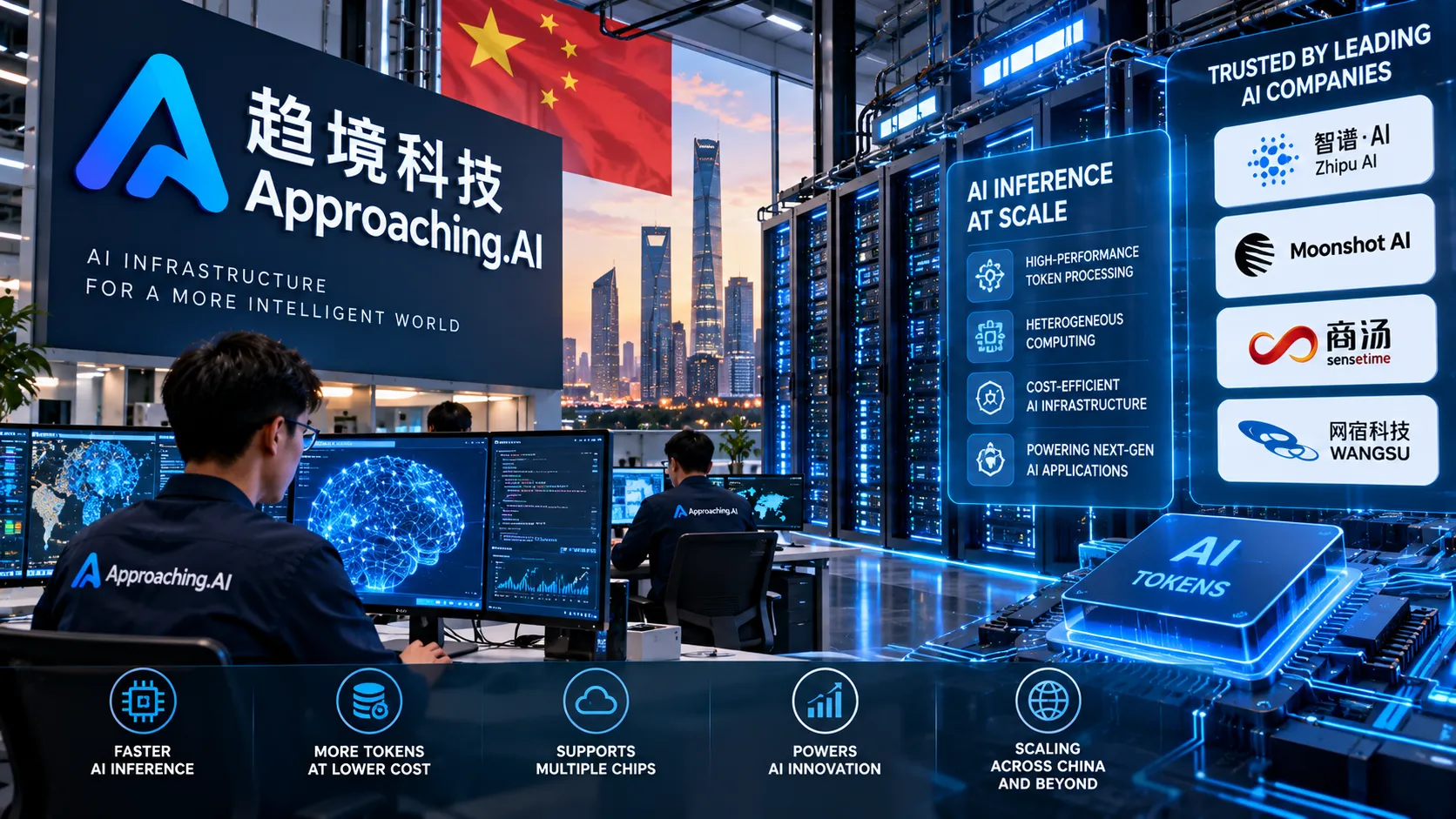
Approaching.AI focuses on AI inference, the process of running trained models to generate responses, images, code or other outputs. The company describes itself as a producer of AI "tokens", the units of text or data that large language models process and generate, and has built a platform it calls ATaaS to deliver inference services efficiently.
Its customers include large-model developers such as Zhipu AI and Moonshot AI, two of China's best-known AI companies. These developers need vast amounts of computing power to serve millions of users, and the efficiency of inference directly affects their costs and the prices they can charge.
The company has emphasised the use of heterogeneous computing, combining different types of chips, including domestically produced accelerators, to run AI workloads. That capability is particularly valuable in China, where US export controls restrict access to Nvidia's most advanced chips and companies must make the most of a mix of available hardware.
The Shift to Inference
Much of the early investment in AI focused on training, the computationally intensive process of building models from vast datasets. As models are deployed to millions of users, however, inference is becoming the larger and faster-growing share of AI computing demand.
Every query to a chatbot, every AI-generated image and every automated coding task requires inference. As usage grows, so does the cost of serving models, making efficiency a critical competitive factor. Companies that can deliver more tokens per unit of hardware and energy can offer lower prices or higher margins.
A Crowded and Well-Funded Field
Approaching.AI is part of a wave of Chinese companies building AI inference infrastructure that have attracted large funding rounds. Dealroom noted that SiliconFlow raised more than $275 million in June, and Infinigence closed a $316.3 million round in October. The size of Approaching.AI's Series B places it in the top tier of comparable Chinese enterprise software rounds, according to Dealroom.
The investor line-up reflects the strong role of state-linked capital in China's technology sector. Many of the lead investors are government-backed funds associated with provinces and municipalities, including Zhejiang and Hangzhou's Xiaoshan district, which seek to attract strategic technology companies to their regions. State-owned financial institutions such as ICBC and China Construction Bank also participated through their investment arms.
Strategic Investors
The participation of SenseTime and Wangsu adds strategic value. SenseTime, one of China's leading AI companies, has extensive computing infrastructure and AI expertise, while Wangsu operates a large content delivery and edge computing network that could support distributed inference services.
China's AI Ecosystem
China's AI industry has advanced rapidly despite US restrictions on chip exports. Companies such as DeepSeek have released highly capable open models at a fraction of the cost of Western counterparts, intensifying global competition. Chinese developers have focused on efficiency, partly out of necessity because of hardware constraints.
Beijing has made AI a strategic priority, supporting domestic chipmakers, computing infrastructure and AI applications. The government has also proposed export controls on certain AI technologies, underscoring the strategic importance it places on the sector.
Implications for India
India's AI ecosystem faces some similar questions about inference infrastructure. As Indian companies deploy AI applications at scale, efficient inference will be critical to keeping costs manageable for a price-sensitive market. GPU cloud providers in India, supported by the IndiaAI Mission's subsidised computing programme, are expanding capacity, and startups are exploring ways to serve models more efficiently.
The Chinese experience suggests that inference infrastructure could become a significant market in its own right, distinct from model development.
The Price War in Chinese AI
China's AI market has been marked by intense price competition. Large technology companies and model developers have repeatedly cut the prices they charge for access to their models, in some cases by more than 90 per cent, as they compete for developers and enterprise customers. Those price cuts have made efficient inference essential, since providers must serve growing volumes of requests at ever-lower prices.
Infrastructure companies like Approaching.AI benefit from this dynamic if they can help model developers reduce costs. By improving the utilisation of chips, optimising software and combining different types of hardware, inference specialists can lower the cost of each token generated. In a market where margins on model access are thin, those savings can determine which developers remain viable. The strong investor demand for inference infrastructure companies reflects a belief that efficiency, rather than raw model capability alone, will shape the next phase of China's AI industry.
The breadth of the investor syndicate, which spans provincial funds, state-owned bank investment arms and strategic technology companies, also gives Approaching.AI access to customers, data centre capacity and government projects that could support its growth. Such backing has become a common feature of China's most strategically important technology companies.
What Comes Next
Approaching.AI will use its new funding to scale its inference capacity and platform, according to earlier statements about its fundraising priorities, which have included expanding high-quality token production and domestic heterogeneous computing. The company did not disclose revenue, profitability or detailed growth metrics.
As AI usage grows, the companies that can deliver inference most efficiently may capture a substantial share of the value in the AI stack. Approaching.AI's rapid series of funding rounds this year suggests investors believe it can be one of them.


