Arm Holdings delivered the strongest quarter in its history, driven by booming demand for its technology in AI data centres, but the results were overshadowed by a broad sell-off in semiconductor stocks that sent its shares sharply lower.
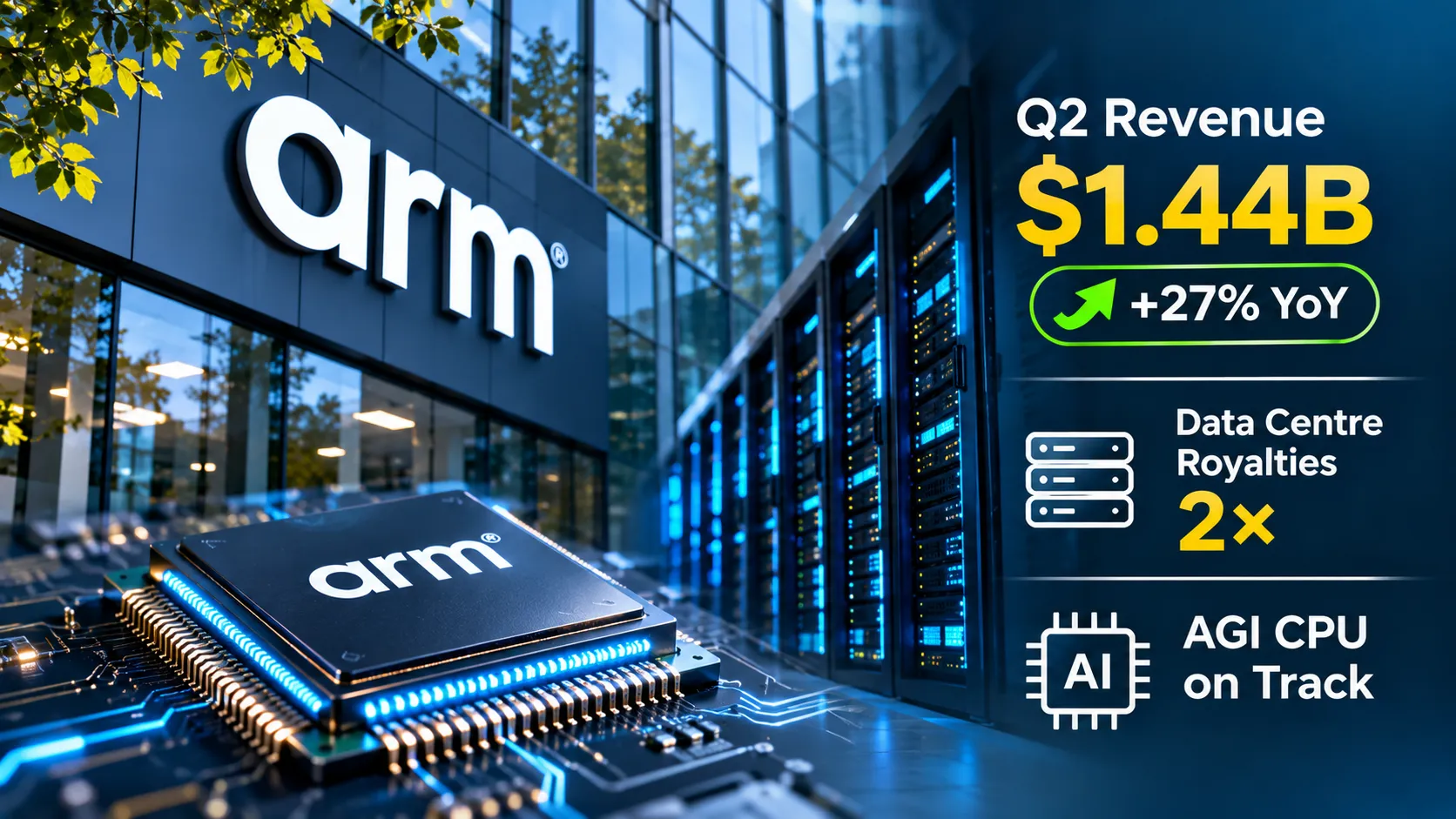
The British chip designer, which is majority-owned by Japan's SoftBank Group, reported total revenue of $1.44 billion for its fiscal second quarter, which ended on September 30, up 27% from a year earlier, according to the company's results announcement on November 4. It was Arm's record second-quarter revenue.
Licensing and other revenue rose 50% to $773 million, also a record, while royalty revenue was $670 million. Data centre royalties doubled from a year earlier, according to Arm. Non-GAAP operating income was $638 million, and GAAP operating income was $201 million.
Shares fall despite the record
Despite the strong results, Arm's shares fell 13.08% on Thursday, November 5, according to StockTitan, as the broader semiconductor sector suffered one of its worst days in years. The iShares Semiconductor ETF fell more than 12%, and the Nasdaq Composite dropped 5.5% into a correction.
The sell-off was driven by fears that Democratic gains in the US midterm elections would slow the construction of AI data centres, the very market that has driven Arm's recent growth. UBS estimates that about 30% of expected 2028 US data centre capacity additions are now at risk.
How Arm makes money
Arm does not manufacture chips. Instead, it designs processor architectures and licenses them to chipmakers, which pay upfront licensing fees and then royalties on every chip shipped using Arm's technology. Arm's designs are used in almost all of the world's smartphones, as well as in a growing number of PCs, cars, internet-of-things devices and data centre servers.
The 50% jump in licensing revenue suggests strong demand from chipmakers designing new products based on Arm's latest architectures, which will generate royalties in future years. Licensing revenue can be lumpy, depending on the timing of large deals.
The data centre opportunity
Data centres have become Arm's most important growth market. Large technology companies, including Amazon, Microsoft, Google and Nvidia, have developed processors based on Arm's designs for their data centres, seeking better performance and energy efficiency than traditional x86 chips from Intel and AMD. Nvidia's Grace CPUs, which are paired with its AI accelerators, are based on Arm technology.
The doubling of data centre royalties reflects the rapid deployment of these Arm-based processors in AI and cloud data centres. Royalty rates on data centre chips are generally higher than on smartphone chips, because the chips are more complex and valuable.
The AGI CPU bet
Arm said its confidence in generating up to $2 billion in revenue from its AGI CPU over its fiscal years 2027 and 2028 had increased over the past 90 days, according to its results announcement. The AGI CPU represents a significant strategic shift for Arm, which has traditionally licensed designs rather than selling its own chips.
The move into its own chips is designed to capture more of the value from the AI boom, but it also puts Arm in potential competition with some of its own customers, which design chips based on its architecture.
Chief executive Rene Haas
Under chief executive Rene Haas, Arm has pursued a strategy of increasing the value it captures from each chip, through higher royalty rates on its latest designs, the sale of more complete "compute subsystems" and now its own chips. The company listed on the Nasdaq in September 2023 in one of the largest technology IPOs of that year, and its shares rose sharply in the AI boom.
SoftBank's AI empire
Arm is a central part of SoftBank founder Masayoshi Son's ambitions in artificial intelligence. SoftBank acquired Arm in 2016 and retains a large majority stake. Son has positioned SoftBank as a major player in AI, with investments including OpenAI and large data centre projects. The sell-off in AI stocks has also weighed on SoftBank's shares in Tokyo, where the Nikkei fell sharply on November 6.
The smartphone business
Smartphones remain an important source of royalties for Arm, although the market is mature. Qualcomm, one of Arm's largest customers, reported on November 5 that its phone chip sales fell 26%, according to StockTitan, highlighting weakness in parts of the smartphone market. Qualcomm and Arm have also been involved in a long-running legal dispute over licensing terms.
The India connection
Arm has a significant engineering presence in India, with large design centres in Bengaluru and other cities employing thousands of engineers. India's growing semiconductor design ecosystem, supported by government incentives, includes many companies that use Arm's architecture. As India builds its semiconductor industry, Arm's technology is likely to play an important role in chips designed in the country.
Royalty rates and the latest architectures
Arm has been increasing the royalties it earns per chip by encouraging customers to adopt its latest architecture, known as Armv9, which carries higher royalty rates than older designs. As more smartphones, PCs and data centre chips adopt Armv9, Arm's royalty revenue grows even if overall chip volumes are flat. This strategy has been a key driver of Arm's revenue growth in recent years.
The company has also introduced compute subsystems, which combine multiple Arm designs into larger, pre-integrated blocks that chipmakers can use to bring products to market faster. These subsystems carry higher royalty rates and deepen Arm's relationship with its customers.
Valuation questions
Arm's shares have traded at a high valuation relative to its earnings, reflecting investor enthusiasm about its role in AI. That valuation makes the stock particularly sensitive to shifts in sentiment, as Thursday's sell-off demonstrated. Even strong results may not be enough to support the shares if investors become more cautious about the AI investment cycle.
Arm's licensing growth also suggests that chipmakers are continuing to design new products for future AI and data centre applications, regardless of near-term market volatility, since chip development cycles typically span several years.
What comes next
Investors will watch whether Arm can sustain its data centre growth if AI infrastructure spending slows, and how its AGI CPU strategy develops. The company's record results suggest strong underlying demand, but its high valuation leaves its shares vulnerable to shifts in sentiment about AI. As the market digests the political and financial risks to the AI boom, Arm's fundamentals and its share price may continue to diverge.