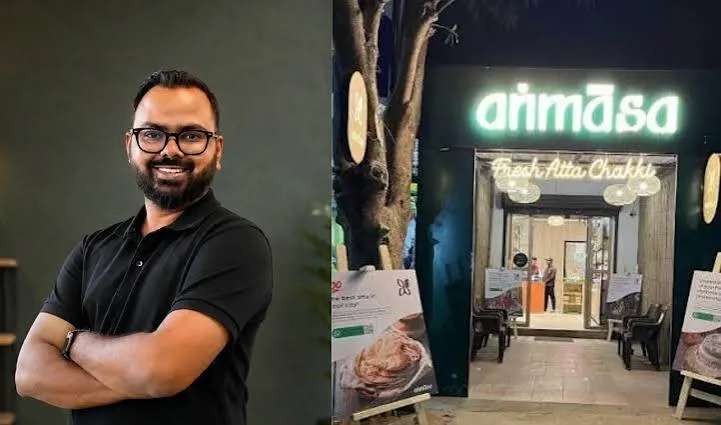
Every Indian city has them: the pickle maker whose jars sell out at the local supermarket, the snack company whose chips are a staple at family functions, the spice brand that three generations of households have trusted. Few of these businesses ever sell beyond their home region. Arovia Consumer wants to change that, and it now has ₹100 crore to try.
The consumer platform, founded by Prashant Parameswaran, has raised ₹100 crore from Fireside Ventures, the consumer-focused venture capital firm. The investment comes from Fireside's Fund IV, which closed in late 2025. The raise was announced on 28 September 2026.
Arovia's model is not to build brands from scratch. It plans to take significant stakes in established regional packaged-food businesses and help them expand into new markets, channels and product categories.
A founder who has done it before
Parameswaran's credentials are central to the pitch. He founded Soulfull, a food brand built around traditional grains such as millets, which Tata Consumer Products acquired in February 2021. He then led the business within Tata Consumer for five years, gaining direct experience of how a large corporate scales a niche brand through national distribution.
He also brings more than two decades of consumer business experience, including a background in a family business. That combination of start-up, corporate and family-business perspectives is relevant, because Arovia's target companies are often family-owned and run by founders who are wary of outside capital.
"The opportunity lies in these regional gems: brands that have been built but not yet scaled beyond their local markets," Parameswaran said.
Where Arovia is looking
The company has named its focus cities as Kochi, Pune, Coimbatore, Madurai, Mysuru, Mangalore, Surat and Indore. The list is instructive. These are prosperous, food-proud cities with strong local brand loyalty and distinct culinary identities, but they sit outside the metropolitan markets where most venture capital has concentrated.
Businesses in these cities often share a common profile. They have loyal customers, established distribution in their region, and supply chains rooted in local ingredients and suppliers. What they frequently lack is the capital, management depth and channel expertise to expand. Moving into modern trade, e-commerce, quick commerce and export markets demands investment in packaging, shelf life, compliance, marketing and working capital that a regional family business may not have.
Arovia intends to supply those capabilities while retaining the product authenticity that made the brands successful locally.
Why Fireside is backing a platform
Fireside Ventures is best known for early investments in digital-first consumer brands, and its portfolio has included companies such as Mamaearth and boAt. Backing a platform that acquires stakes in existing businesses is a different kind of bet.
Kannan Sitaram, co-founder of Fireside Ventures, described the rationale in terms of building on what already works.
"We believe there is significant potential to help these businesses build on their existing strengths and reach consumers across India," he said.
The approach reflects a broader rethink across Indian consumer investing. Many brands built primarily through performance marketing on social media found that customer acquisition costs rose sharply once competition intensified. Regional food brands, by contrast, often have decades of word-of-mouth loyalty and profitable operations, even if they are small. Investing in proven demand can carry less risk than creating demand from nothing.
The roll-up model and its risks
Arovia's strategy resembles the "house of brands" or roll-up model that has attracted investors in consumer markets globally. The idea is to acquire several complementary businesses, share procurement, distribution and marketing across them, and create a combined group larger and more efficient than its parts.
The model has clear advantages. Shared distribution means a salesperson visiting a supermarket can present several brands rather than one. Joint procurement can lower ingredient and packaging costs. A central team can bring professional finance, compliance and digital marketing to businesses that previously relied on the founder for everything.
It also carries well-known risks. Integration is difficult, especially when target companies have strong founder cultures. Regional products that succeed because of local taste may not travel well to other regions. And roll-ups can overpay for acquisitions, particularly when several investors pursue the same attractive targets. Parameswaran's experience inside Tata Consumer should help with integration, but execution at scale will be the true test.
A crowded but fragmented market
Indian packaged food is large and highly fragmented. National giants such as Hindustan Unilever, ITC, Nestlé, Britannia and Tata Consumer compete alongside thousands of regional and local players, many of them unorganised. In categories such as pickles, snacks, sweets, spices and ready-to-cook mixes, local brands often dominate in their home states.
That fragmentation is both the opportunity and the challenge. It means there are many potential acquisition targets. But it also means that large incumbents, private equity funds and other consumer platforms are increasingly scouting the same regional businesses, driving up valuations.
Rising incomes in tier-two and tier-three cities, the spread of organised retail and the rapid growth of quick commerce are all expanding the addressable market for packaged food, particularly for products that carry a sense of regional authenticity. Consumers in Delhi or Mumbai who have moved from southern or western India are a natural early market for brands from their home regions. Beyond India, the diaspora in the Gulf, the United Kingdom, North America and Southeast Asia offers a further export market for regional foods that carry a taste of home.
What to watch
The first acquisitions will reveal a lot about Arovia's approach: which categories it prioritises, how large a stake it takes, and whether it retains the original founders in operational roles. The speed at which it can take a regional brand into new cities and channels will be the key performance indicator for investors.
For India's regional food entrepreneurs, Arovia represents a new kind of option. Instead of choosing between staying small and selling out entirely to a large corporation, they may be able to bring in a partner that provides capital and expertise while preserving the identity of the business.
If the model works, the next national food brand could come not from a Mumbai boardroom or a digital start-up but from a family kitchen in Madurai, Mysuru or Indore.