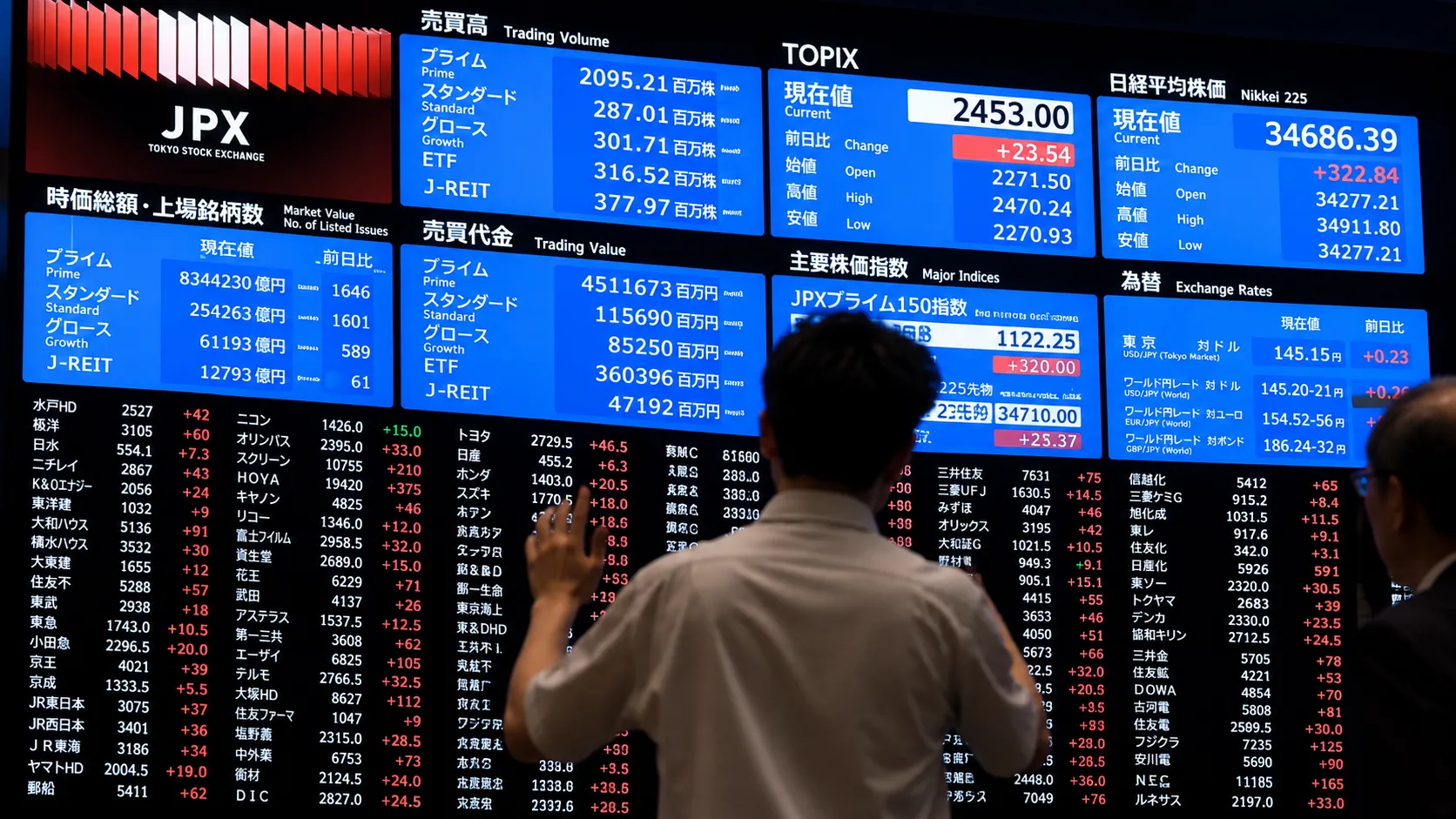
Asian stock markets began the week on a volatile footing on Monday, October 19, as investors digested one of the worst weeks for chip stocks in nearly two decades and growing doubts about the economics of the artificial intelligence boom.
South Korea's Kospi index fell as much as 3.2% at the open, and Japan's Nikkei 225 dropped more than 2% early in the session. Both markets later recovered much of the ground they had lost, with the Kospi swinging between small losses and gains during the day and the Nikkei paring its decline to around 1%. Taiwan's benchmark fell about 1.4%. Hong Kong's market was closed for the Chung Yeung Festival holiday.
The volatility followed a heavy sell-off on Wall Street on Friday, when the Nasdaq Composite dropped 2.1% to 26,140 and the S&P 500 fell 1.1% to 7,659. The Philadelphia Semiconductor Index lost about 11.4% over the week, extending its longest losing streak since 2008.
Korea's chip giants at the centre
South Korea has been hit particularly hard because its market is dominated by the two memory chip giants, SK hynix and Samsung Electronics, which have been among the biggest beneficiaries of AI-driven demand for high-bandwidth memory. Their shares soared earlier in the year, helping drive the Kospi to record highs and attracting heavy foreign investment.
That trade has reversed sharply. The Kospi fell about 14.5% between October 12 and October 16, and foreign investors sold roughly 11 trillion won of Korean shares last week. SK hynix shares fell around 24% over the week and Samsung Electronics about 18%, according to market data. On Monday morning, SK hynix traded around 1,231,000 won and Samsung around 213,500 won.
The sell-off was triggered in part by reports of technological progress at China's ChangXin Memory Technologies (CXMT), the country's largest DRAM maker, which raised concerns that lower-cost Chinese memory chips could erode the pricing power of Korean producers. Han Ji-young, an analyst at Kiwoom Securities, forecast a trading range of 5,200 to 5,900 for the Kospi in the near term, reflecting expectations of continued volatility.

The AI debt question
Behind the sell-off lies a broader concern about how the AI boom is being financed. Technology companies and data centre operators have borrowed heavily to fund the construction of computing infrastructure. The Federal Reserve Bank of Dallas has cited estimates that AI-related investment-grade bond issuance could approach $300 billion in 2026, and syndicated loans have accounted for a large share of data centre financing.
As interest rates have risen, investors have begun to question whether that spending can generate sufficient returns. "The question is shifting from how much AI infrastructure can be built to how profitably it can be operated," one analysis of the sell-off noted. Shares of companies with heavy debt loads and concentrated customer bases have been hit hardest. Oracle fell 8.8% and AI cloud provider CoreWeave fell 15.5% in Friday's trading. Micron Technology lost about 14.6% over the week.
US inflation rose to 3.7% in September, up from 3.4% in August, keeping bond yields high and raising the cost of financing for capital-intensive businesses. The Federal Reserve meets on October 27 and 28, and markets are pricing a high probability that it will hold rates steady.


