The relief rally that began on Wall Street swept across Asia on Tuesday, as investors poured back into the semiconductor companies that form the backbone of the global artificial intelligence supply chain.
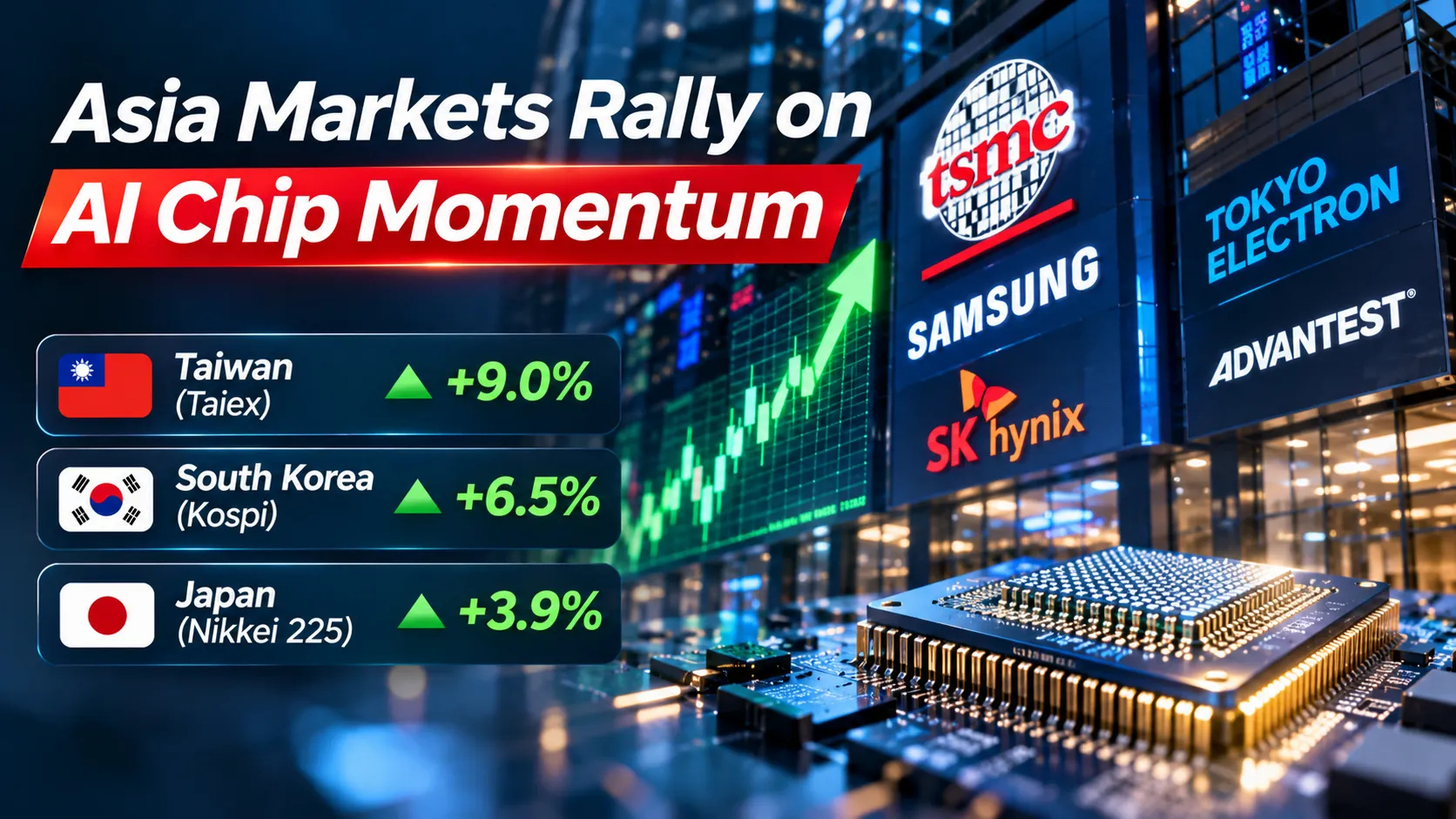
Taiwan's benchmark Taiex index surged more than 9% on Tuesday, November 24, according to the Associated Press, led by Taiwan Semiconductor Manufacturing Company and MediaTek, each of which rose nearly 10%. South Korea's Kospi jumped 6.5% to 5,014.41, and Japan's Nikkei 225 gained 3.9% to 58,654.40.
The rally followed Nvidia's decision on Monday to reinstate Jensen Huang as chief executive, which sent Nvidia shares up 31.5% and lifted the S&P 500 4.7% in its best day since April 2025.
Taiwan leads the way
Taiwan's market is heavily weighted towards technology, with TSMC alone accounting for a large share of the index. TSMC manufactures the advanced chips designed by Nvidia, Apple, AMD and many other companies, making it one of the most important companies in the AI supply chain.
A gain of more than 9% in a single day is exceptional for a major market index, reflecting both the scale of the previous week's sell-off and the concentration of AI-related companies in Taiwan's market.
South Korea crosses 5,000
In South Korea, Samsung Electronics rose 7.5% and SK Hynix gained 8.6%, according to the Associated Press. Both companies are leading producers of memory chips, including the high-bandwidth memory used in Nvidia's AI accelerators. SK Hynix in particular has become one of Nvidia's most important suppliers.
The Kospi's move above 5,000 marks a significant milestone for a market that has rallied strongly in recent years on the back of AI-related demand for memory chips and corporate governance reforms aimed at boosting shareholder returns.
Japan's equipment makers soar
In Tokyo, shares of semiconductor equipment makers led the gains. Tokyo Electron rose 10.5% and Advantest, which makes testing equipment for chips, jumped 14.1%, according to the Associated Press. Japanese companies supply critical equipment and materials used in chip manufacturing, and their fortunes are closely tied to investment in AI chip production.
The Nikkei 225 closed at 58,654.40, near record levels.
China and Hong Kong lag
Markets in China and Hong Kong posted more modest gains. Hong Kong's Hang Seng rose 0.2% to 22,432.45, and the Shanghai Composite gained 0.7% to 3,563.58. Chinese technology companies are less directly exposed to Nvidia, partly because US export controls restrict the sale of Nvidia's most advanced chips to China.
Australia's S&P/ASX 200 rose 1.7% to 8,718.80.
Why Asia moved so sharply
Asian markets are deeply integrated into the global AI supply chain. Nvidia designs AI chips but relies on TSMC to manufacture them, on SK Hynix and Samsung for memory, and on equipment from companies such as Tokyo Electron and Advantest. Any change in sentiment towards Nvidia therefore has an immediate impact on these companies.
Last week, as Nvidia shares fell nearly 23% amid uncertainty over its leadership, Asian chip stocks also declined sharply. Huang's return removed a key source of uncertainty, prompting investors to buy back shares they had sold.
Currencies and bonds
In currency markets, the US dollar slipped against the Japanese yen to 158.92, while the euro rose to $1.0913, according to the Associated Press. The yield on the 10-year US Treasury note was little changed at about 4.93%.