India's startup ecosystem welcomed its latest entrant to the unicorn club this month, as astrology and spiritual-guidance platform AstroTalk crossed the coveted billion-dollar valuation mark to become the country's 133rd unicorn. The milestone, confirmed during the second week of August, arrived even as overall funding momentum across Indian startups cooled, making AstroTalk's ascent a standout data point in an otherwise muted fortnight for the ecosystem. The development immediately drew attention from analysts tracking India's consumer-technology landscape, many of whom had long viewed astrology and spiritual-guidance platforms as a niche, if culturally significant, corner of the broader internet economy rather than a candidate for unicorn-scale valuations.
AstroTalk operates in a category that, until recently, sat at the margins of India's venture-backed technology narrative. The platform connects millions of users with astrologers, numerologists, tarot readers and spiritual counsellors through calls, chat and video consultations, monetising a deeply rooted cultural practice through a modern subscription and pay-per-session model. Its unicorn status arrives at a moment when investors are increasingly rewarding platforms that combine high user engagement, recurring revenue and a defensible cultural moat — attributes that are difficult for foreign or generalist competitors to replicate at scale in the Indian market. The company's growth also illustrates how India's vast, linguistically and culturally diverse consumer base continues to reward platforms willing to build deeply localised products rather than importing global templates. Where many earlier waves of Indian consumer-internet investment chased categories with obvious Western analogues — food delivery, ride-hailing, social commerce — AstroTalk's success underscores investor appetite for businesses built around uniquely domestic cultural practices that lack a comparable international precedent, yet command genuine, sustained consumer demand across income brackets and geographies. The company's rise mirrors a broader pattern within India's consumer-internet economy, where vernacular-first, trust-based platforms have quietly built durable businesses away from the spotlight typically reserved for fintech and enterprise software. Unlike many category creators that rely on discounting to acquire users, AstroTalk's growth strategy has leaned on word-of-mouth referrals, influencer partnerships and a network of thousands of practitioners who effectively act as both service providers and demand generators. AstroTalk's unicorn coronation also lands against the backdrop of a broader slowdown in Indian startup funding. According to data compiled by industry trackers, Indian startups raised roughly $139.5 million across twelve deals in the week spanning August 10 to 14 — a 44 percent decline from the $274.4 million raised the previous week. That AstroTalk achieved unicorn status amid this deceleration suggests investors continue to differentiate between capital-intensive, growth-at-all-costs models and businesses demonstrating genuine unit economics and profitability discipline.
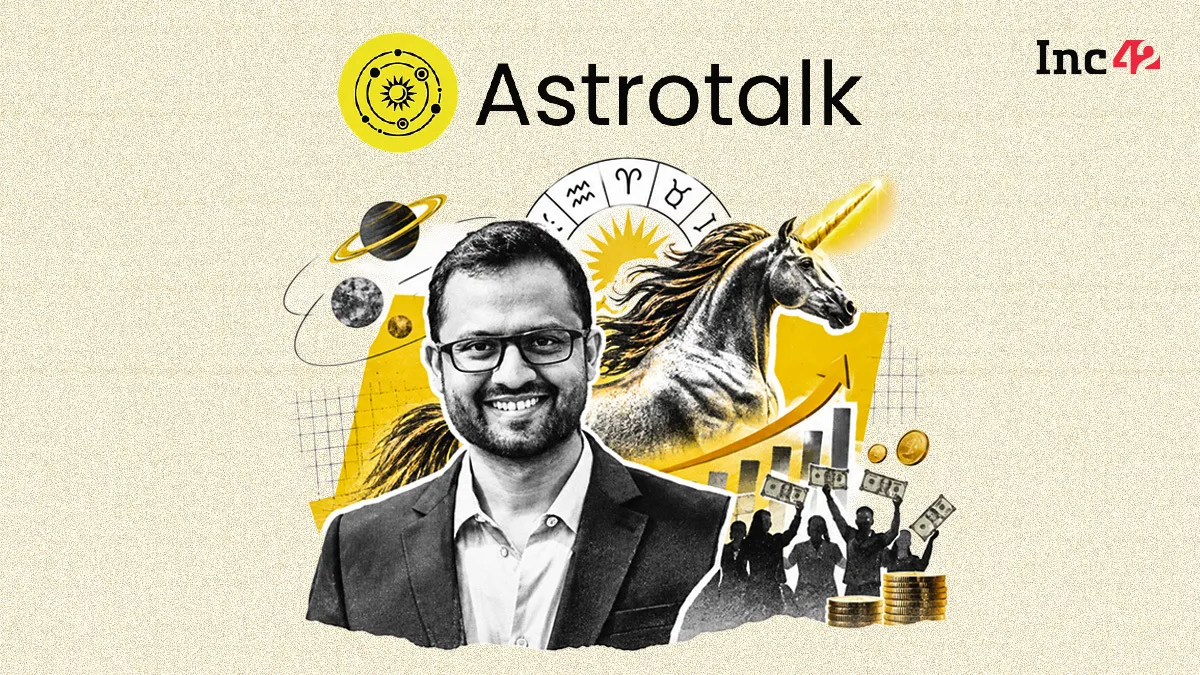
For India's broader startup narrative, each new unicorn carries symbolic weight beyond the balance sheet. The country has spent the past decade cultivating what policymakers describe as the world's third-largest startup ecosystem, and unicorn creation has become a shorthand metric for tracking that ambition. AstroTalk's arrival nudges India's unicorn tally further into triple digits beyond the 130 mark, a threshold that would have seemed improbable a decade ago when the ecosystem was still dominated by e-commerce and food-delivery bets. What distinguishes AstroTalk's trajectory from many of its unicorn predecessors is the category itself. Astrology-as-a-service occupies a curious position in India's cultural and economic life: deeply mainstream in consumer behaviour, yet historically under-served by organised, technology-enabled platforms. By digitising a practice that was traditionally fragmented across neighbourhood practitioners and word-of-mouth referrals, AstroTalk effectively created a new, addressable market rather than disrupting an existing digital incumbent — a positioning that investors have increasingly come to favour in categories where blitzscaling has produced mixed results. The unicorn milestone also invites closer scrutiny of the operating metrics underpinning platforms of this kind. Astrology and spiritual-guidance marketplaces typically monetise through a blend of per-minute consultation fees, subscription bundles and premium practitioner access, a structure that tends to generate more predictable, recurring cash flow than the one-time transaction models common to e-commerce categories. For investors evaluating consumer-internet opportunities in India, this recurring-revenue characteristic has become an increasingly important underwriting criterion, particularly as capital markets reward businesses that can demonstrate customer lifetime value meaningfully exceeding acquisition cost, rather than relying on continuous fundraising to sustain growth. The practitioner network itself represents another structural advantage embedded in AstroTalk's model. By aggregating thousands of independent astrologers, numerologists and spiritual counsellors onto a single platform, the company effectively built a two-sided marketplace in which supply-side participants have a direct financial incentive to refer new users, generating organic growth loops that reduce dependence on paid customer acquisition. This dynamic mirrors patterns seen in other services marketplaces globally, where practitioner-led referral economics have proven more durable than platforms reliant solely on centralised marketing spend.
As India's unicorn club grows more selective in a tighter funding environment, AstroTalk's milestone offers a useful signal for founders and investors alike: durable, culturally-rooted consumer businesses with genuine engagement metrics can still command premium valuations, even when broader capital markets turn cautious. Whether the company can sustain its growth trajectory toward a public listing, as several of its unicorn-era peers are now attempting, will be closely watched by an ecosystem eager for fresh benchmarks of what a sustainable Indian consumer-tech business looks like in 2026 and beyond. For the wider category of culturally-specific consumer platforms — spanning astrology, matrimony, regional-language content and devotional commerce — AstroTalk's ascent to unicorn status offers validation that deep cultural relevance, rather than sheer category novelty, can be a defensible and investable moat in the Indian market. Competitors and adjacent players are likely to study AstroTalk's playbook closely, particularly its approach to practitioner onboarding, trust-building and retention, as they calibrate their own paths toward scale. Over the coming quarters, market attention will also turn to how AstroTalk deploys its enhanced valuation and balance sheet, whether through international expansion into diaspora markets with strong cultural affinity for Indian astrological traditions, or through deeper investment in AI-assisted matching between users and practitioners to improve consultation quality and conversion rates further. Ultimately, the company's unicorn milestone will be remembered less for the valuation figure itself than for what it demonstrates about the maturing sophistication of India's consumer-internet investor base — one increasingly willing to look beyond familiar, internationally validated categories toward genuinely home-grown business models rooted in the specific cultural fabric of the Indian market.