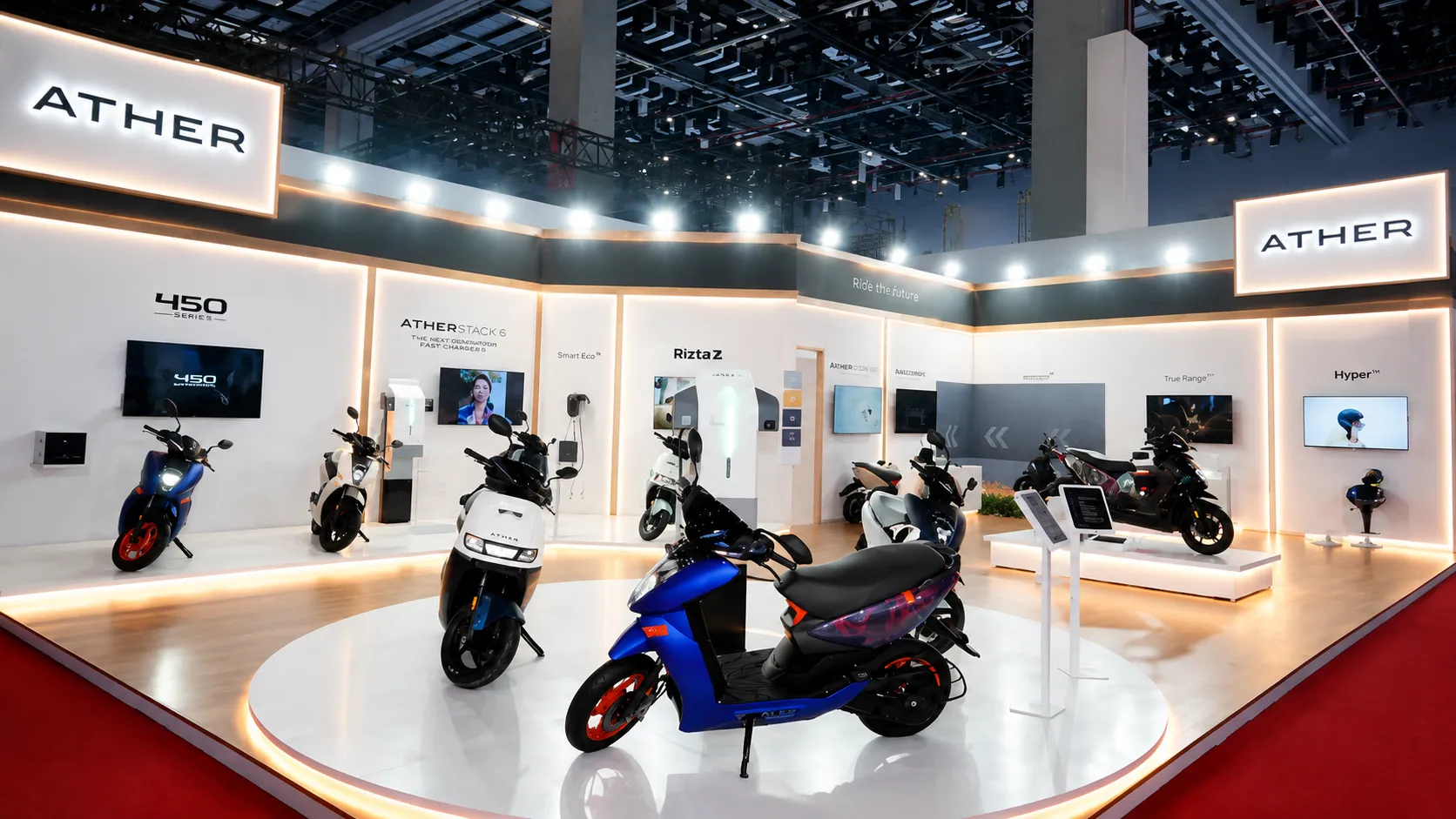
Ather Energy is confronting an unusual problem for a young electric vehicle manufacturer: demand for its scooters is running significantly ahead of its ability to build and deliver them. The company's latest quarterly earnings call revealed that monthly pre-orders have crossed 50,000 units, compared with roughly 30,000 scooters retailed per month on average during the first quarter of FY27 — a gap management estimates cost the company an additional 13,000 to 15,000 units in potential monthly sales purely due to supply constraints.
The mismatch is visible throughout Ather's retail network. Dealer inventory has fallen from roughly 14 days of stock to just three, and existing stores are currently able to fulfil only 50-60% of incoming demand. In some markets, dealers have stopped accepting new bookings altogether, with waiting periods for customers now stretching to two months or more.
"Demand has really gone in a very different orbit altogether, up 158% compared with the same time last year, and the EL launch later this month should further set us up for even stronger demand in the coming quarters," Ather Energy CEO and co-founder Tarun Mehta told analysts on the company's earnings call. The scale of the demand surge shows up across every metric the company tracks: customer enquiries rose 95% year-on-year to 7.07 lakh, paid pre-orders climbed 158% year-on-year to 1.5 lakh units, and industry-wide electric two-wheeler registrations rose 68% annually to approximately 5.25 lakh units during the quarter, with EV penetration crossing 10% of the two-wheeler market for the first time in June 2026, according to Vahan data cited by the company.
Ather's own Q1 FY27 results reflected the demand strength converting into improved financial performance even before the full capacity expansion comes online: revenue surged 89% year-on-year, delivery volumes grew 80.5% to 83,173 units, and the company's net loss narrowed sharply to Rs 51 crore, with the narrower operating loss metric falling even more steeply, to Rs 33 crore from Rs 134 crore a year earlier. Revenue from software subscriptions, charging, accessories, spares and service rose to 14% of operating revenue, up from 13% the previous year, reflecting a gradual shift toward higher-margin, non-vehicle income streams as the company's installed base matures.
To close the demand-supply gap, Ather is racing to expand manufacturing capacity on multiple fronts simultaneously. The company's current annual production capacity stands at approximately 4.2 lakh units, with its existing Hosur facility capable of producing about 35,000 scooters a month. The first phase of Ather's new AURIC facility is expected to lift total annual capacity to 9.2 lakh units later this calendar year, with a second phase under evaluation that could add a further 5 lakh units of annual capacity, taking the total to 14.2 lakh units — though the company has not yet committed capital to that second phase and expects to provide more clarity over the coming one to two quarters. Separately, the company is developing "Factory 3.0" in Chhatrapati Sambhaji Nagar, expected to begin production in Q3 FY27 and add a further 5 lakh units of annual capacity.