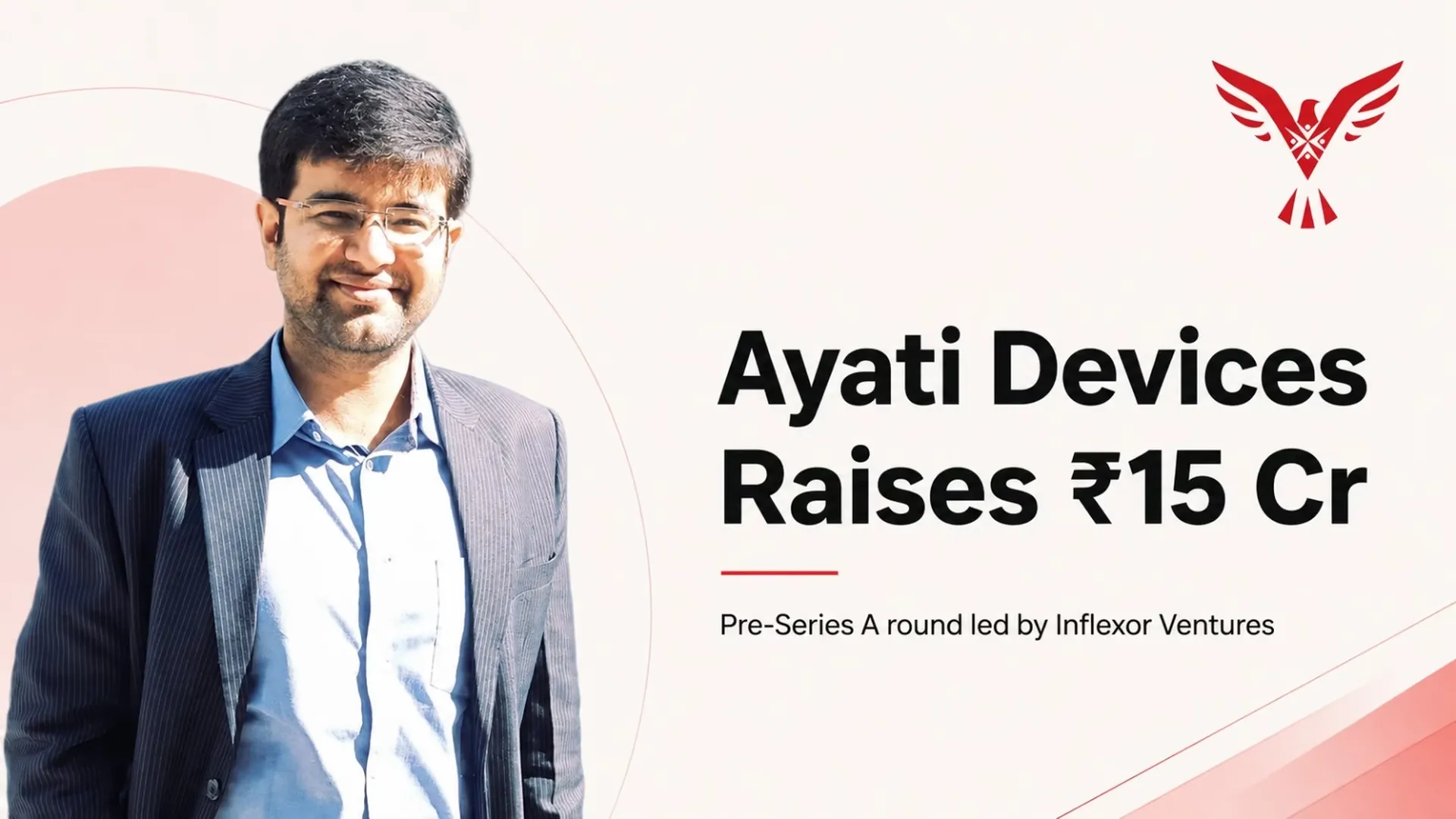
Bengaluru-based medical technology startup Ayati Devices has raised Rs 15 crore ($1.5 million) in a Pre-Series A funding round led by Inflexor Ventures, marking the company's first institutional investment since it was founded in 2019. The fresh capital will be used to accelerate commercialisation, expand the company's presence in domestic and international markets, strengthen manufacturing capabilities, and increase investment in research, regulatory approvals and artificial intelligence.
Founded by Nishant Kathpal and incubated at IIT Bombay's Society for Innovation and Entrepreneurship (SINE), Ayati Devices focuses on diagnostic technologies for diabetic foot complications and peripheral vascular disease, two conditions that remain leading causes of preventable amputation worldwide, particularly in settings where early screening infrastructure is limited or unavailable outside major hospitals. The company has built a portfolio of portable, point-of-care diagnostic devices designed to bring that screening closer to primary healthcare settings, catching complications before they progress into ulcers, severe wounds or amputations.
The company's product portfolio spans multiple stages of diabetic foot assessment. Vibrasense measures vibration perception threshold to identify large-fibre peripheral neuropathy in under five minutes, while Vibrasense+T adds warm and cold perception testing to assess both large- and small-fibre nerve function. Vasosense is designed for peripheral artery disease screening, and Angiocam enables real-time tissue perfusion imaging. The company also offers the PODIA Trolley, a pay-per-test screening model designed to lower the upfront investment healthcare providers must make to offer these diagnostics, a detail that speaks directly to Ayati's ambition of extending access beyond well-resourced tertiary hospitals.
Ayati says its devices have already been deployed across more than 30 countries, with over 10,000 units in the field and more than one million screenings conducted through its platform to date. Beyond India, where the bulk of its installations sit, the company has a commercial presence in markets including Denmark and Spain, and holds regulatory clearances from India's CDSCO, the US FDA, the European CE Mark, and health authorities in Sri Lanka, Malaysia and the UAE, a regulatory footprint that is unusually broad for a company at the pre-Series A stage.
"The scale of the opportunity is as large as the unmet need," said Pratip Mazumdar, Partner at Inflexor Ventures. "Ayati's multi-product platform, proprietary hardware-software integration, and growing IP portfolio give it the moat to become the global standard of care in non-invasive vascular and neurological diagnostics."
The funding lands at a moment when diabetes prevalence continues to climb across both developed and developing markets, placing sustained pressure on health systems already straining under the cost of managing chronic, late-diagnosed complications. Diabetic foot disease in particular carries an outsized economic burden relative to its visibility: amputations and prolonged wound care are among the costliest downstream consequences of diabetes, and early screening, the exact function Ayati's device portfolio is built around, has repeatedly been shown in clinical literature to reduce that downstream cost far more cheaply than treating complications after they emerge.
Beyond diabetic foot care, Ayati's underlying sensing technologies are also being explored for applications in wound care, plastic surgery, burn management, cardiovascular diagnostics and reconstructive medicine, giving the company a broader long-term addressable market than its current core focus suggests. With fresh capital now in hand, Ayati Devices is positioned to move from a company that has proven clinical adoption and regulatory viability across 30 countries into one attempting to scale manufacturing and AI-driven diagnostics to match that global demand, a transition that will test whether the company's technology-first approach can translate into the kind of manufacturing and distribution scale needed to make non-invasive vascular and neurological screening a genuine standard of care rather than a specialised offering available only where Ayati's devices happen to already be deployed.
Ayati's incubation at IIT Bombay's SINE programme situates it within a broader lineage of Indian medtech startups that have used academic incubation infrastructure to bridge the gap between clinical research and commercially viable hardware, a transition that has historically proven difficult for Indian medical device companies competing against far better-capitalised multinational incumbents. The company's decision to pursue a pay-per-test model through its PODIA Trolley product also reflects a broader pattern among Indian healthcare hardware startups: rather than asking cash-constrained clinics and smaller hospitals to make large upfront capital purchases, providers increasingly offer usage-based or subscription-style pricing that shifts risk away from the healthcare provider and toward the device manufacturer, a structure that can accelerate adoption but requires the manufacturer to have confidence in its own unit economics at scale.
The pre-Series A round also reflects a broader resurgence of investor interest in Indian medtech hardware specifically, a category that has historically attracted a smaller share of India's overall healthtech venture capital relative to software-first health platforms such as telemedicine and diagnostics-booking apps. Hardware-based medtech requires longer development cycles, more complex regulatory pathways spanning multiple jurisdictions, and higher upfront capital intensity than software products, all factors that have made investors more selective but arguably more committed once they do back a company, given the defensibility that regulatory clearances and manufacturing capability provide against faster-moving software competitors. Ayati's simultaneous clearances from India's CDSCO, the US FDA and the European CE Mark represent exactly that kind of defensible moat, one built over years rather than months, and one that later-stage investors are likely to weigh heavily as the company approaches subsequent funding rounds.
Diabetic foot complications also sit within a broader global health burden that continues to expand as diabetes prevalence rises across low- and middle-income countries, many of which face precisely the combination of constrained tertiary care capacity and rapidly growing diabetic populations that Ayati's portable, primary-care-oriented device portfolio is designed to address. The company's existing regulatory footprint across South and Southeast Asia and the Gulf positions it well to capture demand in exactly these markets, where the gap between rising diabetic-complication caseloads and available specialist screening infrastructure tends to be widest, and where a lower-cost, portable alternative to hospital-based vascular and neurological diagnostic equipment carries outsized practical value for healthcare systems operating under tight capital constraints. As Ayati converts its first institutional round into expanded manufacturing capacity, the company's next phase of growth will test whether a device portfolio proven across pilot deployments in 30 countries can scale into the kind of sustained, high-volume manufacturing and distribution operation required to make non-invasive vascular and neurological screening genuinely routine, rather than remaining a specialised offering available primarily where Ayati's own sales and clinical-partnership teams have already established a direct presence.