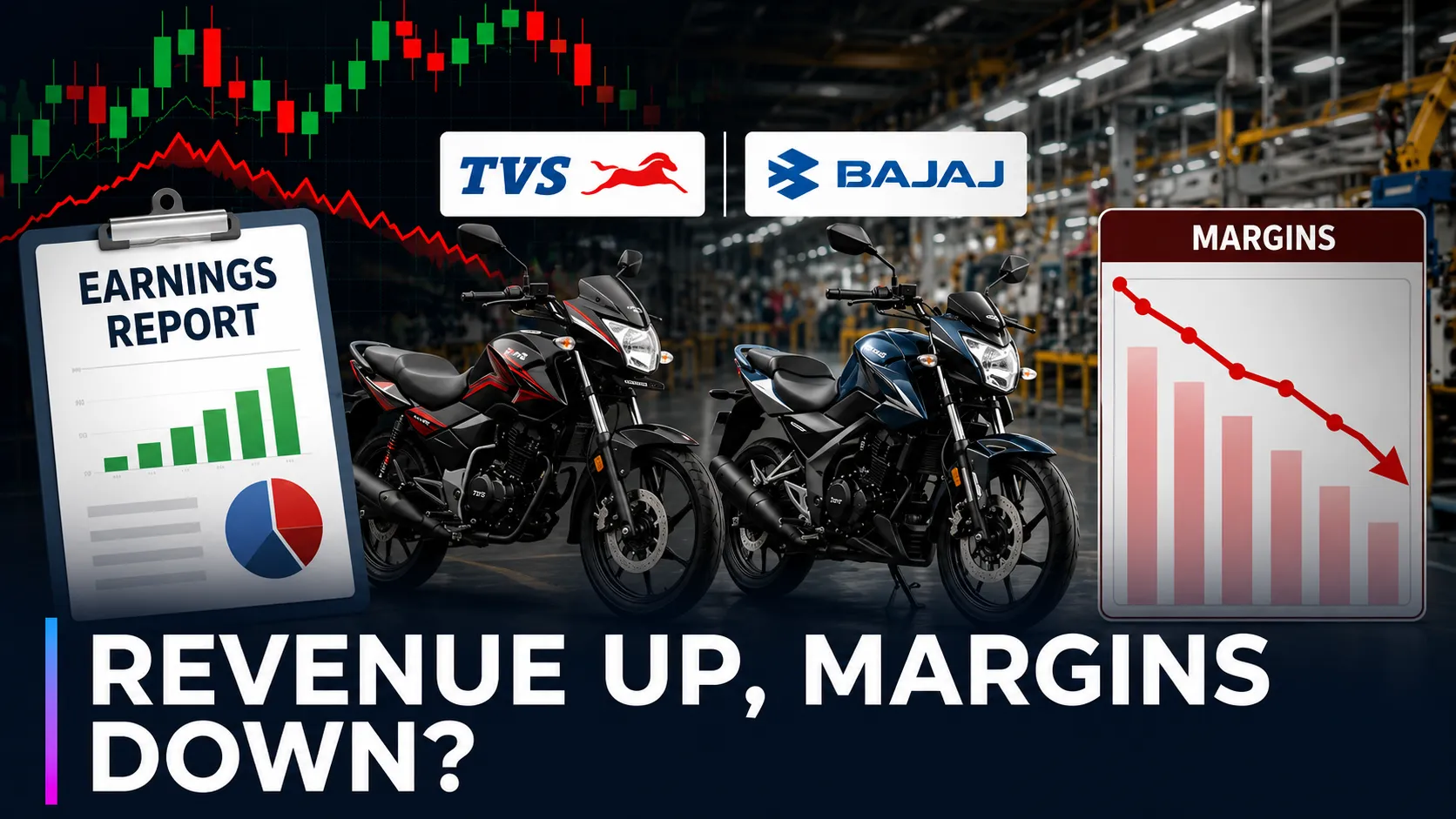
New Delhi: India's two-wheeler industry delivered one of the standout earnings stories of the ongoing Q1 FY27 results season, as both Bajaj Auto and TVS Motor Company posted robust quarterly numbers that sent their stocks — and the broader auto sector narrative — into sharp focus on Dalal Street. TVS Motor surged as much as 5 per cent in trade following its results, comfortably beating Street expectations, while Bajaj Auto reported record exports, all-time high revenue and healthy profit growth, even as its own stock reaction remained comparatively muted.
The quarter's headline numbers from TVS Motor were particularly striking. The company reported a 38 per cent year-on-year jump in revenue alongside a 51 per cent year-on-year rise in standalone net profit, figures that comfortably outpaced Street estimates and triggered an immediate re-rating in the stock as investors digested the scale of the beat. Domestic two-wheeler volumes for TVS grew 21 per cent year-on-year, a pace of growth that significantly outstripped broader industry trends, suggesting the company continued to gain market share even as overall demand conditions remained mixed.
A significant driver of TVS Motor's outperformance came from its scooter portfolio, spanning both internal combustion engine and electric variants, which together accounted for 40 per cent of the company's total sales volume for the quarter. The company's electric two-wheeler business in particular showed exceptional momentum, with volumes climbing 82 per cent year-on-year to touch 260,000 units, generating revenue of ₹1,780 crore. Cumulative sales of the company's iQube electric scooter have now crossed the one million unit mark, a milestone that underscores TVS's early and sustained investment in electrification relative to some of its peers.
The broader industry backdrop for electric two-wheelers also painted an encouraging picture for TVS's strategic positioning. Industry-wide electric two-wheeler penetration crossed 10.6 per cent in June 2026, while electric three-wheeler penetration surged past the 40 per cent mark — figures that illustrate just how rapidly India's electrification of personal and commercial mobility is progressing. TVS has reported gaining market share in both the electric two-wheeler and three-wheeler segments even as it continues to scale up manufacturing capacity to meet rising demand across both categories.
TVS's premium franchise, anchored by its partnerships with KTM and Triumph, also contributed meaningfully to the quarter's strong showing, with domestic revenue from that segment growing at roughly 60 per cent, reflecting continued appetite among Indian consumers for premium and performance-oriented motorcycles even amid a broader environment of cautious discretionary spending.
Bajaj Auto's quarter told a somewhat different but equally compelling story. The company reported robust profit growth alongside record export volumes and all-time high revenue for the quarter — a performance that reflected both a recovering export market and continued resilience in the company's premium and mid-segment domestic product lines. Yet, despite the strength of the underlying numbers, Bajaj Auto's stock reaction to the results was notably more subdued compared with the sharp rally seen in TVS Motor shares, a divergence that has become a talking point among market strategists trying to parse investor sentiment around the two stocks.
Both companies navigated a genuinely challenging cost environment to deliver these results. Commodity inflation ran at 3.5 per cent during the first quarter, with an additional 0.5 per cent increase carrying into the second quarter so far, driven by higher prices for metals and plastics — key raw material inputs for two-wheeler manufacturing. Supply chains for both companies were also disrupted in April by ongoing geopolitical tensions, adding a further layer of operational complexity that both companies appear to have managed effectively enough to still deliver strong headline growth.
The strong Q1 showing from both companies has reignited an active debate among market analysts and brokerages over whether the sector's rally has further room to run, or whether investors should exercise caution given how much of the good news may already be priced into current valuations. Speaking on the sector's prospects, Feroze Azeez, Joint CEO of Anand Rathi Wealth, offered a constructive view on why two-wheeler stocks could continue to outperform, citing improving rural demand and healthy underlying growth prospects across the segment as key supportive factors going forward.
Improving rural demand, in particular, has been flagged repeatedly by sector analysts as a structural tailwind for two-wheeler manufacturers heading into the upcoming festive season. Two-wheelers remain the dominant mode of personal transport across much of rural and semi-urban India, making the segment highly sensitive to trends in agricultural income, monsoon performance and overall rural consumption sentiment — all of which have shown gradual signs of improvement in recent quarters.
Export performance also emerged as a decisive swing factor in this quarter's results. Bajaj Auto's record export volumes reflect a notable recovery in several of the company's key overseas markets, many of which had earlier faced disruptions related to currency availability and local economic conditions in various African and Latin American markets that form an important part of the company's export mix. A sustained recovery in these markets would represent a meaningful tailwind not just for Bajaj Auto but for the broader Indian two-wheeler export ecosystem heading into the second half of the fiscal year.
The 'buy or wait' framing that has come to dominate analyst commentary around these two stocks essentially boils down to a valuation question layered on top of a genuinely strong operational picture. Bulls argue that both companies are demonstrating durable, multi-year structural growth drivers — rising EV adoption, premiumisation of the domestic motorcycle market, and a recovering export cycle — that justify continued investor conviction even after recent share price gains. Sceptics, meanwhile, caution that after a strong run in auto stocks more broadly, near-term upside may be more limited unless upcoming quarters continue to deliver similarly outsized beats relative to Street expectations.
For TVS Motor specifically, the scale of the earnings beat has prompted several brokerages to revisit their price targets and growth assumptions for the stock, particularly given the company's demonstrated ability to simultaneously grow volumes, expand into electric mobility at scale, and improve profitability — a combination that has proven elusive for many legacy two-wheeler manufacturers navigating the transition to electrification.
Bajaj Auto, meanwhile, faces a somewhat different set of investor expectations. Given the stock's more muted reaction despite genuinely strong headline numbers, some analysts suggest the market may be looking for greater clarity on the company's electric vehicle roadmap and margin trajectory before according the stock a more enthusiastic re-rating, even as its core domestic and export franchises continue to perform well.
Looking ahead, both companies will need to sustain this momentum through the crucial festive quarter, traditionally the strongest period for two-wheeler sales in India, spanning the Ganesh Chaturthi, Navratri and Diwali buying season. How rural demand trends evolve, whether commodity cost pressures ease or intensify further, and how quickly electric vehicle adoption curves continue to steepen will all factor heavily into whether the current wave of analyst optimism around India's two-wheeler majors proves durable through the remainder of the fiscal year.
For now, the message from India's two largest two-wheeler earnings reports of the season is unambiguous: the underlying demand and margin story for the sector remains fundamentally strong, even if investors remain divided on precisely how much of that strength is still left to be captured in share prices from current levels.
The results also arrive at a moment when India's broader automobile sector is undergoing one of its most consequential transitions in decades, as electrification reshapes not just product portfolios but entire manufacturing footprints, supplier ecosystems and after-sales service models. Two-wheelers, given their relative affordability and mechanical simplicity compared with passenger cars, have consistently led India's electric vehicle adoption curve, making the sector something of a bellwether for how quickly and smoothly the broader Indian automotive industry can navigate its own electrification journey in the years ahead.
TVS Motor's ability to grow its electric two-wheeler volumes by 82 per cent year-on-year while simultaneously expanding its combustion-engine business and premium motorcycle franchise illustrates a strategic balancing act that few legacy automakers globally have managed successfully. Rather than treating electrification as a threat to existing product lines, TVS appears to have integrated EV development directly into its core growth strategy, allowing the company to capture demand across the full spectrum of price points and powertrain preferences currently present in the Indian two-wheeler market.
Bajaj Auto, for its part, has pursued a somewhat different strategic emphasis, with its record export performance this quarter underscoring the continued importance of international markets to the company's overall growth story. Bajaj has historically maintained one of the strongest export franchises among Indian two-wheeler makers, with a particularly deep presence across African and Latin American markets, and the company's ability to post record export volumes despite earlier disruptions tied to currency availability issues in some of these markets speaks to the resilience of its international distribution network and product positioning.
Analysts tracking the sector also point to the improving outlook for rural incomes as a key swing factor that could determine whether the current earnings momentum extends through the remainder of the fiscal year. A normal or above-normal monsoon, coupled with government spending on rural infrastructure and welfare programmes, has historically translated into stronger two-wheeler demand in India's vast rural and semi-urban markets, which together account for a substantial share of overall industry volumes. Early indications for the current monsoon season have been viewed as broadly constructive by sector analysts, adding a further layer of support to the more optimistic end of brokerage forecasts for the segment.
The divergence in stock market reaction between TVS Motor and Bajaj Auto, despite both companies posting genuinely strong results, also offers a useful reminder of how differently the market can treat companies within the same sector based on the specific composition of their earnings beat, their respective starting valuations heading into results, and the market's forward-looking assumptions about each company's competitive positioning in the rapidly evolving electric vehicle landscape. Investors appear to be assigning a premium to TVS Motor's more visible and rapidly scaling EV franchise relative to Bajaj Auto's currently more measured approach to electrification.
Brokerage price target revisions following the results have generally trended higher for both stocks, though the magnitude of upward revisions has varied. Several domestic and foreign brokerages have flagged the sector's improving return ratios, driven by a combination of premiumisation, operating leverage and gradually improving EV segment profitability, as a key reason for maintaining or upgrading their ratings on both stocks even after the recent share price gains.
As India's two-wheeler majors head into the traditionally strong festive season quarter, the sector's Q1 FY27 performance has set a genuinely high bar, and the coming months will offer a clear test of whether both companies can sustain this combination of volume growth, margin expansion and accelerating electric vehicle adoption that has so impressed the market in the current earnings cycle.
Institutional investors covering the auto sector have also begun sharpening their focus on component and ancillary companies that stand to benefit from the continued volume growth at both Bajaj Auto and TVS Motor, given the ripple effects that strong original equipment manufacturer performance typically has across the wider automotive supply chain, from battery and motor suppliers for the EV segment to traditional component makers serving the still-dominant internal combustion engine portfolio. The commodity cost pressures both companies navigated this quarter also underscore the importance of pricing power and product mix management in preserving margins during periods of input cost inflation. Both TVS Motor and Bajaj Auto have, in recent years, leaned increasingly on premiumisation — shifting sales mix toward higher-margin, feature-rich models — as a structural lever to offset raw material cost volatility, a strategy that appears to have paid off again in the June quarter results. Looking further out, sector analysts will also be watching how both companies navigate the increasingly competitive electric two-wheeler landscape, which has drawn a wave of new entrants and well-funded startups in recent years alongside established players. Sustaining the kind of EV volume growth rates posted this quarter, while newer competitors scale up their own offerings, will be an important test of both companies' product development pace and go-to-market execution over the next several quarters.