Canada's central bank has become one of the first major central banks to raise interest rates in response to the energy price shock, warning that higher fuel costs risk feeding into broader inflation.
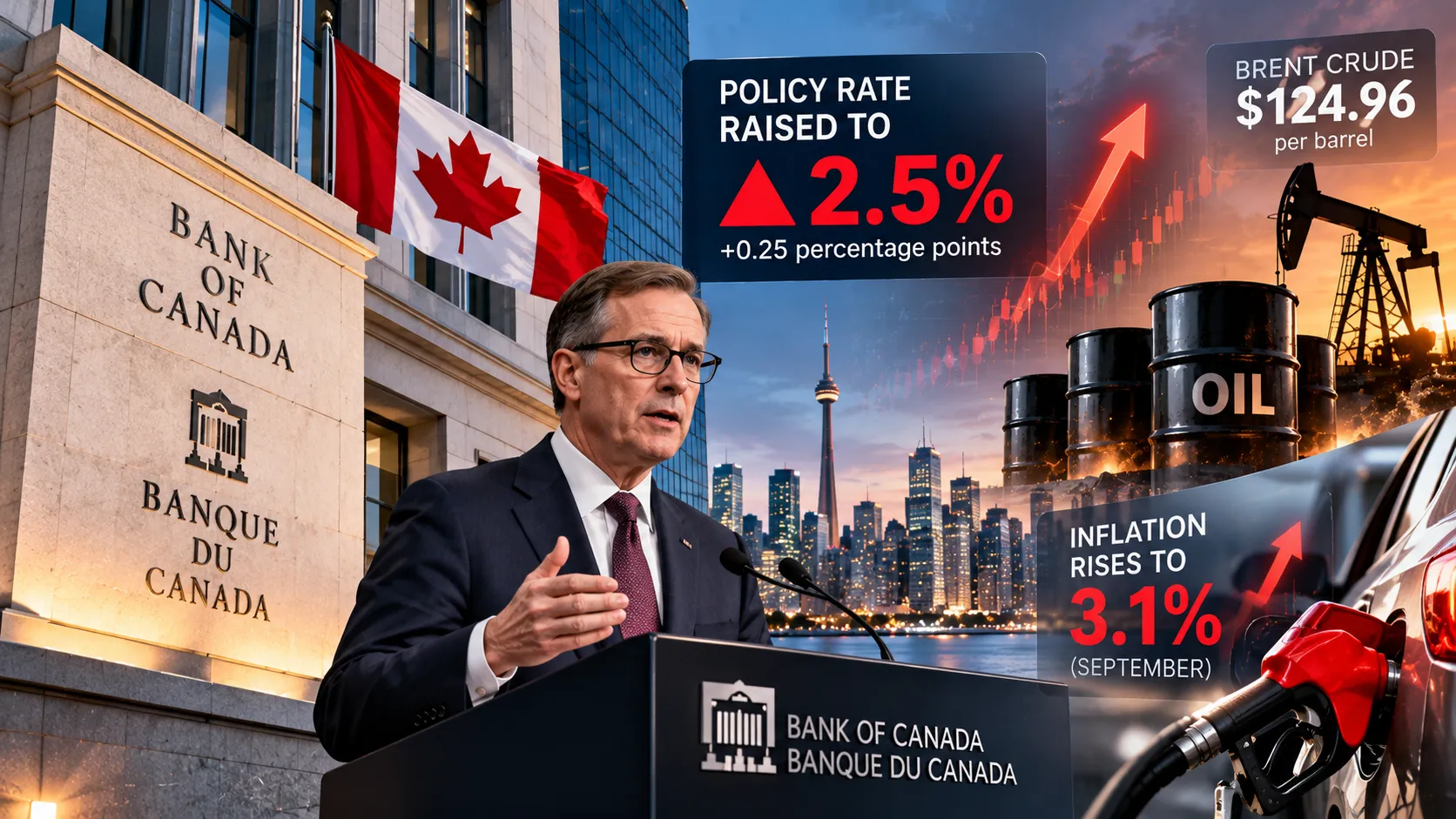
The Bank of Canada raised its policy rate by 0.25 percentage points to 2.5% on Wednesday, October 28, its first increase since July 2023, according to BNN Bloomberg. The decision was widely expected; a Reuters poll last week had projected the hike.
"With the outlook for inflation substantially higher and the economy showing resilience," Governor Tiff Macklem said, "an increase in the policy rate is needed to reduce the risk that elevated energy prices could spill over and become generalized inflation."
Why the bank acted
Energy prices are the main driver. Brent crude averaged $124.96 a barrel in October, about $35 more than in July, amid conflict in the Middle East, according to BNN Bloomberg. Inflation in Canada rose to 3.1% in September, above the bank's 2% target.
Macklem said the inflation outlook had "deteriorated" since the bank's July report. While energy costs have not yet spread broadly through the economy, the bank said cost pressures are building. Sixty per cent of consumer-facing businesses surveyed by the bank expect to pass higher costs on to customers within the next 12 months.
Excluding gasoline, inflation was more moderate at 2.2% in September, according to a preview by The Rio Times, showing how heavily energy is weighing on headline figures. Gasoline prices were up nearly 28% from a year earlier.
More hikes possible
Macklem left the door open to further increases. "There could be a need to raise the policy rate further, but given the uncertainties we will proceed carefully," he said.
Economists cited by Yahoo Finance argued that the hike would not be the last, as inflation expectations have risen among households and businesses.
A difficult economic picture
The bank's decision comes despite signs of a slowing economy. Growth reached 3.3% in the second quarter but is expected to slow to 2% in the third quarter, and further in the fourth quarter as new US tariffs weigh on activity. Unemployment has hovered around 6.5%, and the bank said it is harder than usual for unemployed people to find work.
The bank projects that the economy will contract in the coming months before rebounding in 2027. Raising rates into a slowing economy is a difficult choice, but the bank judged that the risk of entrenched inflation was greater.
Trade uncertainty
Uncertainty about Canada's trade relationship with the United States remains a key risk. Canada sends most of its exports to the US, and new tariffs have hurt industries from autos to steel. The outcome of trade negotiations will shape the economic outlook and the bank's policy path.
Diverging from the Fed
The Bank of Canada's hike came on the same day the US Federal Reserve held its rate steady at 3.75-4%, although two Fed officials voted for an increase. The divergence reflects differences in each country's economic conditions and inflation dynamics. Canada, as a net energy exporter, benefits from higher oil prices in some ways, but consumers still face higher fuel costs.
Impact on borrowers
Higher rates will raise borrowing costs for Canadian households, many of whom carry large mortgages after years of rising house prices. Variable-rate mortgage holders will feel the impact immediately, while those with fixed-rate mortgages will face higher payments when they renew.
The housing market, a major driver of the Canadian economy, could cool further as borrowing becomes more expensive.
What it means for India and the diaspora
Canada is home to one of the largest Indian diaspora communities in the world, including hundreds of thousands of Indian students and many recent immigrants. Higher interest rates affect the cost of housing, car loans and other borrowing for Indian families in Canada, at a time when living costs are already elevated.
Canada is also an important destination for Indian students, and the cost of living there influences decisions about where to study. Remittances from Canada to India could also be affected if household budgets come under pressure.
For global markets, rate hikes by major central banks contribute to tighter financial conditions, which can draw capital away from emerging markets such as India.
The global trend
The Bank of Canada joins a small group of central banks that have raised rates in response to the energy shock. The US Fed raised rates in September before pausing, while others, including the Reserve Bank of New Zealand, have chosen to hold. Central bankers face a difficult balance between preventing inflation from becoming entrenched and avoiding unnecessary damage to growth.
How Canada compares
The Bank of Canada's decision to raise rates sets it apart from many other central banks, which have held rates steady while assessing the impact of higher energy prices. Canada's economy is unusual because it is both a major oil producer and a heavy consumer of energy. Higher oil prices boost revenue for Canadian energy companies and the government, but they also raise costs for consumers and businesses, feeding into inflation.
Canadian households are also highly sensitive to interest rates because of high levels of mortgage debt. Many Canadian mortgages have shorter fixed-rate terms than in the United States, meaning that borrowers face higher payments sooner when rates rise. This makes the decision to hike particularly significant for households.
The housing market
Canada's housing market has been under pressure from high prices and affordability challenges for years. Rising interest rates could further cool the market, which some policymakers would welcome as a way to improve affordability, but which could also weigh on construction activity and household wealth. The Bank of Canada will watch the housing market closely as it assesses the impact of its decision.
What comes next
The Bank of Canada's next decision is in December. Its path will depend on energy prices, inflation expectations, wage growth and the impact of US tariffs. Investors will watch for signs that inflation is spreading beyond energy, which would increase the likelihood of further hikes. Economists will also watch for signs that higher borrowing costs are slowing consumer spending and business investment, which could eventually persuade the bank to pause. For now, the bank has signalled that controlling inflation is its priority, even at the cost of slower growth in the near term.