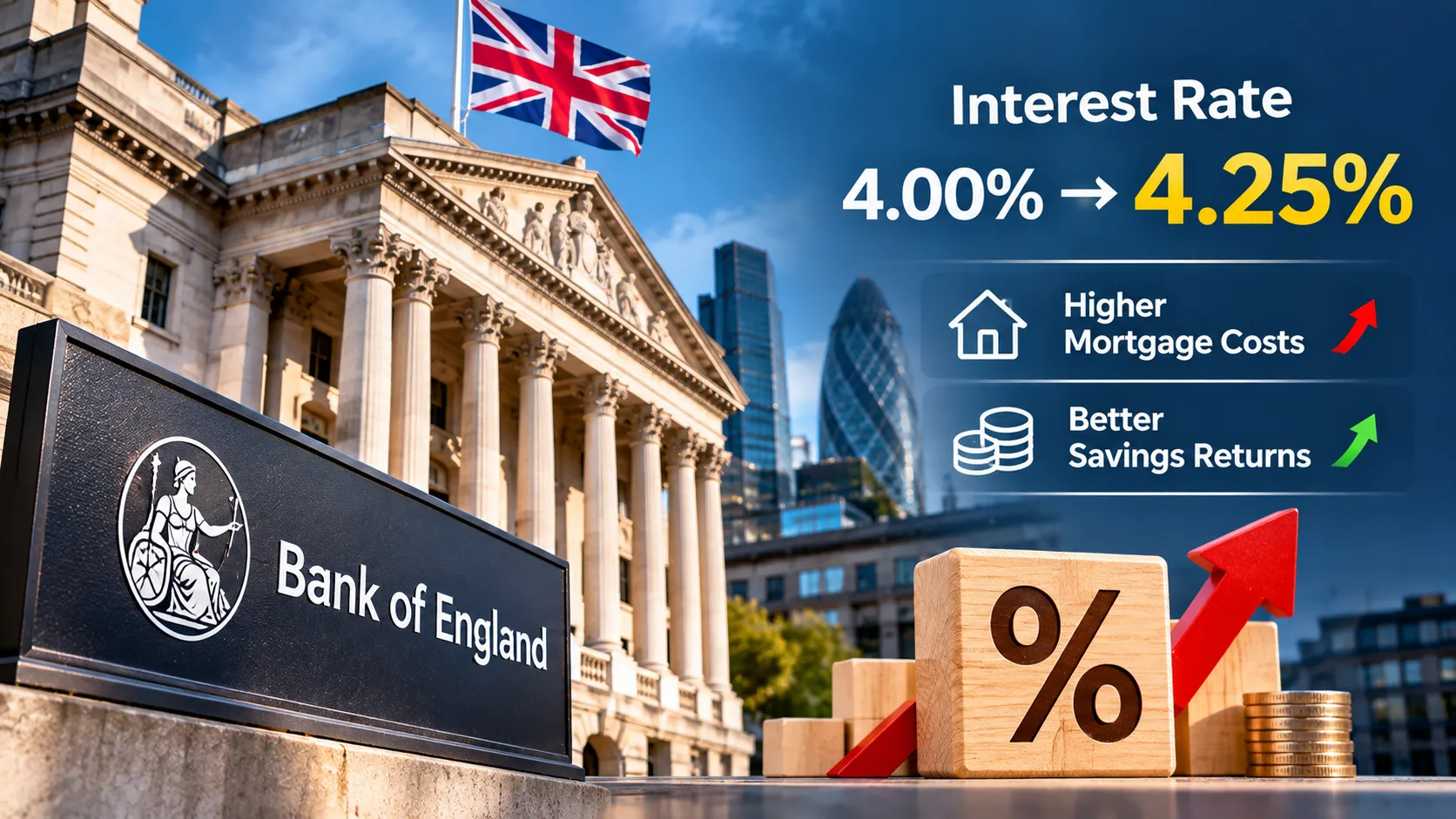
The Bank of England raised interest rates for the first time in more than three years on Thursday, November 5, reversing course after a long series of cuts as surging energy prices linked to the conflict involving Iran threaten to push British inflation sharply higher.
The central bank's Monetary Policy Committee voted 8-1 to raise the Bank Rate by 0.25 percentage points to 4% from 3.75%, according to MoneyWeek. Eight members supported the quarter-point increase, while one member voted for a larger half-point rise. The decision had been widely expected by economists.
The Bank forecast that consumer price inflation will climb to 5% by mid-2027, mainly because of higher energy prices, according to MoneyWeek. Inflation rose to 3.5% in the 12 months to September 2026, up from 3.1% in August, well above the Bank's 2% target.
Bailey signals caution
Governor Andrew Bailey sought to reassure households and businesses that the increase did not mark the start of an aggressive tightening campaign. "Today's increase shouldn't be seen as the first in an inevitable long sequence of hikes," he said, according to MoneyWeek.
However, Bailey also warned that further increases could follow if the conflict continues to drive up energy costs. He said that, unless the war is resolved, the increase does not "seem likely to be the last," according to the BBC, as reported by Yahoo Finance.
A reversal of policy
The rise marks a significant turn for the Bank of England, which had been cutting interest rates since 2024 as inflation fell from the peaks reached after Russia's invasion of Ukraine in 2022. The bank had lowered rates from a high of 5.25% as inflation returned towards its target.
But the conflict involving Iran has disrupted oil and gas supplies from the Middle East, driving up energy prices worldwide. For the United Kingdom, which imports much of its energy, higher prices feed quickly into household bills, transport costs and business expenses, pushing up inflation across the economy.
Economists divided on what comes next
Economists offered differing views on the outlook. "Unless energy prices start to retreat, further rate hikes will move from a risk to a real prospect," said Suren Thiru, chief economist at the Institute of Chartered Accountants in England and Wales, according to MoneyWeek.
Sanjay Raja, chief UK economist at Deutsche Bank, said "we don't think this is the start of a long hiking cycle." Oxford Economics forecast a further quarter-point rise to 4.25% in February 2027, according to MoneyWeek.
What it means for households
The increase will raise costs for borrowers with variable-rate mortgages. Moneyfacts estimates that a quarter-point rise adds about £37 a month to repayments on a £250,000 tracker mortgage over 25 years, according to MoneyWeek. Borrowers on tracker and standard variable rates will feel the change fastest.
Homeowners on fixed-rate deals will be affected only when their current deals end. Lenders had already priced in the increase, according to Nick Mendes, mortgage technical manager at broker John Charcol. "The increase had been expected for weeks and was already reflected in fixed mortgage pricing," he said. The average new mortgage rate is 5.89%, the highest since November 2023, according to MoneyWeek.
Savers, by contrast, could benefit from higher returns on their deposits.