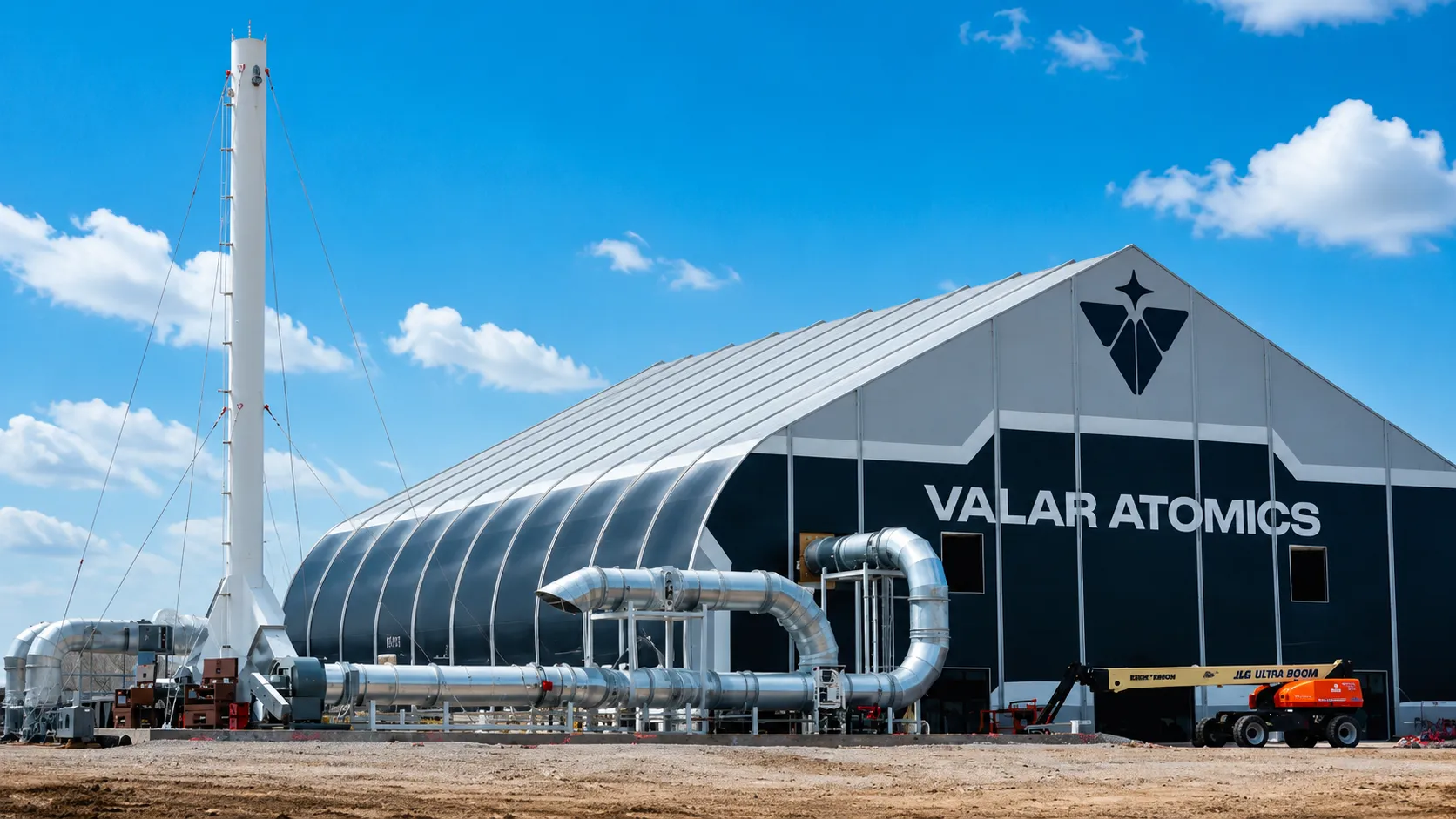
Battery-storage startup Base Power and nuclear-energy company Valar Atomics each closed funding rounds exceeding $1 billion within the same week, as part of a broader wave that saw five companies collectively raise more than $5.75 billion in the opening week of August 2026 — a concentration of capital that industry observers describe as a direct response to the electricity demands of the artificial intelligence boom. The near-simultaneous announcement of two billion-dollar-plus rounds in adjacent energy-infrastructure categories drew immediate attention from investors and policymakers alike, both tracking how quickly capital is now flowing toward solving the power constraints facing AI data-centre expansion.
The two mega-rounds, while backing companies pursuing distinct technological approaches, are understood by investors to represent complementary bets on the same underlying macro trend: the extraordinary and rapidly growing electricity consumption of AI data centres, which is increasingly outpacing the capacity of existing electrical grids to reliably supply. Base Power's distributed battery-storage technology addresses this challenge from a near-term, grid-stabilisation perspective, offering a way to smooth demand fluctuations and provide backup capacity without the multi-year lead times associated with new large-scale generation projects. The scale of both rounds also reflects a broader shift in how infrastructure-focused investors are underwriting risk within the energy-transition sector, increasingly willing to commit capital at a scale and pace historically associated with late-stage growth equity rather than the more incremental, milestone-based funding structures that characterised earlier waves of clean-energy venture investment. This acceleration in check size and deployment speed mirrors the urgency investors now attach to closing the electricity gap facing AI infrastructure operators. Valar Atomics, by contrast, is pursuing compact nuclear reactor technology aimed at providing always-on, carbon-free baseload power — a longer-horizon solution requiring substantially more capital and regulatory navigation, but one that investors evidently believe addresses a structural, rather than cyclical, gap in the electricity supply available to power-hungry AI infrastructure over the coming decade. That both companies secured billion-dollar-plus rounds within days of each other suggests investors are not choosing between these approaches but rather funding both simultaneously, treating distributed storage and next-generation nuclear generation as parallel infrastructure plays addressing the same underlying power-demand curve from different time horizons. The scale of capital deployed — over $5.75 billion across five companies in a single week, spanning defence manufacturing, nuclear energy and AI infrastructure according to industry trackers — illustrates the extent to which venture and growth-equity investors have reoriented around infrastructure-level bets in 2026, a marked shift from the software- and application-layer focus that characterised much of the previous decade's technology investment cycle.

The electricity-demand dynamics driving these investments are well documented across the energy and technology sectors. Training and running large-scale AI models requires enormous, continuous computational power, translating directly into electricity consumption at data centres that has grown at a pace few grid operators anticipated even a few years ago. This has created a supply-demand imbalance that utilities, grid operators and increasingly, private capital, are racing to address through a combination of new generation capacity, storage infrastructure and, in some markets, direct power-purchase arrangements between AI infrastructure operators and energy producers. For investors, the appeal of backing both battery storage and next-generation nuclear reflects a hedged approach to a genuinely uncertain question: which technologies will ultimately prove most capital-efficient and scalable in closing the AI-driven power gap. Battery storage offers faster deployment timelines and lower regulatory complexity but cannot, on its own, generate new baseload capacity. Nuclear technology offers the prospect of substantial, reliable, carbon-free generation but faces longer development timelines, significant capital intensity and jurisdiction-specific regulatory hurdles that have historically slowed nuclear project deployment across many markets. The scale of capital now flowing into power infrastructure also reflects a broader recognition among investors that the AI industry's next major competitive battleground may shift from model capability alone toward reliable access to affordable, abundant electricity. Several major AI infrastructure operators have already begun exploring direct investment in or long-term contracts with dedicated power-generation and storage providers, seeking to secure priority access to capacity in an environment where grid interconnection queues in many markets now stretch years into the future. This dynamic has elevated energy infrastructure companies from a peripheral consideration to a central strategic priority for AI infrastructure investors and operators alike. Compact, next-generation nuclear technology of the kind Valar Atomics is pursuing represents a particularly significant wager, given nuclear power's historical challenges around cost overruns, extended construction timelines and public acceptance concerns in various markets. Investors backing this billion-dollar round are evidently betting that newer, smaller-scale reactor designs can overcome many of the economic and deployment challenges that have constrained traditional large-scale nuclear projects, offering a more modular, potentially faster-to-deploy pathway to carbon-free baseload power specifically tailored to the concentrated, predictable demand profile of AI data centres.
As AI infrastructure buildout continues to accelerate globally, the parallel billion-dollar bets on Base Power and Valar Atomics offer a clear signal of where sophisticated infrastructure investors believe the next decade of value creation will be concentrated. Whether either company — or both — can execute at the pace and scale required to meaningfully close the electricity gap facing AI data centres will be closely watched by an investment community increasingly convinced that power infrastructure, rather than software alone, represents the next critical bottleneck in the AI value chain. For policymakers and grid operators, the scale of private capital now flowing into both distributed storage and next-generation nuclear generation also carries broader implications for national energy strategy, potentially accelerating decarbonisation timelines that public investment alone might have taken considerably longer to achieve — provided the substantial execution risks inherent in both categories can be successfully managed at the scale and speed investors are now underwriting. The coming eighteen months are likely to prove decisive for both companies, as early construction and deployment milestones will offer the first meaningful test of whether the extraordinary capital commitments made this week translate into the operational capacity the AI infrastructure sector urgently requires. Industry analysts tracking the AI infrastructure investment cycle suggest that further billion-dollar rounds across adjacent energy categories, including grid modernisation and transmission infrastructure, are likely in the months ahead as investors continue to identify power availability as the defining constraint on AI's next phase of growth.