Beyond Appliances, a Bengaluru-based maker of kitchen chimneys and cooktops, has raised ₹110 crore in a Series B funding round led by consumer-focused investor Fireside Ventures, as it moves to build more of its products in-house and widen a range designed around the way Indian households actually cook.
Dharana Capital and other investors also participated in the round, announced on 6 October. The company said it would use the capital for research and development, a new manufacturing plant, entry into new product categories within the kitchen appliances space and strengthening its existing portfolio.
The raise is notable for its size relative to the company's age. Beyond Appliances was founded only in 2024, which puts it among the faster-moving consumer hardware brands to reach a Series B in a market where many investors have favoured asset-light digital businesses over companies that need factories.
Designed for tadka, not for a showroom
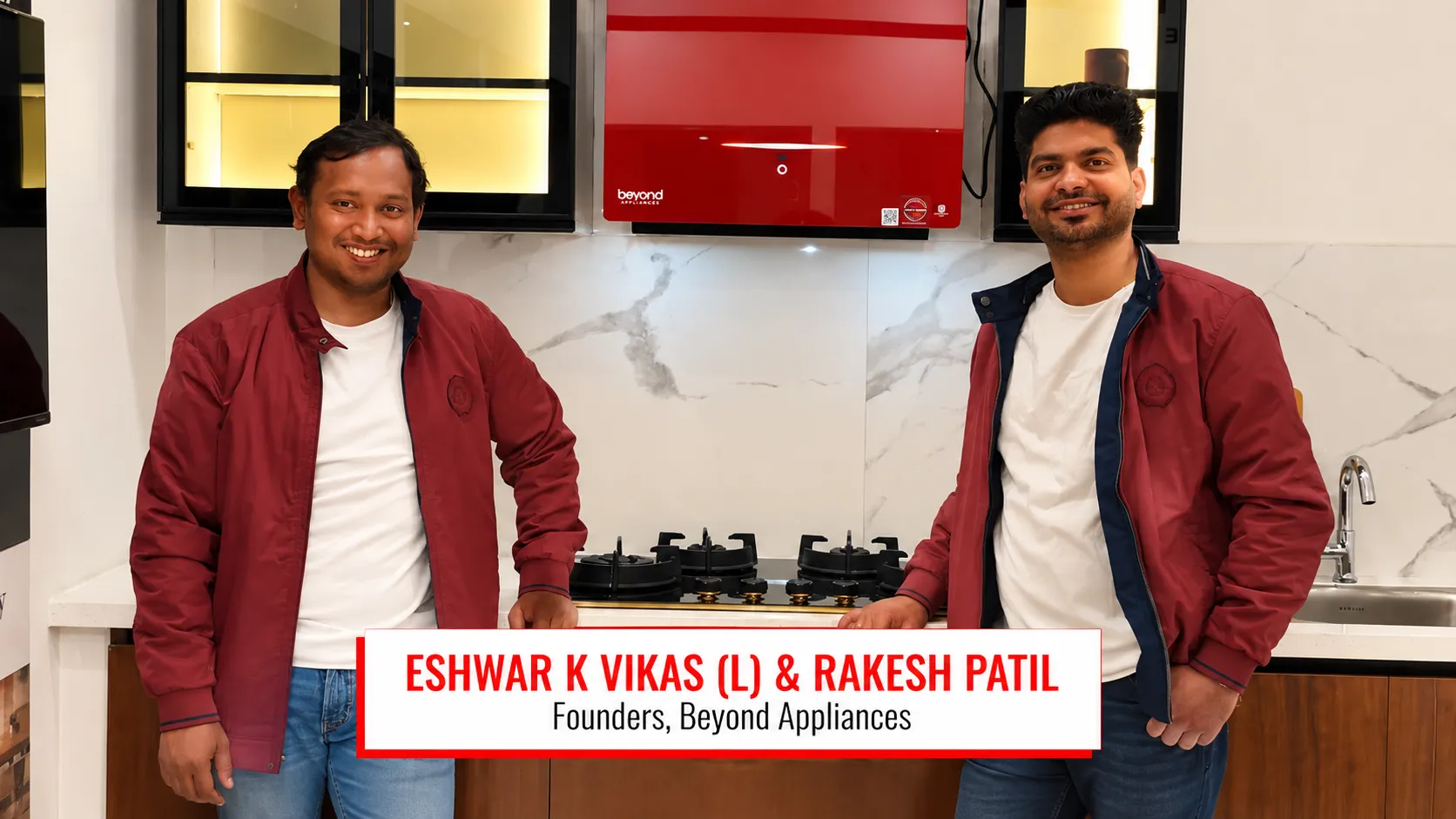
The company was co-founded by Eshwar K Vikas, its chief executive, and Rakesh Patil, its chief technology officer. Its portfolio currently spans Android chimneys, Plug-N-Play chimneys, smart hobs and cooktops, categories where Indian buyers have long chosen between multinational brands adapted from overseas designs and low-cost unbranded products.
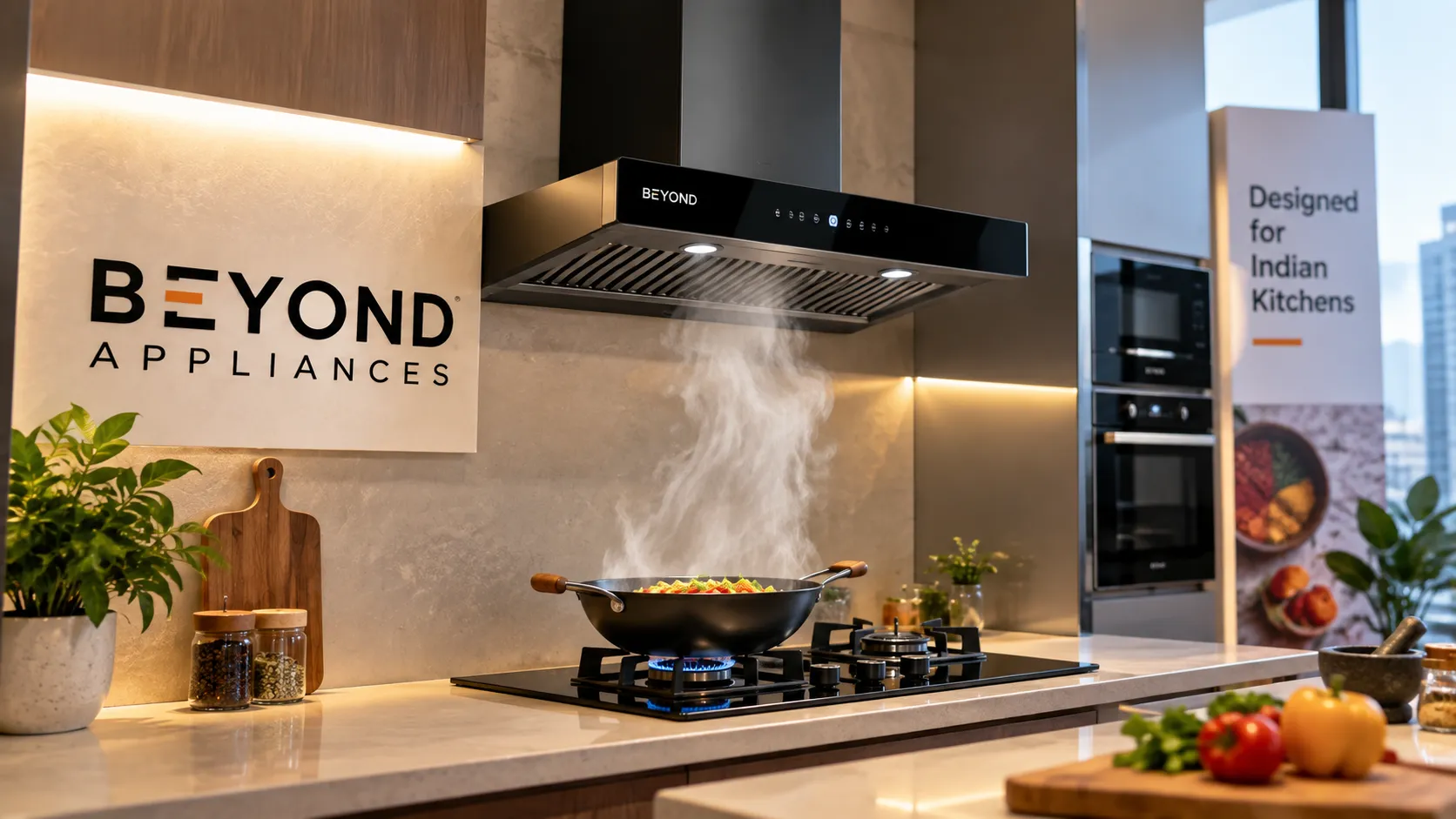
The founders' argument is that neither option was built for Indian kitchens, where high-heat tempering, heavy oil and spice use, and smaller cooking spaces create specific demands on extraction and burner performance. "The next big shift will come from building products that are technologically advanced but fundamentally designed around how Indian households cook and live," Vikas said.
Patil framed the R&D effort in similar terms. "Our R&D teams have worked closely with consumers to identify everyday challenges in Indian kitchens," he said. The new money is intended to deepen that work and turn it into a wider product range.
One measure of early product fit is word of mouth. The company said about 15 per cent of its revenue now comes through customer referrals, an unusually high share for a durable-goods brand, where purchases are infrequent and buyers typically rely on retailer advice or brand familiarity.
The product names hint at the company's thesis. An Android-powered chimney brings a touch interface and software controls to an appliance that has traditionally been operated by a row of push buttons, while Plug-N-Play models are aimed at reducing the installation friction that often accompanies buying a chimney, from ducting to wall mounting. Smart hobs extend the same logic to the cooking surface itself. Each is an attempt to compete on usability and engineering rather than on price alone.
That is a deliberate choice in a category crowded with established names. Indian buyers shopping for a chimney or hob can choose from long-standing specialists, large domestic consumer-durables groups and international brands, many of them with deep dealer networks and service infrastructure built over decades. A newcomer has to give consumers a reason to switch, and Beyond Appliances is betting that reason will be products that feel designed for Indian cooking rather than adapted to it.
From one factory to a national footprint
Beyond Appliances already operates a manufacturing facility in Bengaluru. The planned new plant signals a decision to keep production, and the quality control that comes with it, under its own roof rather than relying entirely on contract manufacturers, a path many young consumer-hardware brands take to conserve capital.
The company's retail presence currently covers Delhi, Mumbai, Bengaluru and Hyderabad. It plans to expand into 10 additional cities over the next three years, taking its products beyond the largest metros into markets where modular kitchens and branded appliances are gaining ground as incomes rise and housing stock is renewed.
For Fireside Ventures, one of India's most active consumer brand investors, the attraction appears to be the company's operating discipline as much as its product. "Very few early-stage brands demonstrate the depth of fundamentals that Beyond Appliances has built," said Shuchi Pandya of Fireside Ventures.
The round fits a broader pattern in Indian consumer investing. After several years in which venture capital chased fast-scaling direct-to-consumer brands in categories such as beauty and apparel, investors have become more selective, favouring companies with defensible products, clear unit economics and some control over manufacturing.
Fireside Ventures has built its reputation backing consumer brands early and staying with them as they scale; it was among the early investors in Mamaearth, whose parent Honasa Consumer is now listed. Its decision to lead a Series B in a hardware business, rather than in the personal-care and food categories where many consumer funds concentrate, suggests investors see room for new Indian brands in durables as well as in fast-moving consumer goods.
Owning manufacturing also gives the company more control over cost, design cycles and quality, three factors that weigh heavily in a category where a faulty motor or a poorly sealed filter quickly turns into a service complaint and a lost referral. It is a heavier model to finance, which helps explain the size of the round.
A market primed for premiumisation
Kitchen appliances sit at the intersection of several trends reshaping Indian consumption: the spread of modular kitchens in new apartments, rising household incomes in Tier 2 cities, and a willingness among younger buyers to pay more for products that combine design, connectivity and durability. Chimneys and built-in hobs, once confined to premium homes, are increasingly standard fittings in new urban housing.
Kitchen appliances also tend to be bought at moments of high emotional and financial commitment, when a family moves into a new home or renovates an old one. That makes them sensitive to the health of the housing market and to the availability of consumer credit, including the no-cost EMI schemes that have become a fixture of Indian electronics and appliance retail. A brand that can tie itself into those purchase moments, through builders, interior designers and modular-kitchen installers, can win customers before they ever reach a showroom.
That growth has drawn intense competition, from established multinational and Indian appliance makers to a wave of digital-first challengers. Beyond Appliances will need to prove that a product-led, India-specific design approach can hold its ground on price, after-sales service and distribution against companies with far larger balance sheets.
The ₹110 crore round gives it the means to try. If the new plant, the R&D programme and the 10-city expansion go to plan, the company will have built a full-stack consumer hardware business in under five years, a rare outcome in a sector where scale has traditionally belonged to incumbents.