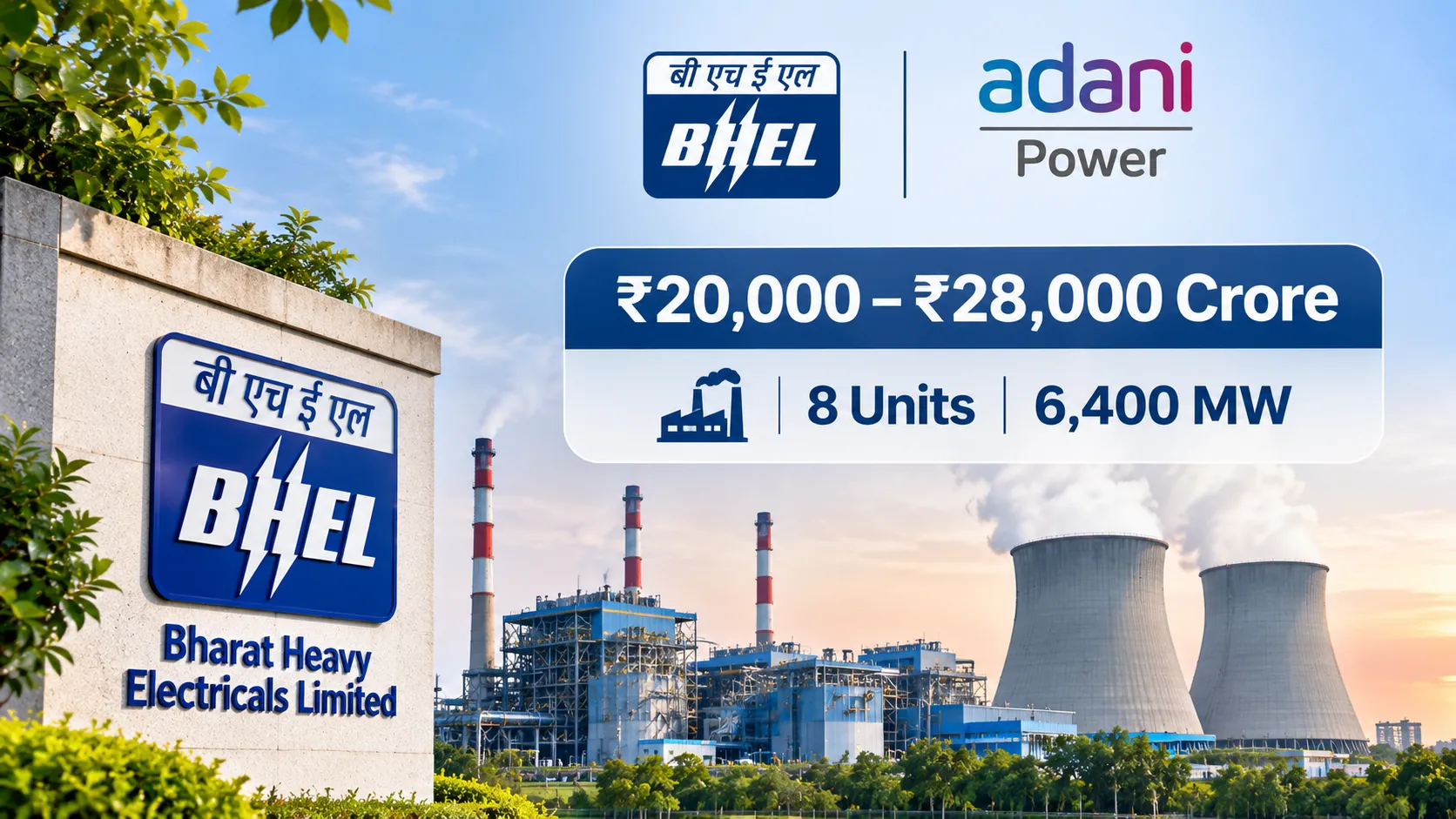
Bharat Heavy Electricals Ltd (BHEL), India's largest state-owned power equipment maker, has won orders worth between ₹20,000 crore and ₹28,000 crore from Adani Power. The contracts are among the largest the company has received this year and give a sharp lift to its order inflows after a slow September quarter.
In a regulatory filing on Wednesday, November 4, BHEL said it had received orders from Adani Power for four thermal power projects, each with two 800 MW units. Each project is valued at between ₹5,000 crore and ₹7,000 crore, excluding GST. In total, the four projects add up to eight units and 6,400 MW of generating capacity.
BHEL's shares rose about 6% in intraday trading after the announcement, touching a high of about ₹425 on the National Stock Exchange.
What the orders cover
The contracts cover the supply of the main equipment for the power plants, including boilers, turbines and generators, along with auxiliaries and agreed services. These are the core components of a coal-fired power station. The boiler produces steam, the steam drives the turbine, and the generator turns that motion into electricity.
BHEL said the orders are not related-party transactions. Adani Power and its promoters have no interest in BHEL or its promoter group. Work on the projects will follow Adani Power's construction schedule.
BHEL did not disclose the locations of the four projects in its filing.
A boost after a slow quarter
The orders arrive at an important time for BHEL. The company received orders worth only about ₹4,000 crore in the September quarter of FY27, far below the ₹26,700 crore it won in the June quarter and about ₹30,000 crore in the March quarter of FY26.
The new Adani Power contracts could therefore more than make up for the weak second quarter and put the company on track for strong inflows in the second half of the financial year.
BHEL's order book already stood at more than ₹2.57 lakh crore before the latest wins. That backlog gives it significant revenue visibility for several years.
Adani Power's expansion
Adani Power, part of the Adani Group, is India's largest private thermal power producer. It operates installed thermal capacity of about 18,110 MW across 12 plants in Gujarat, Maharashtra, Karnataka, Rajasthan, Chhattisgarh, Madhya Pradesh, Jharkhand and Tamil Nadu. It also runs a 40 MW solar plant in Gujarat.
The company has been expanding rapidly, both through new projects and by acquiring stressed power assets. The new orders with BHEL are part of its plans to add significant new capacity over the coming years.
Adani Power has been one of BHEL's most important private-sector customers. In earlier years, it placed orders for twelve 800 MW units with BHEL, making it a major contributor to the equipment maker's order book.
Why India is still building coal plants
The orders reflect a central feature of India's energy policy. Even as the country rapidly expands solar and wind capacity, it continues to build new coal-fired power stations to meet rising electricity demand and ensure reliable supply.
India's electricity demand has been growing strongly, driven by economic growth, urbanisation, the spread of air conditioning and the electrification of more activities. Peak demand has repeatedly reached record levels in recent years.
Renewable energy is variable. Solar plants produce no power at night, and wind output fluctuates. Until battery storage and other technologies can fully balance the grid, India is relying on thermal power to provide steady baseload and meet peaks. The government has set a target of adding significant new thermal capacity by the early 2030s.
BHEL's position in the thermal market
BHEL is the dominant domestic supplier of equipment for large thermal power plants. In recent years it has often been the only bidder for many thermal power tenders, giving it a strong position as India's new wave of coal plant construction gets under way.
That position has helped the company recover from a difficult period in the late 2010s, when thermal power orders slowed sharply and BHEL's revenue and profits came under pressure. The revival of thermal power investment has restored its order flow.
Analysts have noted that BHEL has been more selective in accepting thermal orders, because of past execution challenges. Large power projects are complex and can face delays from land acquisition, financing, supply chain issues and other factors. Delays can squeeze margins and tie up working capital.
Earnings momentum
The orders follow strong September-quarter earnings from BHEL. The company's results exceeded expectations, prompting some brokerages to raise their earnings estimates. IIFL Institutional Equities, for example, raised its estimates for the next two years by around 20% to 25%.
Execution will be the key factor for BHEL's profitability. With a large order book, the company's challenge is to convert orders into revenue efficiently and on schedule. Improvements in execution have been one of the main reasons for its better recent performance.
Climate considerations
The continued construction of coal plants raises questions about India's climate commitments. India has pledged to reach net-zero emissions by 2070 and to meet a large share of its electricity needs from non-fossil sources by 2030.
The government argues that India, as a developing country with relatively low per capita emissions, needs to ensure energy security and affordable electricity while it builds renewable capacity. New coal plants use supercritical and ultra-supercritical technology, which is more efficient and produces fewer emissions per unit of electricity than older plants.
Critics argue that new coal plants risk locking in emissions for decades and could become stranded assets as renewable energy and storage become cheaper. That debate is likely to intensify as India prepares for further international climate negotiations, including COP31 later this month.
Diversification beyond thermal
BHEL has been working to diversify its business beyond thermal power equipment. It has expanded into areas such as railways, defence, renewable energy equipment and transmission. Analysts expect order inflows in the second half of FY27 to be supported by opportunities in railways and other segments.
Diversification is important for BHEL's long-term prospects. While thermal power orders are strong now, the long-term trend in India's energy mix is towards renewables. A broader business base would help the company manage that transition.
What it means for investors
For investors in Indian capital goods and power-sector stocks, the Adani Power orders reinforce the strength of the current investment cycle in thermal power. BHEL's large order book provides visibility, and its improving execution has supported earnings.
The main risks are execution delays, cost overruns and longer-term questions about demand for thermal power equipment as India's energy mix shifts. For now, though, the new orders confirm BHEL's central role in one of India's biggest infrastructure build-outs.


