The world's largest technology companies are about to show investors whether their enormous bets on artificial intelligence are generating returns, in an earnings week that could set the tone for global markets through the end of the year.
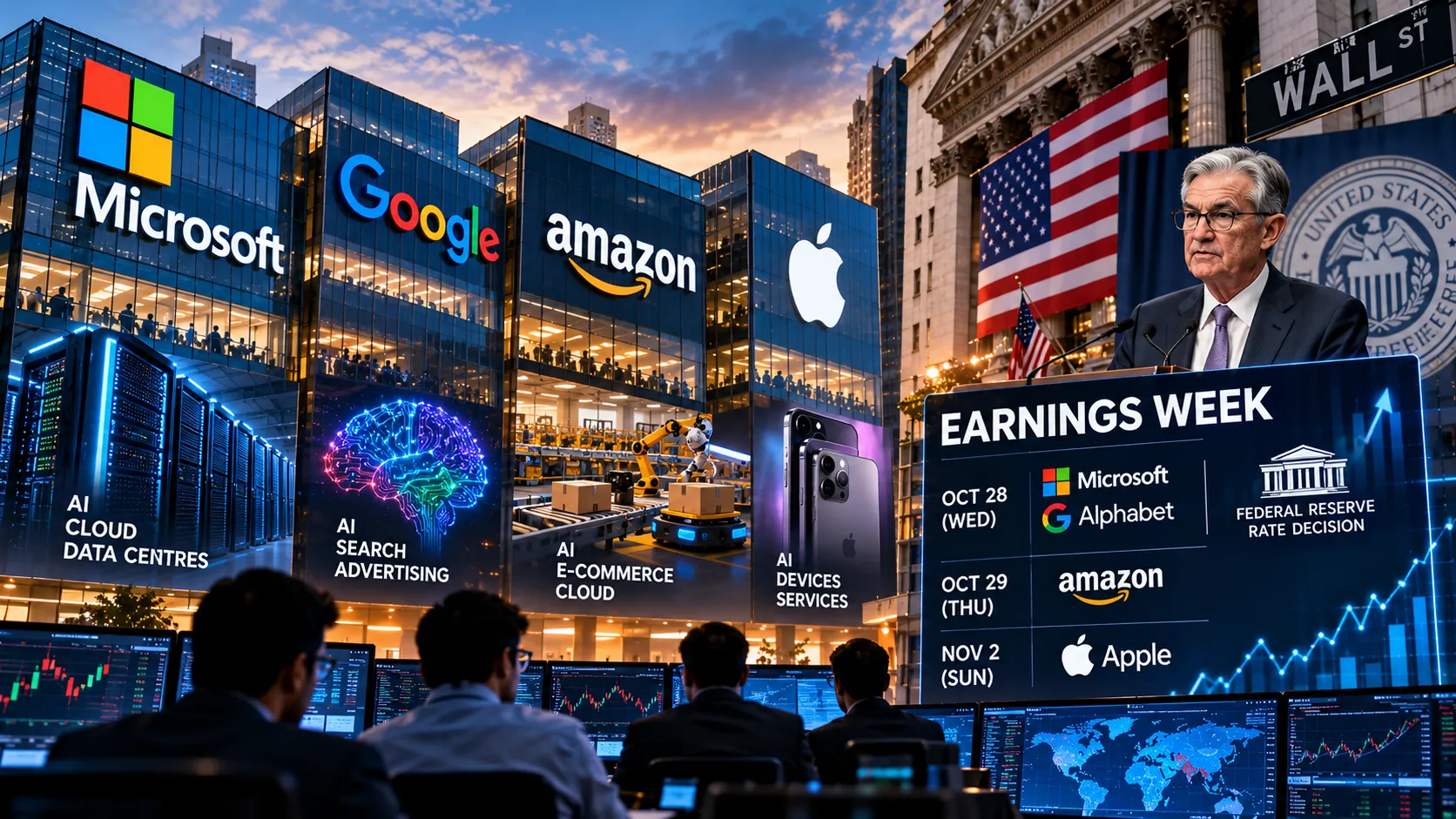
Microsoft and Alphabet, Google's parent company, report quarterly results after the US market closes on Wednesday, October 28, the same day the Federal Reserve announces its interest rate decision. Amazon reports on Thursday, October 29, the busiest day of the week, with 202 companies scheduled to report, according to an earnings calendar compiled by StockTitan. Apple reports separately on November 2.
The bar for Microsoft
In July, Microsoft forecast revenue of $89.85 billion to $90.95 billion for the quarter, and growth in its Azure cloud computing business of about 45% at constant exchange rates. Azure is the main channel through which Microsoft sells AI computing services, including access to models from OpenAI, and its growth is closely watched as a measure of AI demand.
Microsoft has been one of the largest spenders on AI infrastructure, investing tens of billions of dollars a quarter in data centres and chips. Investors will look for evidence that revenue growth justifies that spending.
Alphabet's cloud surge
Alphabet does not provide quarterly guidance, but expectations are high after Google Cloud revenue grew 82% to $24.8 billion in the previous quarter. Alphabet's earnings per share last quarter were boosted by gains on investments, making them a less reliable guide to underlying performance.
Google has been integrating AI across its search, advertising, cloud and consumer products, and investors will watch whether AI features are strengthening its core search business or cannibalising it.
Amazon's outlook
Amazon forecast net sales of $197 billion to $202 billion for the quarter in July. Amazon Web Services, the world's largest cloud computing provider, is the company's most profitable business and a key battleground in the AI race. Consensus estimates call for earnings per share of $2.01, up from $1.95 a year earlier.
A packed calendar
The week is full of other major reports. Verizon reports on Monday. Coca-Cola, Boeing, UPS, S&P Global and Hilton report on Tuesday morning, followed by Visa, Seagate, Robinhood and NXP after the close.
On Wednesday, GE Vernova, Phillips 66 and Boston Scientific report before the open, with T-Mobile, ServiceNow and Fortinet joining Microsoft and Alphabet after the close.
Thursday brings Eli Lilly, Mastercard, Merck, Caterpillar and Shell before the open, and Amazon, Intel, Sandisk, Starbucks and Gilead after the close. ExxonMobil, Chevron and AbbVie report on Friday, along with European companies AstraZeneca, BP and Sanofi.
Energy companies' windfall
Oil companies are expected to report sharply higher profits as crude prices have surged. Consensus estimates for ExxonMobil's earnings per share are about $3.96, roughly double the $1.88 a year earlier. Chevron's are about $4.78, up from $1.85, and Phillips 66's about $12.02, up from $2.52, reflecting soaring refining margins.
AI doubts in the background
The earnings come amid growing questions about AI investment. Apollo's chief economist, Torsten Slok, argued in a note reported on October 25 that AI has delivered "zero financial payoff" to corporate America outside technology. Elon Musk said SpaceX closed $40 billion of debt for GPUs but warned that most smaller AI cloud providers will fail as debt markets tighten. South Korea's Kospi, heavily exposed to AI memory chips, has fallen more than 35% from its June peak.
Strong results from Microsoft, Alphabet and Amazon, particularly in cloud and AI revenue, could ease those concerns. Disappointing numbers or signs of slowing demand could intensify the sell-off in AI-related stocks globally.
Chip makers in focus
Results from Intel, Seagate, NXP and Sandisk will offer insight into the semiconductor and storage markets. Sandisk's consensus earnings estimate of $45.22 per share, compared with $0.90 a year earlier, reflects the surge in memory and storage prices driven by AI demand. SK hynix also reports in South Korea on Wednesday.
What it means for India
The results matter for India in several ways. Microsoft, Alphabet and Amazon are major investors in Indian data centres and cloud infrastructure, and their spending plans influence investment in India. They are also important clients and partners for Indian IT services companies, whose growth depends on technology spending by global companies.
Infosys cut its revenue growth guidance last week, citing client demands for productivity gains. Commentary from big technology companies about AI adoption and enterprise spending will be closely watched by Indian IT investors.
The Fed overlap
The coincidence of Microsoft and Alphabet results with the Federal Reserve's decision on Wednesday adds to the potential for volatility. The Fed is expected to keep rates at 3.75-4.00%, but its signals on future policy, combined with the tech results, could move markets significantly.
What investors will be listening for
Beyond headline numbers, investors will focus on several key metrics. For Microsoft, Alphabet and Amazon, capital expenditure plans for the coming year will indicate whether the AI investment boom is accelerating or levelling off. Cloud revenue growth rates will show whether demand for AI computing is keeping pace with capacity. Commentary on AI monetisation, including how many customers are paying for AI products and at what prices, will be scrutinised for signs that spending is translating into revenue.
Profit margins are also in focus. Heavy spending on data centres raises depreciation costs, which can weigh on margins in future years. Investors want to see that revenue growth will outpace those rising costs.
What comes next
By the end of the week, investors will have a much clearer picture of the health of the AI boom and the broader US economy. Apple's results on November 2 will round out the reporting from the biggest technology companies.
For global markets, including India, the outcome could determine whether the recent retreat from AI-related stocks deepens or reverses as the year draws to a close. For Indian investors, the results will also influence the performance of Nasdaq-linked mutual funds and international fund-of-funds that have become popular as a way to gain exposure to US technology stocks. Strong results could lift those funds, while disappointments could add to losses. Currency movements matter too, since a weaker rupee increases the rupee value of overseas holdings. Market regulators have capped industry-wide overseas investment by mutual funds, which has limited the availability of some international schemes for new investors.