
FundingLatest Deals5 MIN READ

Blackstone Set to Take a 15% Stake in IIFL Finance for About ₹5,000 Crore as Part of a ₹6,200 Crore Capital Infusion

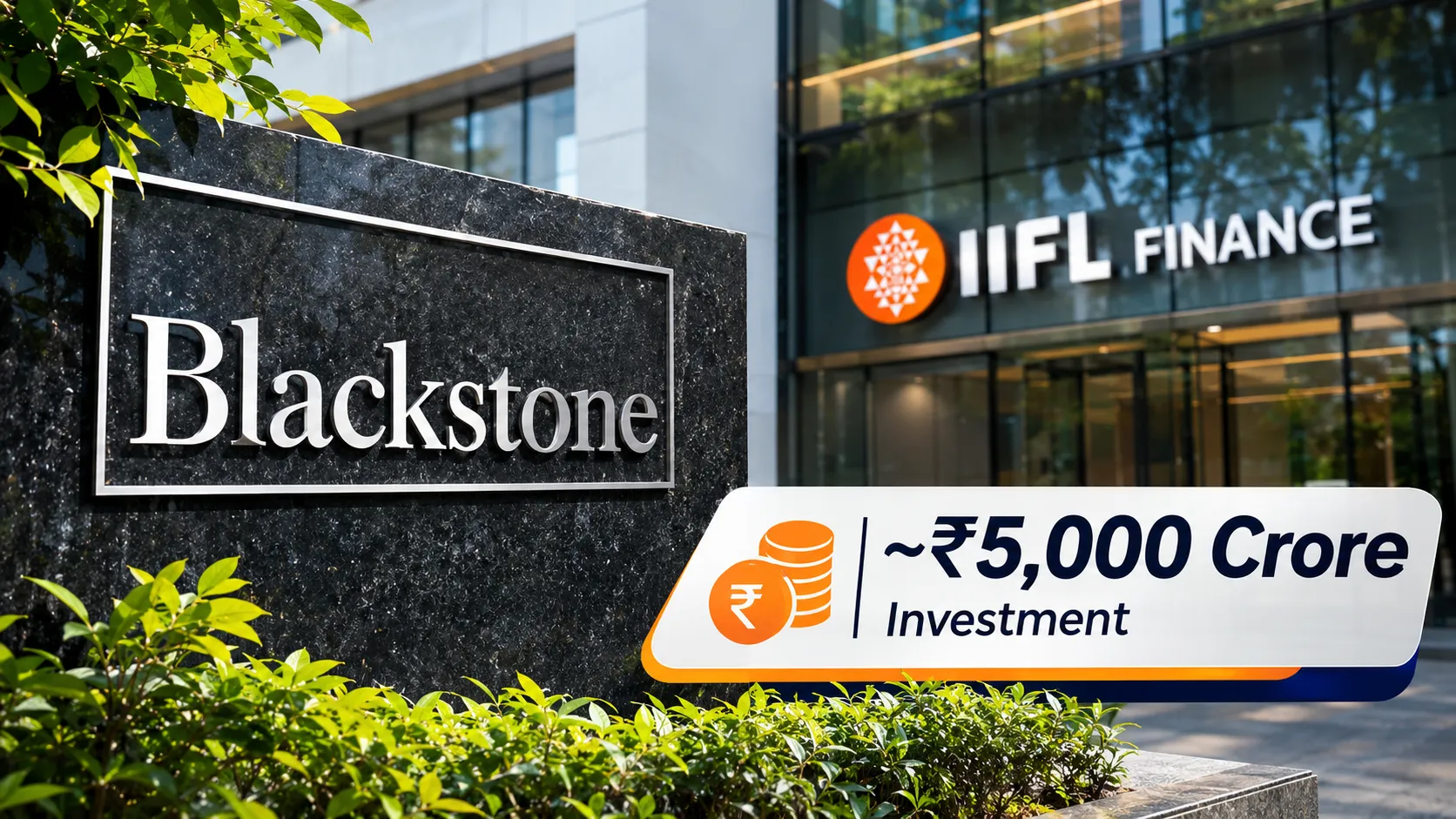
Blackstone is set to invest about ₹5,000 crore for a 15% stake in IIFL Finance, part of a capital infusion of more than ₹6,200 crore that would also include ₹1,200 crore from promoters Nirmal Jain and R Venkataraman, according to reports on November 9 and 10. The board of the gold and retail lender met on November 10 to consider the fundraise.

By Shaym Kumar · Author12 November 2026New
Blackstone Set to Take a 15% Stake in IIFL Finance for About ₹5,000 Crore as Part of a ₹6,200 Crore Capital Infusion

Blackstone, the world's largest alternative asset manager, is poised to make one of its biggest bets on Indian financial services, with a planned investment of about ₹5,000 crore in non-bank lender IIFL Finance, according to reports.

Blackstone is set to invest roughly ₹5,000 crore for a 15% stake in IIFL Finance, Business Standard reported on November 10, citing The Economic Times. The investment is part of a broader capital infusion of more than ₹6,200 crore, and Blackstone would receive a seat on IIFL Finance's board.

IIFL Finance's board met on Tuesday, November 10, to consider the fundraise, and the deal was expected to be announced that day, according to Business Standard. The final investor, valuation and structure had not been officially confirmed as of the reports.

How the deal would work

Blackstone would subscribe to compulsorily convertible preference shares (CCPS), which convert into equity at a later date, according to Business Standard. The company's promoters, Nirmal Jain and R Venkataraman, would invest ₹1,200 crore through warrants, aiming to maintain a combined stake of about 25%. Rohit Kothari's Anchorage Capital would contribute about ₹100 crore.

Advent International, TPG and Temasek had also considered investing, according to Business Standard. Lapaas Voice reported, citing Moneycontrol, that talks began in September and that Advent had also submitted a proposal.
e17b5f22-5ed3-457e-8c54-840a095d98b4.png

Strengthening the balance sheet

The capital infusion is expected to raise IIFL Finance's capital adequacy ratio by about 5 percentage points to 28%, according to Business Standard. Moneycontrol estimates cited by Lapaas Voice put post-deal capital adequacy near 30%, with Tier-1 capital close to 25%. The company's capital adequacy ratio was 23.5% at the end of September.

Stronger capital could improve IIFL Finance's credit rating and reduce its borrowing costs by 100 to 150 basis points, according to Business Standard. For a lender, lower borrowing costs translate directly into better profit margins or the ability to offer more competitive interest rates.

A strong quarter

IIFL Finance's assets under management grew 38% year-on-year to ₹1.24 lakh crore at the end of the September quarter. Profit after tax rose 93% to ₹805 crore, and net revenue was ₹2,340 crore, according to Lapaas Voice. The gross non-performing asset ratio improved to 1.5% from 2.1%, and about 90% of its assets under management are secured loans.

A recovery from regulatory trouble

The investment marks a turnaround for IIFL Finance. In March 2024, the Reserve Bank of India barred the company from sanctioning or disbursing new gold loans after identifying material concerns in its gold loan portfolio, including deviations in how gold was assayed and loans were valued. The restrictions were lifted later that year after the company addressed the regulator's concerns.

IIFL Finance last raised capital in May 2024, through a ₹1,272 crore rights issue, after the RBI's scrutiny, according to Business Standard.

Gold loans are one of IIFL Finance's core businesses, alongside home loans, small business loans and microfinance. High gold prices have boosted demand for gold loans, as borrowers can raise more money against the same quantity of gold.

The Fairfax angle

The deal also involves a major existing shareholder. Fairfax Financial Holdings, the Canadian group led by Prem Watsa, holds about 13.7% of IIFL Finance and is set to exit by selling its stake, according to Business Standard. The exit is linked to Fairfax's acquisition of a majority stake in IDBI Bank under the government's disinvestment programme.


“Blackstone's bet on IIFL is a vote of confidence in a lender that has rebuilt itself after regulatory turbulence.”
— TIGI Markets Desk

Fairfax will keep a board nominee after the Blackstone transaction until its eventual exit, according to Business Standard. Because the Blackstone investment is a primary infusion of new capital, Fairfax's existing shares would not automatically be sold as part of the deal, Lapaas Voice noted.

Blackstone's India financial services push

Blackstone has been steadily expanding its exposure to Indian financial services. In October 2025, it announced a ₹6,196.5 crore investment in Federal Bank for up to 9.99%, according to Business Standard. It is also the controlling shareholder and promoter of Aadhar Housing Finance, with a 65% stake.

The firm, which manages about $1.4 trillion in assets globally, is one of the largest foreign investors in India, with investments in real estate, infrastructure, technology and financial services.

Why global investors want Indian lenders

Foreign investors have shown strong interest in Indian lenders, attracted by the country's rapid credit growth, rising financial inclusion and large underserved markets for small business loans, housing finance and consumer credit. Several large deals have been struck in recent years, including investments in banks and non-bank lenders by Japanese, Middle Eastern and American investors.

India's non-bank financial companies play a crucial role in lending to small businesses, self-employed borrowers and households that banks often do not serve.

Risks and regulation

Investing in Indian lenders carries risks, including regulatory changes, asset quality pressures and competition from banks and fintech companies. The RBI has tightened oversight of non-bank lenders in recent years, including on gold loans, unsecured lending and fintech partnerships. IIFL Finance's experience in 2024 is a reminder of how regulatory action can affect a lender's business.

Gold loans in focus

Gold loans have become one of the fastest-growing segments of Indian lending. Borrowers pledge gold jewellery as collateral, allowing them to access credit quickly without extensive documentation. The segment is popular among small businesses, farmers and households in need of short-term funds. Record gold prices have increased the value of collateral, allowing lenders to grow their gold loan books rapidly.

The RBI has issued new guidelines to standardise practices in gold lending, including on loan-to-value ratios, valuation of gold and auction processes, to protect borrowers and ensure lenders manage risks properly.

The promoter perspective

For IIFL Finance's founders, Nirmal Jain and R Venkataraman, the deal offers a way to raise substantial capital while maintaining a significant stake. Their planned investment of ₹1,200 crore through warrants signals their confidence in the company's prospects and helps limit dilution. The IIFL group, which Jain founded, has grown into a diversified financial services group spanning lending, wealth management and capital markets.

A strong institutional investor such as Blackstone, with a board seat, could also bring governance expertise and strategic support as the company grows.

What comes next

If the deal is confirmed, it will require approvals from shareholders and regulators. Investors will watch for the final terms, including the conversion price of the preference shares and the warrants issued to promoters. The infusion would give IIFL Finance substantial capital to expand its lending, and could further boost confidence in a company that has recovered strongly from its regulatory setback.

TagsBlackstoneIIFL FinanceNirmal JainR VenkataramanNBFCgold loansprivate equityFairfax FinancialPrem WatsaIDBI Bankcapital adequacyAdvent InternationalFederal BankAadhar Housing FinanceIndian financial servicesretail lendingRBIcredit ratingforeign investmentinvestors

Reader reviews

Sign in to rate and review this article.
Loading reviews…
