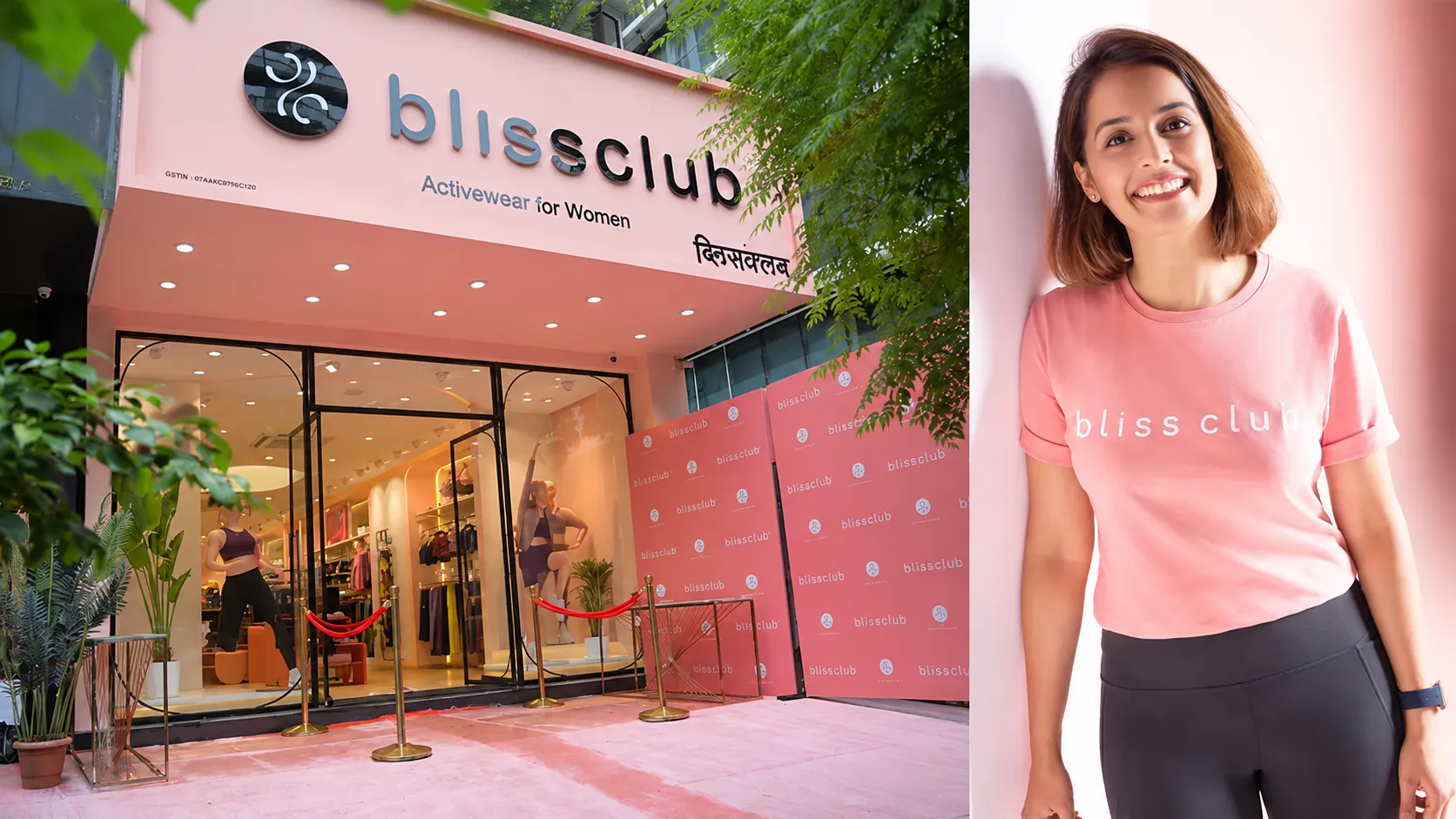
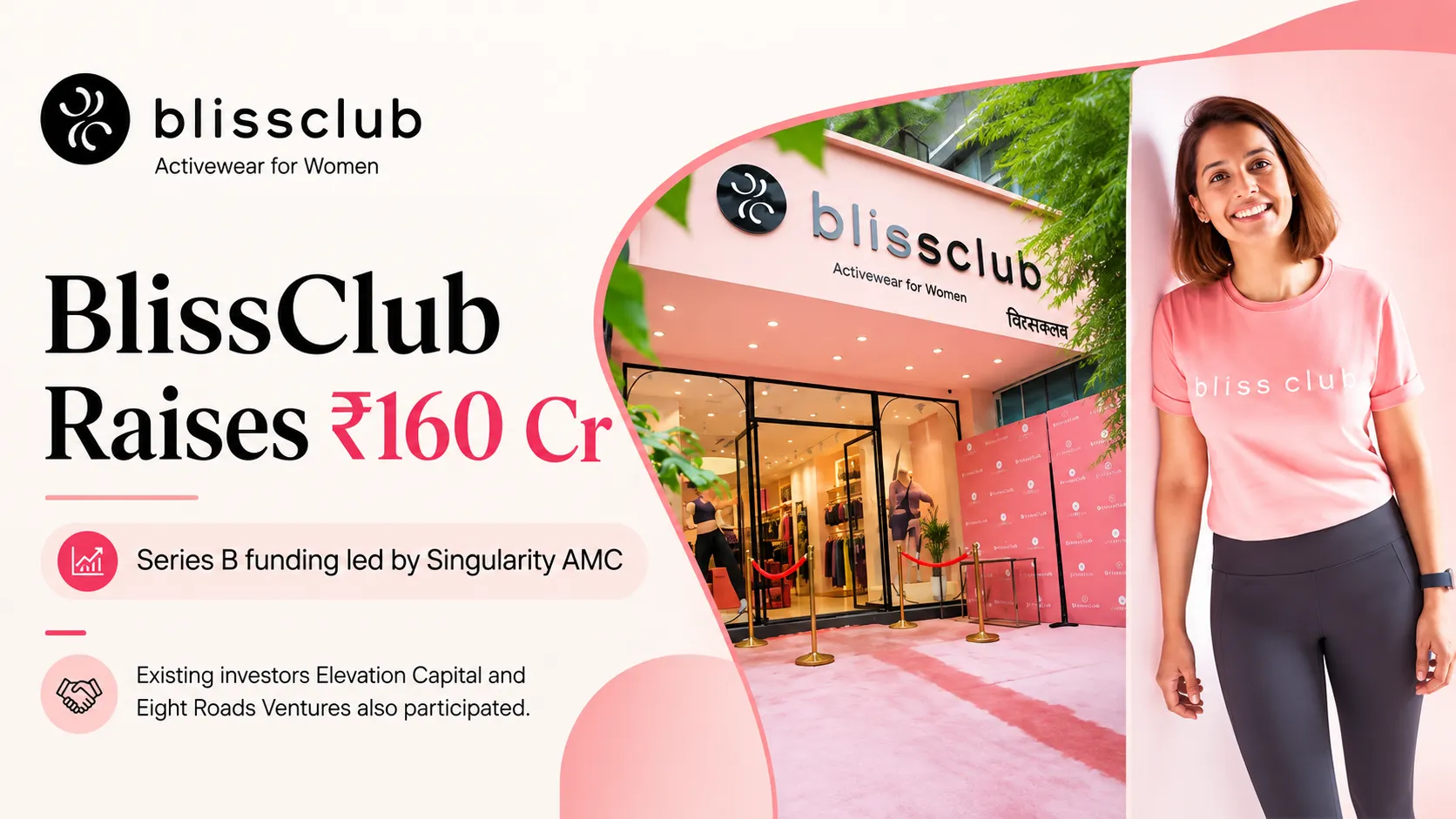
BlissClub, the Bengaluru-headquartered direct-to-consumer athleisure brand founded by Minu Margeret, has raised ₹160 crore in a Series B funding round led by Singularity AMC, an India-focused alternative asset manager known for backing high-growth consumer and technology businesses. Margeret and her partner Vidit Aatrey contributed significant personal capital to the round alongside the institutional investment, while existing backers Elevation Capital and Eight Roads Ventures increased their commitments, signalling continued confidence from the company's earlier investor base in its growth trajectory as it moves to fuel offline expansion and enter new product categories.
The round places BlissClub among a select group of Indian D2C brands that have successfully navigated the considerably more selective funding environment that has characterised India's consumer startup ecosystem over the past two years, a period during which investors have grown markedly more discerning about which direct-to-consumer businesses merit continued capital investment following the broader recalibration away from the growth-at-all-costs funding philosophy that dominated the sector's earlier expansion phase. BlissClub's ability to secure a meaningful Series B round from a respected institutional lead investor, alongside continued backing from its existing venture investors, suggests the company has built the kind of demonstrated unit economics and growth trajectory that has become the baseline expectation for consumer startups seeking growth-stage capital in the current environment.
BlissClub's positioning within India's athleisure and activewear category has benefited from a broader structural shift in Indian consumer behaviour around fitness, wellness and casual comfort-oriented apparel that has gathered pace considerably over the past several years. India's activewear market, historically dominated by international sportswear brands and a fragmented unorganised segment, has increasingly made room for domestic D2C brands that have identified specific underserved consumer segments, with BlissClub in particular having built its early brand identity around women's activewear designed with sensitivity to fit, comfort and body-positive sizing considerations that the company's founders identified as inadequately addressed by existing market offerings at the time of the brand's launch.
Founder Minu Margeret's own entrepreneurial journey has positioned her as one of the more closely watched women founders within India's broader D2C ecosystem, building BlissClub from an initial niche activewear concept into a brand that has achieved meaningful scale and, evidently, sufficient institutional investor confidence to support a ₹160 crore growth round. Her continued personal financial commitment to this funding round, investing alongside partner Vidit Aatrey — himself a prominent figure within India's ecommerce ecosystem as the founder of Meesho — reflects a level of founder conviction that institutional investors typically view favourably when evaluating growth-stage funding decisions, signalling that the company's leadership retains strong confidence in its forward trajectory even as external capital is brought in to fund the next phase of expansion.
The specific strategic priorities BlissClub has articulated for its new capital — offline retail expansion and entry into new product categories — reflect broader patterns increasingly visible across India's more successful D2C fashion and lifestyle brands, as discussed in the context of Knya's recent results elsewhere in this coverage. Physical retail presence has proven particularly valuable for apparel categories including activewear, where fit, fabric feel and try-before-buy considerations remain meaningful purchase drivers for a significant share of Indian consumers, even those who initially discover and build trust in a brand through digital channels. BlissClub's move to accelerate offline expansion suggests the company has reached a stage of brand maturity and unit economic confidence sufficient to justify the higher fixed costs and operational complexity that physical retail presence entails relative to a purely digital-first model.
Category expansion beyond BlissClub's core activewear positioning also reflects a common growth strategy among successful D2C brands that have established strong initial brand equity within a focused category, subsequently leveraging that brand trust and customer relationship to expand into adjacent product categories that serve the same core customer base's broader lifestyle needs. This adjacent category expansion strategy, when executed successfully, allows D2C brands to increase customer lifetime value and average order frequency without the considerably higher cost and risk associated with acquiring entirely new customer segments, making it a generally preferred growth vector for brands with sufficient existing customer trust and repeat purchase behaviour to support the expansion.
Singularity AMC's decision to lead this round reflects the growing sophistication and specialisation visible across India's alternative asset management landscape, with a number of India-focused funds increasingly building dedicated expertise and conviction around specific consumer categories, including fashion, wellness and lifestyle brands that have demonstrated the kind of durable, culturally rooted demand patterns that tend to prove more resilient across funding cycles than categories more purely dependent on discretionary spending trends or intense promotional competition. The involvement of Elevation Capital and Eight Roads Ventures as continuing investors, rather than new entrants to the company's cap table, further reinforces the narrative of sustained institutional confidence built over multiple funding rounds and multiple years of company performance.
India's activewear category has itself matured considerably from what was, a decade ago, a market dominated almost entirely by international sportswear giants offering largely undifferentiated product ranges across global markets with minimal localisation for Indian body types, climate considerations or cultural preferences around modesty and styling. BlissClub's emergence, alongside a handful of other India-focused activewear brands that have built meaningful scale over the past several years, reflects a broader pattern of category-specific unbundling that has characterised much of India's D2C ecosystem, in which founders identify a specific, previously underserved dimension of a broader category — in BlissClub's case, activewear designed specifically around Indian women's fit and comfort preferences — and build a focused brand proposition around addressing that gap more effectively than incumbent players positioned for a more generic, less localised customer base.
The competitive landscape within India's growing activewear segment has intensified considerably as the category's commercial potential has become more evident, with both international brands increasingly localising their India strategies and a growing number of domestic challenger brands entering the space alongside BlissClub. This intensifying competition places a premium on the kind of sustained product innovation, brand community building and operational execution that has allowed BlissClub to distinguish itself within an increasingly crowded field, factors that likely featured prominently in Singularity AMC's investment thesis when evaluating the company's prospects for continued category leadership as competitive intensity within Indian activewear continues to increase over the coming years.