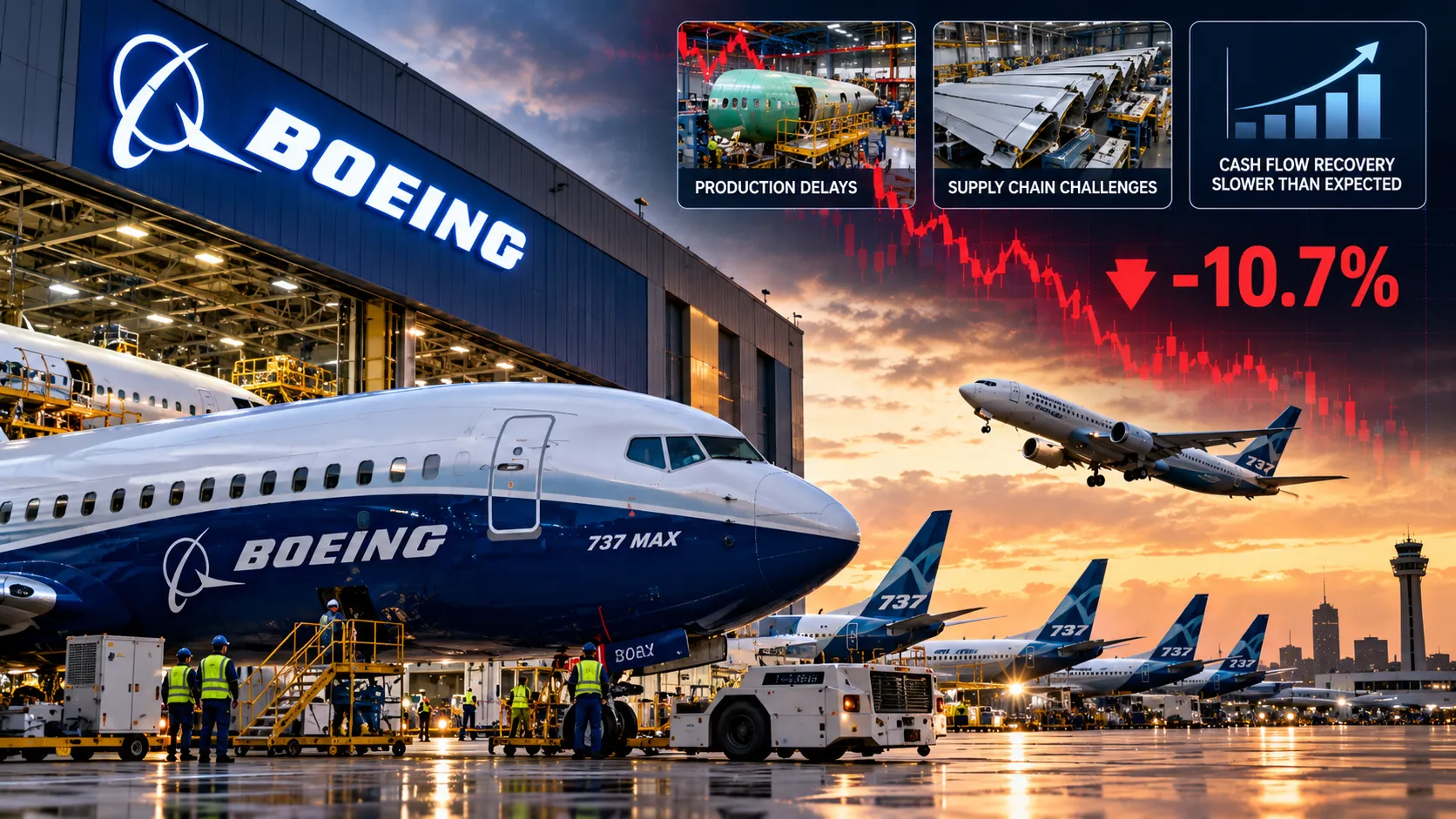
Boeing's long road to recovery has hit another bump. The American plane maker's shares had their worst day in more than 18 months after it warned that production of its best-selling jet would take longer to ramp up and that its cash flow would recover more slowly than investors had hoped.
Boeing shares fell 10.7% on Tuesday, October 27, according to the Associated Press, after the company reported third-quarter results and updated its outlook. The Spokesman-Review reported it was the stock's worst day since April 3, 2025.
Missing targets
Chief executive Kelly Ortberg said Boeing would miss its 2026 targets for 737 production and jet deliveries. Chief financial officer Jay Malave said the company would not reach its target of 500 deliveries this year.
Boeing now expects to reach a production rate of 47 737 jets a month in early 2027. In May, executives had projected reaching that rate in the summer of 2026. Wing production remains a major constraint, though Boeing still plans to reach 52 a month in the second half of 2027.
The company also pushed back its free cash flow growth target by a year. It now expects $3 billion of free cash flow next year, well below the analyst consensus of $5.5 billion, according to LSEG data cited by the Spokesman-Review.
"Expectations are rising, and they should," Ortberg said in a memo to employees.
The numbers
Boeing reported an adjusted loss of 34 cents a share for the quarter, compared with analyst expectations of a loss of 21 cents.
Free cash flow was positive at $464 million for the quarter, but negative $359 million for the year to date. Net debt fell to $25.2 billion from $25.9 billion in the previous quarter and $30.4 billion a year earlier.
The commercial airplanes division reported revenue of $10.7 billion and an operating loss of $697 million, an operating margin of minus 6.5%, a significant improvement from minus 48.3% a year earlier, when the business was disrupted by a strike.
Bright spots
There were positives in the results. The defence business earned nearly $500 million, a 6.2% margin, helped by a $252 million gain on the sale of a subsidiary. Global services earned $1 billion, an 18.3% operating margin.
Boeing has also secured certification for the 737 MAX 7 and, in October, the MAX 10, two variants that had been delayed for years. It won the US Navy's contract for the F/A-XX sixth-generation fighter, a major defence programme.
The 777-9, the largest version of Boeing's new widebody 777X, is on track for certification by mid-2027, although Boeing expects the programme to continue burning cash through next year. The 787 and 777 freighter programmes continue to face production challenges.
The long recovery
Boeing has been working to recover from a series of crises. Two fatal crashes of the 737 MAX in 2018 and 2019 led to a worldwide grounding. A door plug blew out of an Alaska Airlines 737 MAX 9 in January 2024, prompting regulatory caps on production and intense scrutiny of the company's quality controls. A machinists' strike in 2024 further disrupted production.
Ortberg, who became chief executive in 2024, has focused on improving quality, stabilising production and repairing relationships with regulators, employees and customers. Progress has been real but slower than investors hoped.


