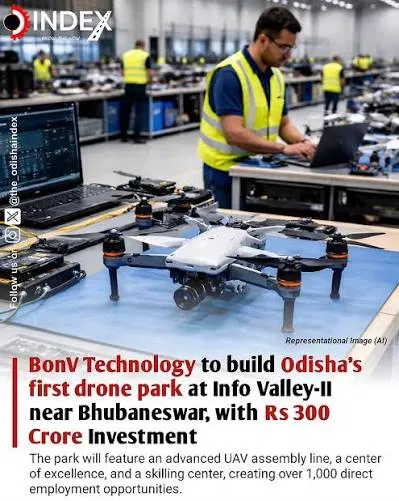
BonV Aero, an Indian deep-technology company building autonomous heavy-lift aerial platforms, has been named among five finalists for Round 10 of GENIUS NY, described as the world's largest accelerator programme dedicated to uncrewed systems and robotics. The selection marks another significant step in the company's planned expansion into the United States market, following a series of earlier milestones that have progressively built BonV Aero's profile and credibility within the global uncrewed systems industry, an increasingly competitive category that spans commercial logistics, agricultural, defence and homeland security applications for autonomous aerial vehicles. GENIUS NY's accelerator programme has established itself as one of the most closely watched competitive platforms within the global drone and robotics industry, offering finalists not just funding and mentorship but also access to a dense network of US defence, homeland security and commercial partners that can prove instrumental in helping international companies like BonV Aero navigate the complex regulatory and procurement landscape governing uncrewed systems in the American market, a landscape that differs substantially from the regulatory environment BonV Aero has operated within in India.
BonV Aero previously won Season 6 of Meet the Drapers, a competitive pitch programme that secured the company $1.6 million in funding from prominent investor Tim Draper, an early milestone that provided both capital and international visibility for the Indian startup at a relatively early stage of its development. The company has also engaged directly with the US Department of Defense and Department of Homeland Security through the I2A Launchpad programme and has joined the Arlington Global Security Tech Launchpad, engagements that reflect a deliberate strategy of building relationships with US government and defence-adjacent institutions well ahead of pursuing formal procurement opportunities, a long-cycle relationship-building approach that companies attempting to enter the US defence-adjacent technology market typically find necessary given the extended timelines and trust-building requirements involved in government procurement processes. The company has showcased its autonomous heavy-lift platforms at XPONENTIAL 2025 in Houston, one of the largest annual trade events for the uncrewed systems industry globally, an appearance that provided BonV Aero with direct visibility among the commercial and government buyers, integrators and competitors who collectively define the competitive landscape the company is now working to establish itself within as it pursues its US expansion strategy.
India's deep-tech and defence-adjacent drone sector has grown considerably over recent years, driven partly by domestic government procurement initiatives favouring indigenous uncrewed systems manufacturers and partly by a broader wave of Indian deep-tech startups seeking to establish credibility in international markets where defence and dual-use technology procurement has traditionally been dominated by American, European and Israeli companies. BonV Aero's progressive accumulation of US-focused milestones — from the Draper-backed pitch competition win through direct defence department engagement to now a GENIUS NY finalist position — represents one of the more sustained and deliberate international expansion trajectories among Indian uncrewed systems startups, suggesting a founding team that has prioritised building international credibility systematically rather than relying purely on domestic market traction to eventually attract international attention. The autonomous heavy-lift platform category that BonV Aero operates within addresses a specific technical niche within the broader uncrewed systems market, focused on aerial vehicles capable of transporting substantial payloads without a human pilot, a capability with applications spanning commercial logistics in hard-to-reach locations, agricultural spraying and monitoring at scale, and various defence and humanitarian logistics use cases where traditional crewed aviation proves too costly or operationally risky for the specific mission profile involved.


