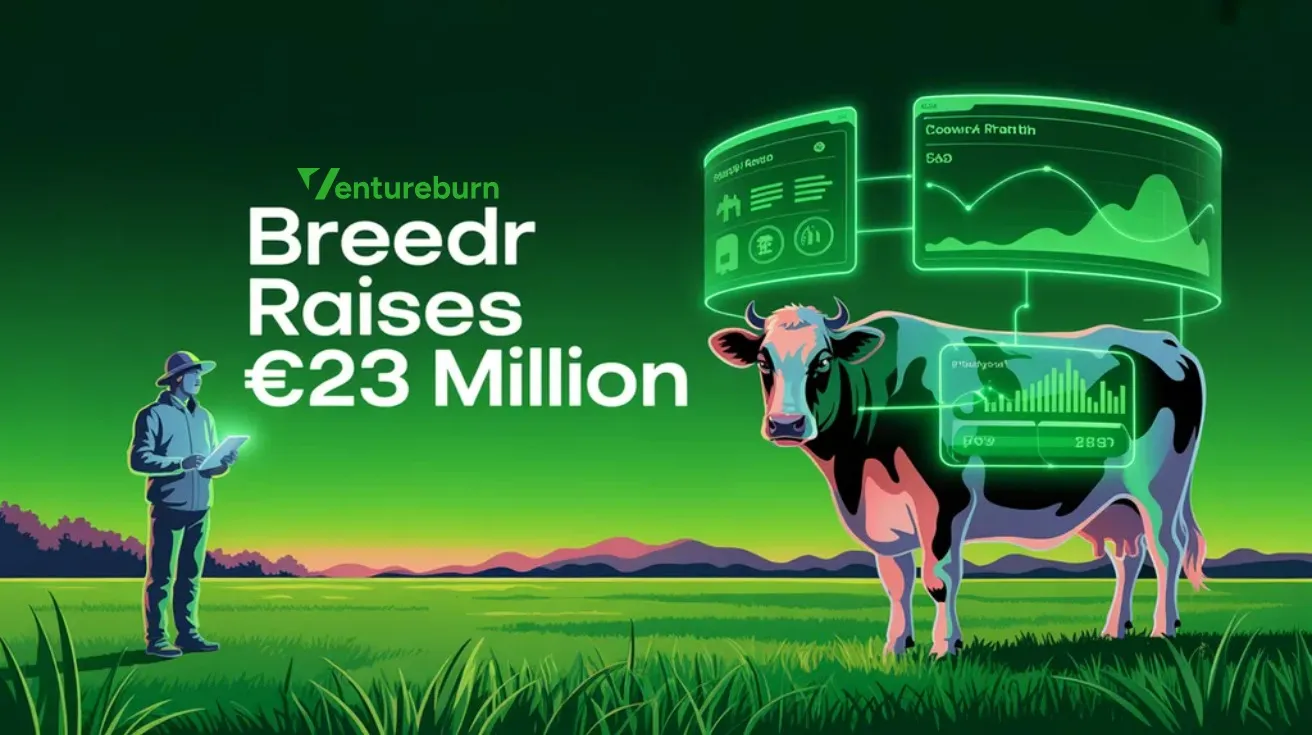
Breedr, an agricultural technology startup that gives cattle digital records tracking them through their entire lifecycle, has raised $27 million in Series B funding led by Partech's impact fund, with participation from Latitude, LocalGlobe's growth fund, and Outsiders Fund. The financing, equivalent to roughly €23 million, brings Breedr's total capital raised to approximately $46.6 million as the company pushes to digitise one of agriculture's most stubbornly analogue supply chains.
The company's platform connects production data with livestock commerce, allowing farmers, feedlot operators and buyers to track individual animals from birth through to sale using digital records rather than the paper-based systems and informal knowledge that have traditionally governed cattle management. Breedr says its platform now tracks more than two million cattle and expects nearly $500 million worth of livestock to move through its marketplace this year, figures that suggest the company has moved well beyond a pilot-stage proof of concept into genuine commercial scale.
Now headquartered in Texas, Breedr operates across the United States, United Kingdom and Australia, with expansion into New Zealand currently underway — a footprint spanning several of the world's largest cattle-producing nations, each with distinct regulatory environments, production systems and market structures for livestock trading. Building a single technology platform capable of serving farmers operating under such varied regulatory and commercial conditions represents a significant product and go-to-market challenge that few agtech startups have successfully navigated at this scale.
The involvement of Partech's dedicated impact fund as lead investor signals that Breedr's value proposition extends beyond pure commercial efficiency into genuine environmental and welfare considerations. Better data on individual animal health, growth rates and movement histories can support more targeted veterinary intervention, more efficient feed allocation and, proponents argue, meaningfully reduced emissions intensity per unit of livestock production — a claim increasingly scrutinised by climate-focused investors evaluating agtech investments given agriculture's outsized contribution to global greenhouse gas emissions.
Livestock supply chains have historically resisted the kind of digitisation that has transformed other agricultural segments, partly because cattle trading has long relied on relationship-based trust between farmers, auctioneers and buyers that digital platforms have struggled to fully replicate, and partly because the fragmented, often smallholder-dominated structure of cattle farming in many regions has made technology adoption slower than in more consolidated, corporate-dominated agricultural sectors such as poultry or industrial crop farming.
Breedr's thesis — that better information can make fragmented supply chains easier to price, manage and finance — mirrors a familiar software playbook applied to an unusually physical, biologically variable market where individual animals, unlike standardised industrial inputs, carry genuine variation in health, growth trajectory and market value that digital records must accurately capture to be genuinely useful to buyers and sellers alike.
As the company scales toward its stated goal of nearly $500 million in livestock transaction volume this year, Breedr's ability to maintain data accuracy and farmer trust across an expanding, geographically diverse user base — while continuing to demonstrate the environmental and welfare benefits that attracted impact-focused capital to this round — will likely determine whether it can sustain the growth trajectory that justified its Series B valuation.
For agtech investors more broadly, Breedr's raise adds to a growing body of evidence that livestock-focused digital infrastructure, long overshadowed by crop-focused agtech investment, represents a genuinely underserved and potentially lucrative category, particularly as climate and food-security pressures increase scrutiny of the environmental footprint associated with global meat and dairy production.
The company's expansion strategy — establishing operations across the United States, United Kingdom and Australia before pursuing New Zealand — reflects a deliberate focus on English-speaking, institutionally mature cattle markets with relatively well-developed regulatory infrastructure around animal traceability, rather than attempting to simultaneously tackle the more fragmented, less formally regulated cattle markets found across much of the developing world. That sequencing likely reflects a pragmatic recognition that proving commercial viability in markets with existing traceability requirements and higher farmer technology adoption rates offers a more achievable path to scale before attempting the considerably more complex challenge of digitising livestock supply chains in markets with less developed regulatory and infrastructure foundations.
Partech's impact fund lead position on this round also reflects a broader shift among European and international impact investors toward funding agricultural technology with demonstrable environmental co-benefits, rather than confining impact-labelled capital exclusively to renewable energy or direct emissions-reduction technologies. Livestock farming's substantial contribution to global methane emissions has made the sector an increasingly prominent target for climate-focused investment, even though — or perhaps because — the sector has historically received comparatively less dedicated climate capital than energy or transportation decarbonisation efforts.
The Texas headquarters relocation also signals Breedr's ambitions within the American cattle market specifically, home to one of the world's largest and most commercially sophisticated beef production sectors, where the company will face established incumbents in cattle management software as well as the practical challenge of persuading a traditionally conservative farming community, often operating on thin margins, to adopt new digital tools and processes for animals that have historically been tracked using far simpler, paper-based or basic spreadsheet methods.
Investor appetite for agtech has fluctuated considerably over the past several funding cycles, with many pure software-for-farmers plays struggling to achieve the retention and expansion revenue that venture investors typically expect, given farmers' often seasonal cash flow and understandable caution toward recurring software subscription costs relative to one-time equipment purchases. Breedr's marketplace-adjacent model, which appears to generate revenue not solely from software subscriptions but from facilitating actual livestock transactions, may offer a more resilient revenue structure than pure SaaS-for-agriculture competitors have historically achieved, since transaction-based revenue can scale directly alongside genuine commercial activity on the platform rather than depending solely on subscription renewal rates.
As Breedr scales toward its stated target of nearly $500 million in livestock moving through its marketplace this year, the company's next several quarters will offer a meaningful test of whether digital cattle records can genuinely improve outcomes for farmers — through better pricing information, more efficient buyer matching and reduced administrative overhead — at a scale sufficient to justify continued expansion into new geographic markets and livestock categories beyond cattle.