Britannia Industries, India's largest biscuit maker, reported strong growth in sales volumes for the September quarter, as consumer demand recovered, but rising raw material costs weighed on its profit margins.
The Bengaluru-based company posted a consolidated net profit of ₹725.99 crore for the July-September quarter, the second quarter of the 2026-27 financial year, up 10.82% from ₹655.06 crore a year earlier, according to Business Standard, citing results announced on Thursday, November 5. Revenue from operations rose 15.64% to ₹5,597.79 crore from ₹4,840.63 crore. Revenue from product sales rose 16.6% to ₹5,541.57 crore.
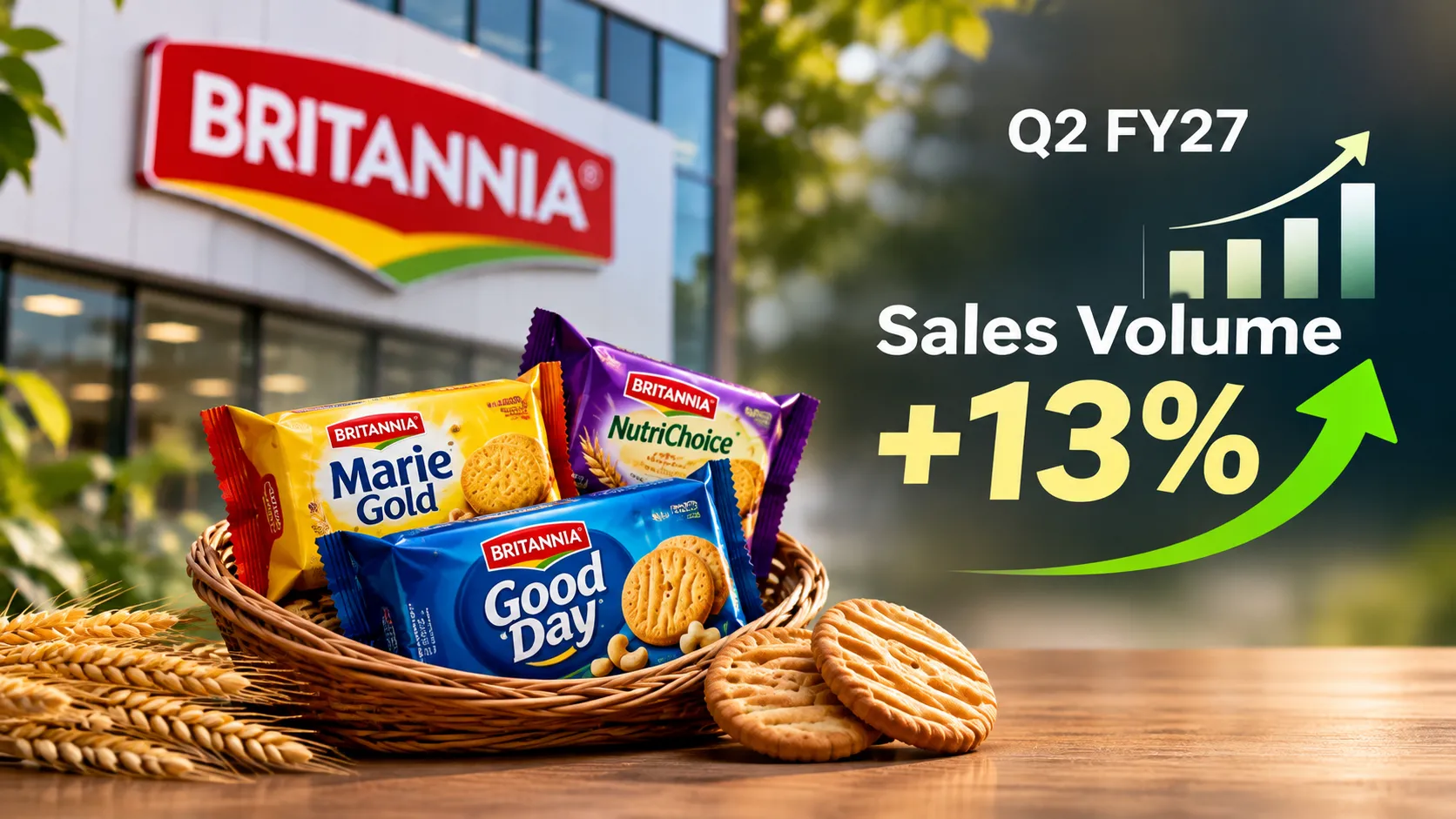
Sales volumes grew 13%, according to Business Standard, a strong performance for a mature consumer goods company and a sign that demand for everyday products is improving.
Margins under pressure
Despite the strong sales growth, profitability came under pressure. EBITDA was ₹1,022 crore, with an EBITDA margin of 18.25%, down 147 basis points from 19.72% a year earlier, according to Whalesbook. "Rising raw material costs have squeezed profit margins," Whalesbook reported.
Total expenses rose 17% to ₹4,690.47 crore, faster than revenue, according to Business Standard. Britannia's key raw materials include wheat flour, sugar, edible oils, milk and packaging materials, whose prices can be volatile. Higher energy and transport costs, linked to elevated global oil prices, have also added to costs across the consumer goods industry.
Management confident
Chief executive Rakshit Hargave said the company "sustained strong top-line momentum during the quarter," according to Business Standard. He described growth as "broad-based across channels and key states," and pointed to "strong quarter-on-quarter momentum," with revenue up 12% and profit up 22% from the previous quarter.
For the first half of the financial year, consolidated income rose 12.12% to ₹10,732.68 crore.
Britannia's shares settled at ₹5,000 on the BSE, up 1.70%, according to Business Standard.
The 'Many Indias' strategy
Britannia is pursuing a strategy it calls "Many Indias," a localised approach designed to counter regional competitors, according to Whalesbook. The strategy involves "empowering regional teams to make local decisions on pricing, packaging, and product promotions."
India's packaged food market is highly diverse, with consumer preferences, price sensitivity and competition varying significantly from state to state. Regional and local brands, often with lower costs and deep distribution in their home markets, have gained market share in categories such as biscuits, snacks and bakery products, particularly in smaller towns and rural areas.
By giving regional teams more autonomy, Britannia aims to respond more quickly to local competition and consumer preferences, while leveraging its national scale in manufacturing, distribution and brand building.
Brands and market position
Britannia, part of the Wadia Group, is one of India's oldest and best-known food companies, with a history dating back more than a century. Its brands include Good Day, Marie Gold, Tiger, NutriChoice, Milk Bikis and 50-50 biscuits, as well as bread, cakes, rusks, dairy products and croissants. It competes with Parle Products, ITC's Sunfeast, Mondelez and many regional players.
The company's extensive distribution network reaches millions of retail outlets across India, a key competitive advantage in a market where small neighbourhood stores remain the dominant retail channel.
Consumer demand recovery
Britannia's 13% volume growth adds to evidence of a recovery in consumer demand in India. Income tax cuts introduced in 2025, reductions in goods and services tax rates on many products and easing food inflation have boosted household purchasing power. The festive season has also supported demand.
Other consumer companies have reported improving demand trends, although the picture varies across categories. Rural demand, which had lagged urban demand for some time, has shown signs of improvement, supported by government spending and agricultural incomes.
The cost challenge
Managing input costs is a constant challenge for food companies. When raw material prices rise, companies must choose between raising prices, which can hurt volumes, absorbing the costs, which hurts margins, or reducing pack sizes. Britannia's decline in margins suggests it chose to prioritise volume growth, absorbing some of the cost increases.
Elevated global oil prices, linked to the conflict involving Iran, have increased costs for packaging, transport and energy, adding to pressure on margins across the consumer goods sector.
Why it matters
As one of India's leading consumer companies, Britannia's results provide insight into the health of Indian consumer spending. Strong volume growth is a positive sign for the broader economy, while margin pressure highlights the challenges posed by rising costs.
Beyond biscuits
Britannia has been diversifying beyond biscuits into adjacent categories such as cakes, rusks, bread, croissants, wafers and dairy products, including cheese and beverages. These categories offer growth opportunities and help the company leverage its brand and distribution network. Its dairy business, in particular, has been an area of focus, although it faces strong competition from cooperatives and other dairy companies.
The company has also invested in modernising its manufacturing, adding capacity in new plants across India to support growth and reduce distribution costs.
The pricing balance
Britannia's decision to prioritise volume growth over margins reflects a strategic choice. Losing market share to regional competitors can be costly in the long run, so companies sometimes accept lower margins to defend their position. Analysts will watch whether Britannia can restore margins through selective price increases as raw material costs stabilise, without sacrificing the volume gains it has achieved.
The company's management has historically been known for disciplined cost management, including efficiency programmes in procurement, manufacturing and logistics, which have helped protect margins during periods of inflation.
Britannia's results come as India's consumer goods companies report a mixed picture. Companies with strong brands and distribution, such as Britannia, have benefited from improving demand, but rising input costs have squeezed margins across the sector. Emami, for example, reported revenue growth of 36% but a slight decline in profit for the September quarter, according to Upstox, illustrating the pressure from costs. Investors are watching closely for signs that volume growth can be sustained as companies adjust prices to protect margins in the months ahead.
What comes next
Investors will watch Britannia's ability to restore margins through pricing, cost efficiencies and product mix improvements, while sustaining volume growth. The company scheduled its earnings call with analysts for November 6. With demand recovering and a strategy to counter regional competitors, Britannia is aiming to defend its leadership in India's large packaged food market.