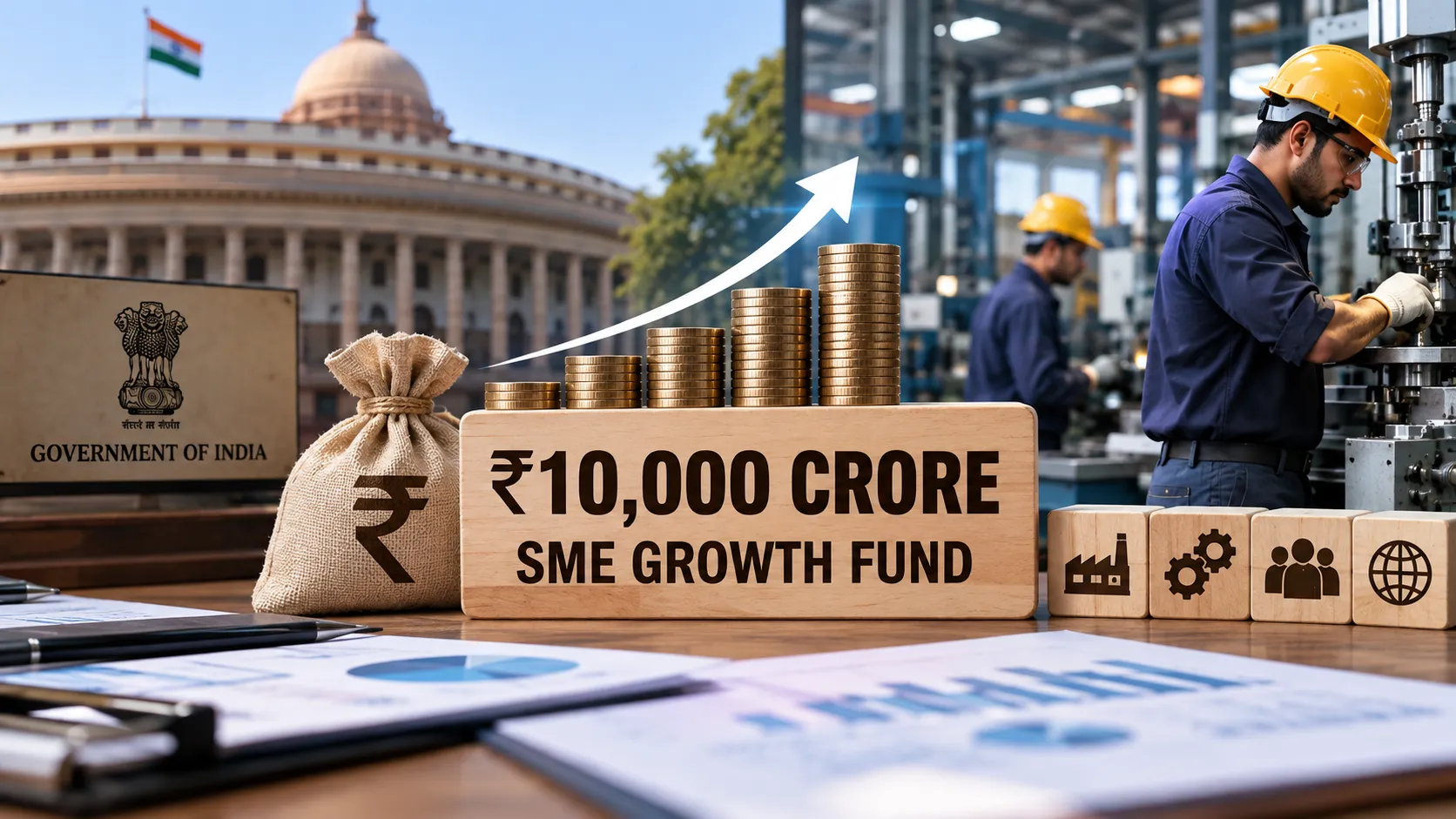
The Union Cabinet on 6 October approved a ₹10,000 crore SME Growth Fund, a fund-of-funds that will commit government capital to privately managed alternative investment funds (AIFs), which will in turn invest equity and growth capital in high-potential small and medium enterprises.
The fund is designed to address one of the most persistent gaps in India's financial system: the shortage of long-term risk capital for established small businesses that have outgrown informal funding and bank credit but are too small, or too unglamorous, to attract venture capital or tap public markets.
Its mandate covers manufacturing, services, technology and innovation-driven sectors, with manufacturing expected to account for the majority of investments. The government has also signalled a focus on industrial clusters in Tier 2 and Tier 3 cities and on firms that can integrate into strategic and global supply chains.
How the fund will work
Rather than lending or investing directly, the government will act as an anchor investor in SEBI-registered AIFs. Those funds, run by professional managers, will select companies, structure investments and raise additional capital from private investors alongside the government's commitment.
Routing money through AIFs also keeps investment decisions at arm's length from government. Officials set the broad mandate and the size of the commitment; professional managers, whose own returns depend on the performance of their portfolios, decide which companies receive capital and on what terms. That separation is intended to reduce the risk that a public fund ends up supporting businesses for political rather than commercial reasons.
The structure borrows from the playbook used for start-ups through the Fund of Funds for Startups, administered by the Small Industries Development Bank of India, under which a public anchor commitment has been used to draw in a much larger pool of private capital. The underlying logic is that a government cheque reduces perceived risk for private limited partners and encourages fund managers to look at segments they might otherwise ignore.
The stated objectives are specific: to fill the growth-capital gap for SMEs, enable business expansion and higher manufacturing capacity, support technology adoption, and help companies enter international markets and global supply chains. For a mid-sized auto-component maker or speciality chemicals firm, that might mean funding a new production line, an export certification programme or an acquisition, without taking on debt that strains cash flows.
The scale of the opportunity, and the gap
The numbers explain why policymakers keep returning to the sector. According to the Economic Survey 2025-26, micro, small and medium enterprises account for about 31.1 per cent of India's GDP, 35.4 per cent of manufacturing output and 48.58 per cent of exports. More than 7.47 crore enterprises employ about 32.82 crore people, making the sector the country's second-largest employer after agriculture.
Yet most of that activity is financed through promoters' own funds, family capital, informal lenders and working-capital loans from banks. Equity investors have historically concentrated on two ends of the market: early-stage technology start-ups chasing rapid growth, and large companies with access to public markets. The established, profitable but sub-scale manufacturer in an industrial cluster has often fallen through the gap, the so-called missing middle.
That gap has become more costly as India tries to deepen its manufacturing base. Production-linked incentive schemes, tariff policy and the global push to diversify supply chains away from single-country dependence have created openings for Indian suppliers. Many SMEs that could capture those openings lack the balance sheets to invest in capacity, quality systems and certifications ahead of orders.
Debt alone has not solved the problem. Bank lending to small businesses has expanded significantly over the past decade, supported by credit guarantee schemes and digital lending platforms, but loans come with fixed repayment schedules and collateral requirements that sit awkwardly with multi-year investments in new plants or export markets. Equity, by contrast, shares risk with the business owner and typically arrives with board-level guidance on governance, finance and strategy.
Many economies with strong manufacturing sectors have relied on a dense layer of well-capitalised mid-sized firms. Germany's Mittelstand is the most frequently cited example, but Taiwan, South Korea and Japan have also built supplier ecosystems around family-owned companies with patient long-term financing. India's policymakers have long argued that the country needs a comparable tier of companies large enough to win global contracts but nimble enough to specialise.
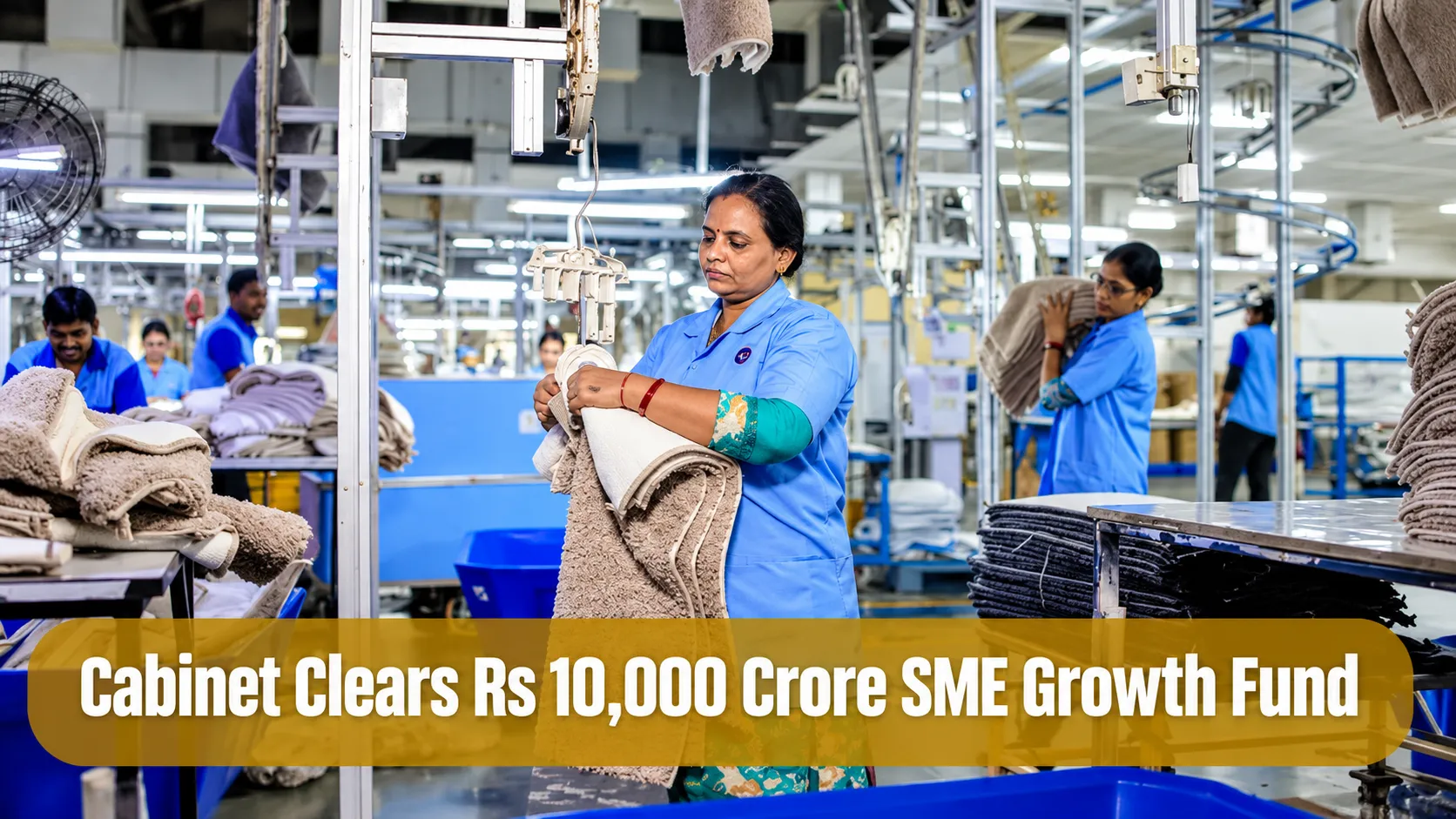
Part of a wider push
The fund sits alongside a set of measures announced in the Union Budget 2026-27 aimed at small businesses, including a ₹2,000 crore Self-Reliant India Fund for micro enterprises, improvements to the Trade Receivables e-Discounting System (TReDS), a credit guarantee mechanism through the Credit Guarantee Fund Trust for Micro and Small Enterprises for invoice discounting, and the integration of the Government e-Marketplace with TReDS to speed up payments to small suppliers.
For fund managers, the government commitment changes the arithmetic of raising a fund focused on smaller companies. Such strategies often struggle to attract institutional investors because individual deal sizes are small, due diligence is labour-intensive and exits are uncertain. An anchor commitment from the state can provide the first close that a new fund needs, and can signal to domestic pension funds, insurers and family offices that the segment has official backing.
Its success will depend on execution details that have yet to be published: how quickly fund managers are empanelled, how much private capital they can raise alongside the government's commitment, and whether they are willing to back companies outside the largest metropolitan areas. Equity investment in small firms also requires credible exit routes, and India's SME exchange platforms have faced their own governance questions in recent years.
There is also the question of readiness on the companies' side. Many family-run SMEs have little experience of outside shareholders, audited governance structures or the reporting that institutional investors expect. Fund managers will need to invest time in professionalising boards and accounts, and some promoters may be reluctant to dilute control. The funds that succeed are likely to be those with sector expertise and the patience to work alongside founders over several years.
Even so, the approval marks a shift in emphasis from credit towards equity for small businesses. If the fund can crowd in private investors and build a track record, it could help create a pipeline of mid-sized Indian manufacturers capable of competing in global markets, a group the country has long struggled to grow.