Capillary Technologies, the Bengaluru-based provider of customer loyalty and engagement software to global brands, returned to profit in the September quarter as revenue growth accelerated and its artificial intelligence products began to gain traction with large enterprise customers.
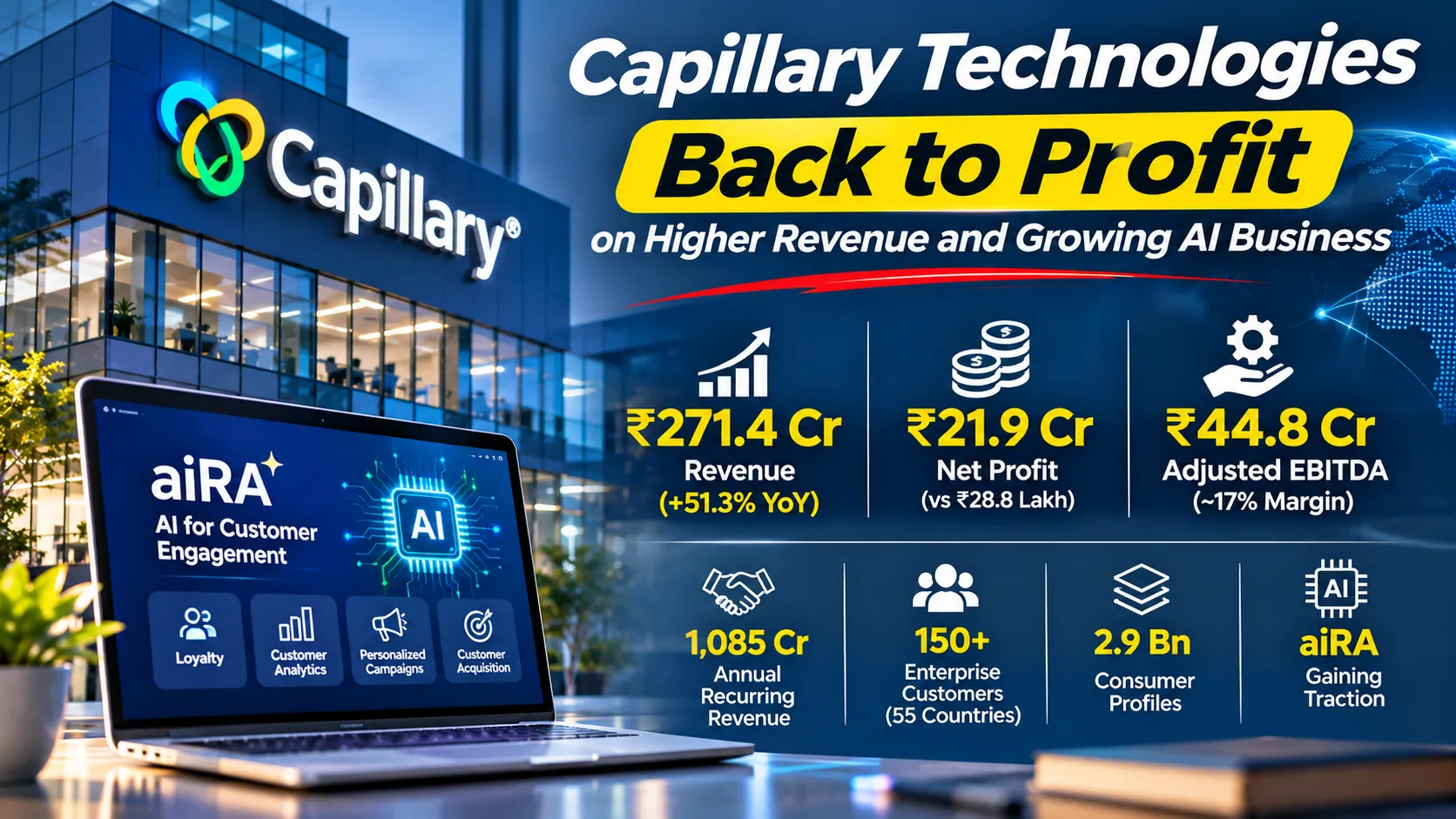
The company reported a net profit of ₹21.9 crore for the July-September quarter, the second quarter of the 2026-27 financial year, compared with ₹28.8 lakh a year earlier, according to Inc42. Operating revenue rose 51.3% to ₹271.4 crore from ₹179.3 crore, and increased 5.7% from ₹256.6 crore in the previous quarter. In constant currency terms, revenue grew 43%, according to the company's earnings call.
The results, announced on Monday, November 2, mark a sharp recovery from the previous quarter, when Capillary reported a net loss of ₹9.6 crore after taking a one-time charge of ₹33.4 crore linked to a banking fraud at its Czech subsidiary.
The numbers
Capillary's total expenses rose 41.8% to ₹257.5 crore, slower than revenue growth, allowing margins to expand. Adjusted EBITDA was ₹44.8 crore, a margin of about 17% and roughly double the level a year earlier, according to the earnings call. Pre-tax profit was ₹19.9 crore, and a net tax credit of ₹2 crore lifted net profit above pre-tax profit.
For the first half of the financial year, revenue rose 47% to ₹528 crore, and adjusted EBITDA rose to ₹89 crore from ₹41 crore. Gross margin was 67%, despite the lower margins of recently acquired businesses.
Annual recurring revenue (ARR), a key measure for software-as-a-service companies, rose 51% to ₹1,085 crore. New annual contract value over the past 12 months rose 79% to ₹93 crore, and organic net revenue retention, which measures how much existing customers expand their spending, was about 116%.
The company had ₹573 crore of cash and no long-term debt at the end of the quarter.
What Capillary does
Founded in 2008 by Aneesh Reddy, Krishna Mehra and Ajay Modani, Capillary provides software that helps retailers, consumer brands and other businesses manage customer loyalty programmes, analyse customer data and run personalised marketing campaigns. It serves more than 20 Fortune 500 companies and about 150 large enterprise customers across about 55 countries, with 2.9 billion consumer profiles on its platform, according to the earnings call.
The company listed on Indian stock exchanges in November 2025, one of a growing number of Indian SaaS companies to go public at home.
Growth through acquisitions
A significant part of Capillary's growth has come from acquisitions. In the first half, organic revenue rose 23% to ₹318 crore, while inorganic revenue, mostly from SessionM, reached ₹210 crore, compared with ₹101 crore a year earlier.
SessionM, a customer engagement platform acquired from Mastercard, has about 40 customers and an annual revenue run rate of roughly $30 million. Capillary plans to migrate SessionM customers to its own platform over two to three years and aims to reduce SessionM's server costs from about 50% of its revenue to about 25% by March or April 2027. It also acquired Kognitiv, a loyalty platform, in May 2025, and aims to migrate all Kognitiv customers by September 2027.
The AI opportunity
Capillary is betting that artificial intelligence will transform its business. Its main AI product, aiRA, is described as a system of intelligence and workflow layered on top of customer data, which can automate marketing tasks such as designing loyalty programmes, segmenting customers and running campaigns.
The company said aiRA now extends to customer acquisition channels such as Google Ads, Meta and TikTok, and can run on data platforms including Databricks, Snowflake and BigQuery, allowing it to be sold to customers who do not use Capillary's core platform. Average aiRA deals are worth about $100,000 to $200,000, with a pipeline of $8 million to $9 million, according to the earnings call. Management believes aiRA could reach $10 million in ARR within one to two quarters.
"Compared to our competitors, you can run our stack with one-fifth the number of people," said chief executive Aneesh Reddy on the earnings call.
The company is shifting aiRA pricing from usage-based fees to fixed-fee licences, including a Teams tier priced at about $60,000 and a Professional tier at about $100,000.
Guidance
"We definitely think we will hit the guidance or do a little better," Reddy said. The company maintained guidance for organic growth of about 20% for the year, even though first-half organic growth was 23%, and expects new customer annual contract value of ₹70 crore to ₹80 crore for the year.
"I think overall, we have had very good momentum through the quarter, both on the organic, aiRA, and the inorganic side," Reddy said.
Chief financial officer Anant Choubey highlighted the company's operating leverage. "For every INR 100 of new organic revenue, it is generating INR 44 of adjusted EBITDA," he said.
Regional performance
Capillary said Europe, South Asia and India were performing well, while the United States was similar to last year but showing more momentum. The company signed what management described as one of the largest SaaS deals in Asia with a healthcare customer, which it did not name.
The fraud episode
Capillary disclosed in the previous quarter that it had suffered a ₹33.4 crore loss from a banking fraud at its Czech subsidiary, which resulted in a quarterly net loss. The company has since reported a strong recovery. Separately, the company announced a change of auditor alongside its results, according to Multibagg. Investors will watch for any further details on the fraud and on controls at its overseas subsidiaries.
Indian SaaS goes global
Capillary is part of a growing group of Indian software companies selling to global enterprises, alongside companies such as Freshworks, Zoho, Chargebee and others. Indian SaaS companies have benefited from strong engineering talent, lower costs and growing confidence in selling to customers in the United States and Europe.
The rise of AI presents both opportunities and risks for these companies. AI agents could automate many tasks currently performed by software users, changing how software is priced and sold. Companies that successfully integrate AI into their products could gain market share, while those that fall behind risk disruption.
What comes next
Capillary's priorities include scaling aiRA, integrating acquired businesses, improving margins and expanding in the United States. Investors will watch whether the company can sustain revenue growth above its organic guidance and convert its AI pipeline into recurring revenue. With profitability restored and a strong balance sheet, Capillary is positioning itself as one of India's leading AI-enabled enterprise software companies.