
StartupsTrending5 MIN READ

Captain Fresh Crosses ₹5,000 Crore Revenue in FY26, Nearly Triples EBITDA and Targets ₹10,000 Crore in FY27

Bengaluru-based seafood company Captain Fresh reported FY26 revenue of ₹5,169 crore, up 52%, with adjusted EBITDA rising 173% to ₹371 crore, as it stayed profitable for a second year and set a ₹10,000 crore target for FY27.

By Shaym Kumar · Author23 September 2026New
Captain Fresh Crosses ₹5,000 Crore Revenue in FY26, Nearly Triples EBITDA and Targets ₹10,000 Crore in FY27

Captain Fresh, the Bengaluru-based seafood supply-chain and packaged seafood company, has crossed the ₹5,000 crore revenue mark, reporting consolidated net revenue of ₹5,169 crore for the financial year ended March 2026, a 52% increase from ₹3,397 crore in FY25.

The company, which disclosed its results on 22 September 2026, also reported a sharp improvement in profitability. Adjusted earnings before interest, tax, depreciation and amortisation (EBITDA) rose 173% to ₹371 crore from ₹136 crore a year earlier, while gross margin expanded by 6.5 percentage points to 23.5% from 17%. Captain Fresh remained profit-after-tax positive for the second consecutive year.

The company has set an ambitious target for the current financial year: revenue of ₹10,000 crore, or roughly $1.1 billion, in FY27.

Growth through a turbulent trade year

The results are notable given the environment in which they were achieved. FY26 was a difficult year for global seafood trade, marked by tariff uncertainty and disruptions to supply chains. For a company with heavy exposure to export markets, particularly the United States, those pressures could easily have derailed growth.

"FY26 stress tested the industry in the form of tariffs and an unsettled trade environment, and we came out stronger than we went in," said Mathew George, Group CFO and Whole-time Director of Captain Fresh.

George said return on capital employed improved from 9% to 11% and that the company is targeting a ROCE above 20% in FY27. He also noted that the company's debt-to-equity ratio stood at 1.6, which he described as conservative for a business that has grown at an 80% compound annual growth rate over the past three years.

From B2B marketplace to global seafood platform

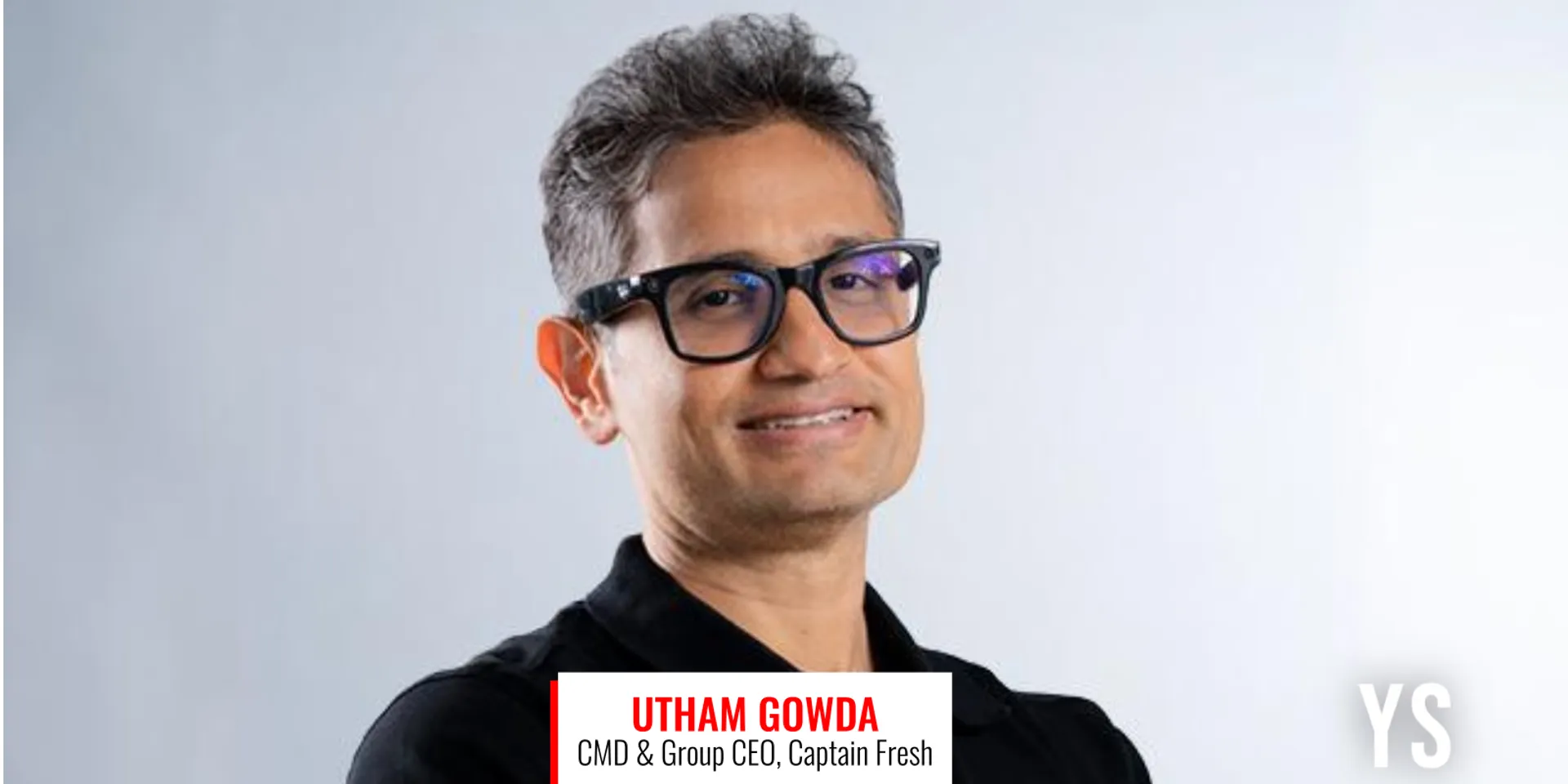
Founded in 2019 by Utham Gowda, a former investment banker who spent years studying the seafood industry, Captain Fresh began as a business-to-business platform aimed at organising India's fragmented seafood supply chain. The company later shifted its focus towards international markets, where demand was more stable and margins stronger, and has built a significant export business.

In FY25, exports accounted for the overwhelming majority of the company's operating revenue, with the United States alone contributing about 71% of total revenue, according to earlier disclosures. Captain Fresh has also expanded through acquisitions, including Poland's Koral, Indonesia's Fishlog and US-based CenSea, giving it processing capacity, distribution and brands in key markets.

The company's recent emphasis has been on moving up the value chain into branded and ready-to-eat seafood products, which typically command higher margins than commodity trading. George said margin expansion had been the priority in FY26 and that each step further into ready-to-eat products would extend it. He added that the company delivered about ₹1 crore of EBITDA a day through FY26 and is close to ₹2 crore a day currently.

The balance-sheet question

Captain Fresh's growth has required significant working capital. The company ended FY26 with ₹2,300 crore of debt, of which ₹440 crore was long-term borrowing, with the remainder comprising working-capital financing, according to reports. It attributed the higher working-capital requirement to elevated inventory levels maintained during the year to ensure uninterrupted supply to customers amid global disruptions.

The company is targeting a reduction in its debt-to-equity ratio to between 1.3 and 1.5 as operating conditions normalise. For investors, the trajectory of working capital and debt will be as important as revenue growth. Seafood is a perishable, inventory-intensive business exposed to commodity-price swings, currency movements and trade policy, and disciplined capital management will be critical to sustaining returns.

FY26 stress tested the industry in the form of tariffs and an unsettled trade environment, and we came out stronger than we went in.
Mathew George, Group CFO, Captain Fresh

image.png

A remarkable turnaround

The FY26 numbers cap an extraordinary turnaround. In FY24, Captain Fresh reported revenue of about ₹1,395 crore and a net loss of ₹229 crore. By FY25, revenue had more than doubled and the company had turned profitable, reporting a net profit of about ₹42 crore. FY26 extended that trajectory with further revenue growth, substantially higher EBITDA and continued profitability.

That shift from heavy losses to profitable growth is exactly what Indian public-market investors have come to demand from new-age companies. Captain Fresh has been considered an IPO candidate for some time and withdrew a confidential filing in December 2025. The improved financial performance could strengthen its case if it chooses to revisit a listing.

What the ₹10,000 crore target requires

Doubling revenue in a single year is an ambitious goal for any company, particularly one of Captain Fresh's scale. Achieving it will likely require growth from existing brands and infrastructure, further penetration of international retail and food-service channels, and continued expansion of higher-margin ready-to-eat products.

The company has said its focus is shifting towards scaling its existing portfolio and infrastructure rather than pursuing new acquisitions. That suggests management is prioritising operating leverage and returns, a strategy that could support both growth and margins if demand holds.

Risks remain. Trade policy in the United States, Captain Fresh's largest market, continues to be unpredictable. Currency fluctuations, freight costs and the availability of raw material can all affect margins. And rapid growth can strain quality control and working capital, particularly in a business where food safety and traceability are paramount.

Operating leverage in a physical business

One of the most striking aspects of Captain Fresh's FY26 results is the gap between revenue growth and EBITDA growth. Revenue rose 52%, but adjusted EBITDA grew more than threefold as fast. That pattern indicates operating leverage: as volumes rise, fixed costs in processing, logistics and overheads are spread across a larger revenue base, and a richer mix of branded products lifts gross margins.

For a physical business, achieving such leverage is harder than in software, where incremental revenue carries little additional cost. Every additional tonne of seafood must be sourced, processed, frozen, packed and shipped. The fact that Captain Fresh was able to expand gross margins by 6.5 percentage points while growing volumes suggests improvements in procurement, pricing and product mix rather than purely scale effects.

Why it matters for India's startup ecosystem

Captain Fresh's performance is a reminder that some of India's most interesting startup stories are being written outside consumer apps and software. By applying technology, data and supply-chain discipline to a traditional, fragmented industry, and by building a global business from India, the company has demonstrated that Indian startups can compete in international food supply chains.

If Captain Fresh meets its FY27 target, it would join a small club of Indian startups generating more than $1 billion in annual revenue while remaining profitable. That achievement would carry weight well beyond seafood, reinforcing the case that Indian founders can build globally competitive, capital-efficient businesses in physical industries.

TagsCaptain FreshSeafoodFY26 ResultsEBITDAUtham GowdaExportsIPOIndian StartupsProfitabilityFood Supply ChainMathew GeorgeUS Tariffs

Reader reviews

Sign in to rate and review this article.
Loading reviews…

