The world's major central banks face one of their most consequential weeks of the year, as an oil price shock driven by conflict in West Asia forces policymakers to weigh rising inflation against slowing growth.
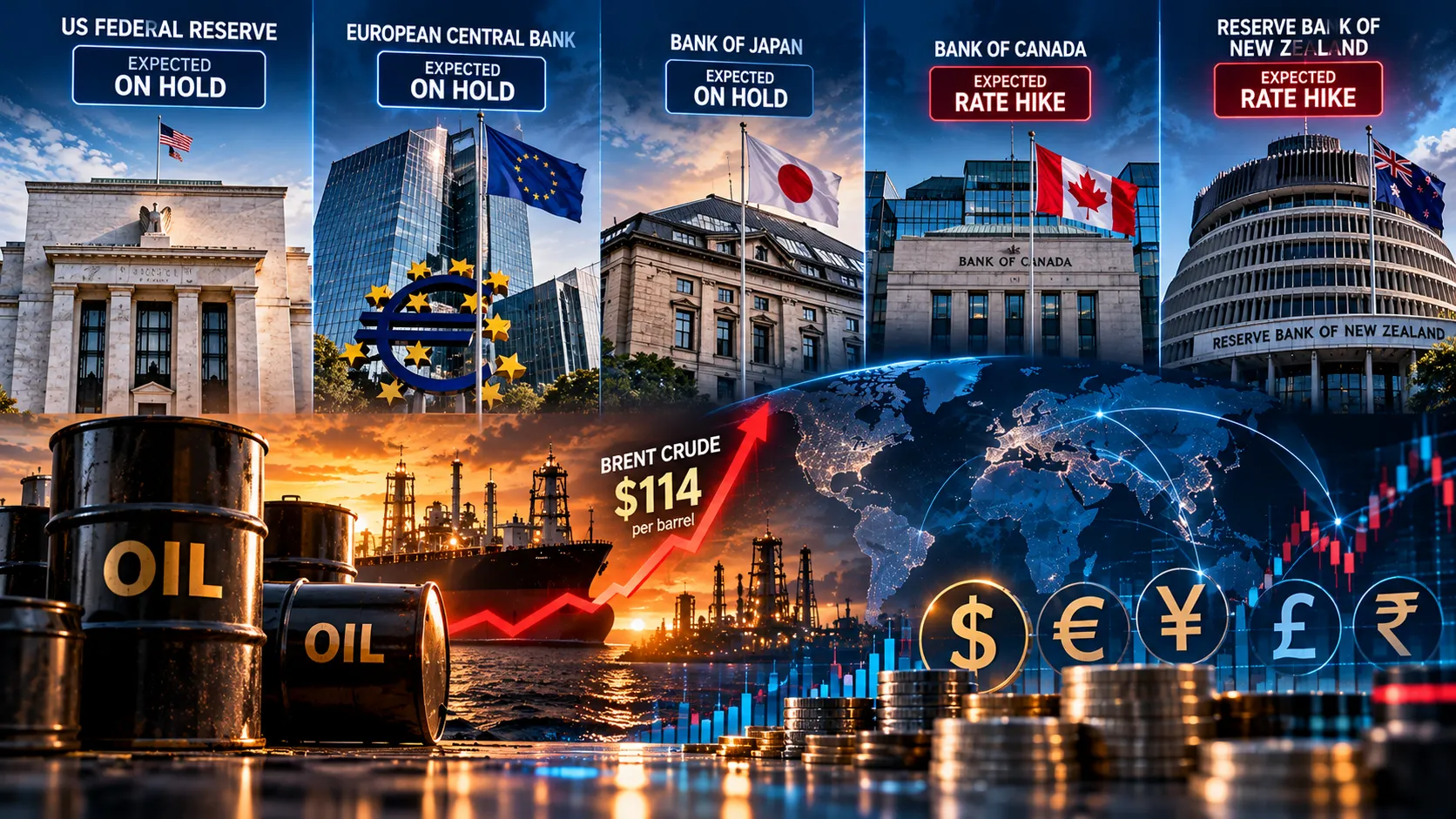
The US Federal Reserve, the European Central Bank and the Bank of Japan are all expected to leave interest rates unchanged this week. But the Bank of Canada and the Reserve Bank of New Zealand are expected to raise rates, highlighting how differently central banks are responding to the same energy-driven inflation pressures.
The Fed: on hold
The Federal Reserve is expected to keep its benchmark federal funds rate in a range of 3.75-4.00%. The US economy has proved resilient, with third-quarter GDP growth forecast at an annualised 3.2%, but inflation remains above the Fed's 2% target. Core personal consumption expenditures (PCE) inflation, the Fed's preferred measure, is expected at 3.1%.
With growth solid and inflation elevated, the case for further rate cuts has weakened. Some investors have even begun to consider the possibility that the Fed's next move could be a hike if energy prices keep pushing inflation higher. Most expect the Fed to stay on hold for now while signalling vigilance.
The ECB: steady at 2.50%
The European Central Bank is expected to hold its deposit rate at 2.50%. The eurozone economy faces weaker growth than the United States, and high energy prices are squeezing households and businesses. Europe's dependence on imported energy makes it particularly vulnerable to the oil shock.
Political stress adds to the challenge. France has faced cost-of-living protests, and the spread between French and German government bond yields recently widened to its highest level since 2011. The ECB will need to balance inflation risks against fragile growth and financial stability concerns.
The Bank of Japan: patient
The Bank of Japan is expected to keep its policy rate at 1.25%. Japan has been gradually raising rates from ultra-low levels after decades of deflation, and the central bank has moved cautiously to avoid destabilising markets.
Higher energy prices push up inflation in Japan, which imports almost all its oil, but also weigh on growth and household spending. The BOJ is likely to remain patient while assessing the impact.
Canada and New Zealand: tightening
In contrast, the Bank of Canada and the Reserve Bank of New Zealand are expected to raise rates. Both central banks have seen inflation pressures intensify and appear more willing to act pre-emptively.
The divergence reflects differences in economic conditions, inflation dynamics and central bank mandates. Countries where inflation expectations appear at risk of becoming unanchored may feel compelled to tighten, even at the cost of growth.
The oil factor
Oil is the common thread. Brent crude has traded around $114 a barrel, driven by disruption to shipments through the Strait of Hormuz. Higher oil prices feed directly into fuel and transport costs, and indirectly into the prices of goods and services across the economy.
Central banks typically try to "look through" temporary energy price shocks, focusing on underlying inflation. But when shocks are large and persistent, they risk feeding into wages and inflation expectations, prompting a policy response. The current shock has lasted long enough to test that approach.
Market implications
The decisions will shape currency, bond and equity markets. A hawkish Fed could strengthen the dollar and push up Treasury yields, adding pressure on emerging market currencies and equities. A more dovish tone could provide relief.
Gold, which has fallen to near a three-month low around $4,000 an ounce, is sensitive to interest rate expectations. Higher-for-longer rates make non-yielding gold less attractive, which has contributed to its decline.
Asian markets have already been under pressure. South Korea's Kospi fell 1.6% on Monday and is down nearly 20% for October, partly reflecting concerns about AI spending and financing costs.
What it means for India
For India, the central bank decisions matter through several channels. A strong dollar and high US interest rates encourage foreign investors to pull money from emerging markets. Foreign portfolio investors have already withdrawn ₹48,056 crore from Indian equities in October, and the rupee has weakened to about 94.9 per dollar.
The Reserve Bank of India faces its own dilemma. High oil prices raise inflation risks and pressure the rupee, but growth also faces headwinds. The RBI has intervened in currency markets to smooth volatility, and its next policy decisions will be shaped partly by the actions of global central banks.
Data to watch
Beyond the rate decisions, the US GDP and PCE reports will be closely watched for signs of how the American economy is handling high energy prices. Strong data would reinforce expectations that the Fed will hold rates for longer, while weaker data could revive hopes of easing.
Corporate earnings, including from major US technology companies and Asian chip makers such as SK hynix, will also influence market sentiment during the week.
Lessons from past oil shocks
Central banks have learned hard lessons from previous oil shocks. In the 1970s, many allowed energy-driven inflation to become embedded in wages and expectations, leading to years of high inflation that eventually required painful interest rate increases to subdue. In 2008, the European Central Bank raised rates as oil prices spiked, shortly before the global financial crisis, a decision widely criticised in hindsight.
These experiences shape today's debates. Policymakers want to avoid both overreacting to a temporary shock, which could cause unnecessary economic damage, and underreacting, which could allow inflation to become entrenched. The divergence between central banks this week reflects different judgements about where that balance lies.
What comes next
Central bank communication will be as important as the decisions themselves. Investors will parse statements and press conferences for signals about future policy, particularly how each bank views the inflation risks from oil.
The week may mark a turning point in the global monetary policy cycle. If more central banks join Canada and New Zealand in raising rates, it would signal a shift from the easing cycle of recent years towards renewed tightening, with significant implications for markets, borrowers and economic growth around the world. Investors will also monitor bond markets closely. Government bond yields have risen in several countries as inflation expectations have climbed, increasing borrowing costs for governments and companies alike, and any surprise in central bank guidance could trigger sharp moves.