China has proposed sweeping new controls on the export of artificial intelligence technology, adding model weights, AI agents and large-scale computing clusters to the list of technologies that cannot leave the country without government approval, as competition with the United States over the future of AI intensifies.
The Ministry of Commerce and the Ministry of Science and Technology on 16 October jointly published proposed revisions to China's Catalogue of Technologies Prohibited or Restricted from Export. The draft adds 40 technologies across three fields: 23 in artificial intelligence, 12 in photovoltaics and five in biomedicine. Of the 40, 14 would be prohibited from export outright and 26 would be restricted, requiring a licence.
A temporary pre-export registration requirement for the affected technologies took effect immediately on publication and will run until the revised catalogue formally comes into force. A public consultation on the draft is open until 15 November.
What the AI Controls Cover
The AI items, which make up more than half of the proposed additions, span the full stack of modern artificial intelligence, according to a summary of the announcement published by Geopolitechs.
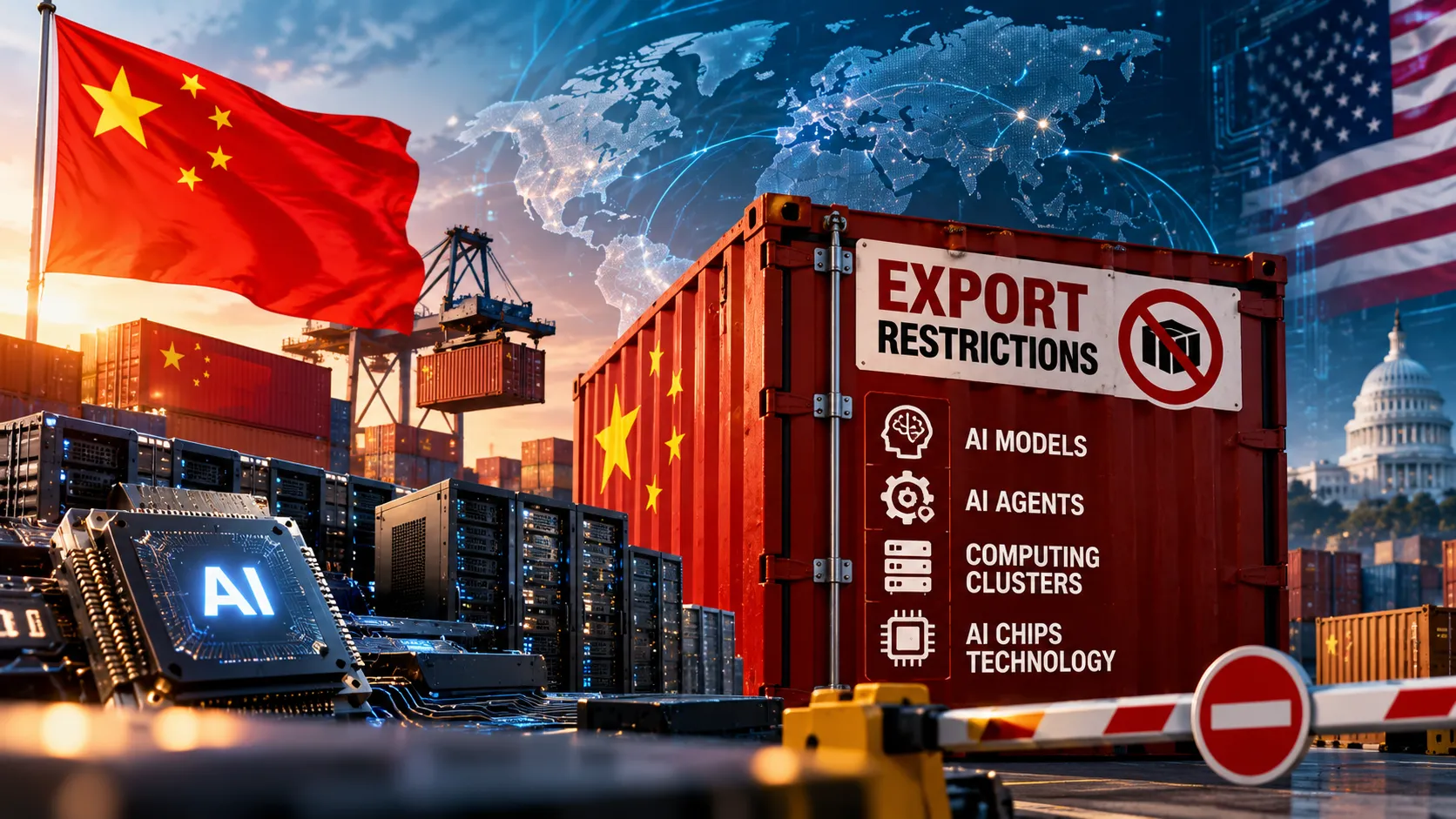
At the model level, the draft would prohibit the export of large models trained on what China classifies as "core data" and restrict those trained on "important data", two categories defined under the country's data security laws. It also covers core model technologies, including model weights, checkpoints, source code and architecture, where the underlying products exceed designated performance thresholds.
The draft extends to AI agents, systems that can plan, break down tasks, call software tools and work together, again subject to performance thresholds, with the most sensitive agents prohibited from export. It also covers technologies for building and running computing clusters of more than 10,000 accelerator cards, including high-speed interconnects, fault tolerance, communication scheduling and the management of clusters built from different types of chips.
Design technologies for AI processors and memory chips are included, as are several security and information-processing technologies. AI-driven generation of malicious code would be prohibited, while AI vulnerability discovery, deepfake detection, steganography, voiceprint recognition and translation for Chinese and minority languages would be controlled.
What Is Left Out
The proposal includes significant carve-outs. Technologies that are already public through open-source releases, academic publications or other means would not be controlled. That matters because several of China's leading AI developers, including DeepSeek and Alibaba's Qwen team, have released powerful models with openly published weights that are used by developers around the world.
The Ministry of Commerce spokesperson also said that offering AI models to overseas users through application programming interfaces, apps, websites, software-as-a-service platforms or lightweight on-device deployment would not fall under the large-model export controls. What would be covered is overseas local deployment of models containing restricted technology, such as installing a restricted model on servers abroad.
Open-source technology exports and Chinese companies operating their own overseas computing centres would face simplified licensing, and most AI technologies would remain freely exportable, according to reports on the proposal.
Beijing's Stated Rationale
The spokesperson described the revision as routine and said it was "not directed at any particular country, region, or entity". The stated rationale for the AI controls is safety and controllability, including preventing the misuse of tools that could be used for attacks.
The spokesperson also emphasised China's support for open-source development, international cooperation and building AI capacity in countries of the Global South.
Yet the timing and scope of the proposal place it squarely within the wider technology rivalry between Beijing and Washington. The United States has spent years restricting exports of advanced AI chips and chipmaking equipment to China, aiming to slow its progress in frontier AI. China has responded with its own export controls in strategic areas, including critical minerals used in semiconductors and batteries. The new proposal extends that approach to the software and systems where Chinese companies have become globally competitive.
Solar and Biotech in the Crosshairs
Although AI dominates the headlines, the photovoltaic controls could prove just as consequential for global industry. The draft covers technologies for polysilicon production, silicon wafer preparation and solar cell manufacturing, including next-generation perovskite and tandem cells, as well as key equipment that incorporates the controlled technologies. Restricted items include polysilicon production technology for lines of 30,000 tonnes a year and wafer technology at 130 micrometres or thinner.
China dominates every stage of the solar manufacturing supply chain, and its engineering know-how has been central to the dramatic fall in solar panel prices over the past decade. Restricting the transfer of that know-how could make it harder for other countries to build their own polysilicon, wafer and cell factories.
In biomedicine, the draft would prohibit transferring ownership of original cell and gene therapy and siRNA drug process platforms abroad, as well as certain gain-of-function technologies involving pathogenic microorganisms. Overseas licensing without a transfer of ownership, along with outsourced research and manufacturing, would generally remain outside the controls.
Why It Matters for India
The proposal carries direct implications for India on two fronts.
In solar, India is trying to build a domestic supply chain that extends beyond module assembly into cells, wafers and polysilicon. Government rules that require domestically made cells for many projects have accelerated investment in cell manufacturing, but the upstream segments remain heavily dependent on Chinese technology, equipment and engineers. Controls on the export of polysilicon, wafer and advanced cell technologies could raise costs or slow the build-out of Indian factories that rely on Chinese know-how.
In AI, the impact is likely to be more limited in the near term. Indian developers and startups that use Chinese open-weight models would be largely unaffected, as published models fall outside the controls, and access through APIs and cloud services is exempt. But companies seeking to license proprietary Chinese models for deployment on their own infrastructure, or to partner with Chinese firms on large computing clusters, could face new licensing requirements.
A Global Contest Over AI Technology
The move underscores how AI has become a matter of national strategy for the world's major powers. The United States has used export controls to limit China's access to the most advanced chips, while encouraging allies to adopt American AI technology. China, whose companies have closed much of the gap in AI models despite those restrictions, now appears intent on controlling how its own most advanced capabilities spread abroad.
For multinational companies and investors, the proposal adds another layer of compliance complexity. Cross-border deals involving Chinese AI technology, including acquisitions, joint ventures and licensing arrangements, may now require careful review under both Chinese and American rules.
What Comes Next
Much will depend on details that remain unclear, particularly where China sets the performance thresholds that determine which models and agents are controlled. High thresholds would capture only a handful of frontier systems; lower ones could affect a much larger share of the industry.
The consultation period, which runs until 15 November, gives companies and other stakeholders an opportunity to seek clarity and propose changes. Meanwhile, the temporary registration requirement means Chinese exporters must already file details of covered technology transfers, including the recipient, destination and intended use.
For the global technology industry, the message is clear. The contest over AI is no longer fought only through restrictions on chips flowing into China. It is increasingly about which countries control the models, agents and computing infrastructure that will define the next era of technology, and who they are willing to share them with.