FundingMarket Data Women6 MIN READ

China's Economy Grows 4.5% in Third Quarter, Beating Forecasts as Exports Offset a Deepening Property Slump

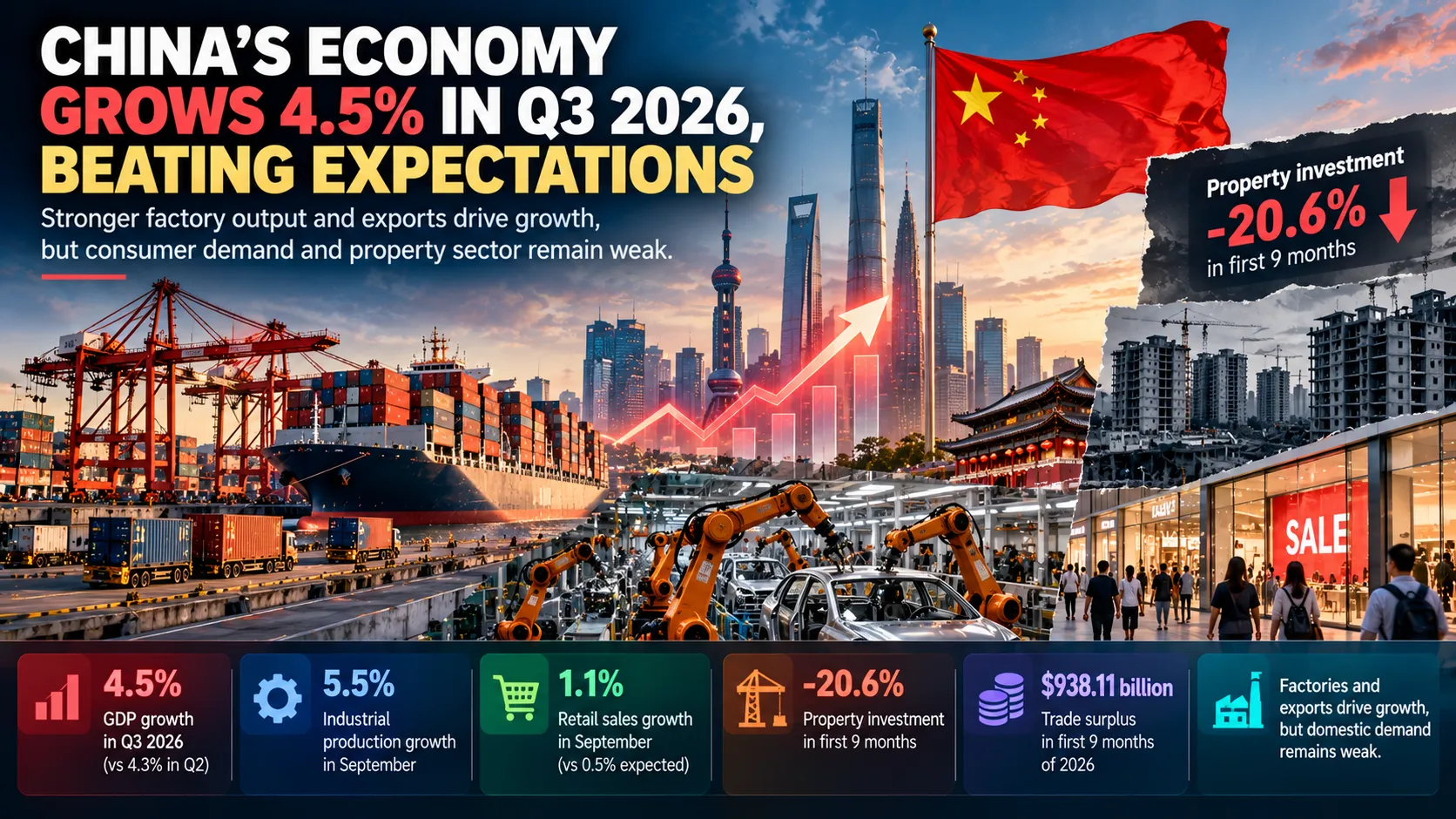
China's economy expanded 4.5% year on year in the July-to-September quarter, slightly ahead of the 4.4% analysts expected and faster than the 4.3% recorded in the second quarter, but weak consumption, falling fixed-asset investment and a 20.6% slump in property investment show how unbalanced the recovery remains.

By Shaym Kumar · Author19 October 2026New
China's Economy Grows 4.5% in Third Quarter, Beating Forecasts as Exports Offset a Deepening Property Slump

China's economy picked up speed in the third quarter, growing faster than economists had expected and keeping Beijing within reach of its growth target for 2026. Gross domestic product rose 4.5% year on year in the July-to-September period, according to data released by the National Bureau of Statistics on October 19, slightly ahead of the 4.4% median forecast and up from 4.3% in the second quarter.

Over the first nine months of the year, the economy grew 4.6%, with total output reaching 107.11 trillion yuan. That keeps China within the official 2026 growth target of 4.5% to 5%, though at the lower end of the range. Growth in the first quarter had been 5.0%.

The headline figure offered some reassurance to global investors, who have been unsettled by a sell-off in technology stocks, high oil prices and rising bond yields. China's CSI 300 index reversed early losses to trade higher after the release. But the details of the data showed an economy that remains heavily dependent on factories and exports, while domestic demand and the property market continue to struggle.

Factories strong, shoppers cautious

Industrial production rose 5.5% year on year in September, supported by strong output in manufacturing, technology hardware and equipment. Chinese factories have benefited from global demand for electronics and components linked to the artificial intelligence boom, as well as continued growth in sectors such as electric vehicles and renewable energy equipment.

Consumer spending, by contrast, remained weak. Retail sales grew just 1.1% in September, although that was better than the 0.5% economists had forecast. Households have been cautious for several years, held back by falling property values, uncertain job prospects and a weak social safety net that encourages precautionary saving.

The gap between production and consumption has been a central feature of China's economy since the pandemic. When factories produce more than households buy, the surplus must be exported or stockpiled, and prices tend to fall. China has battled weak or negative inflation for much of the past three years, which squeezes corporate profits and makes debt harder to repay.

Property slump deepens

The weakest part of the economy remains real estate. Property investment fell 20.6% year on year in the first nine months of 2026, extending a downturn that began in 2021 when regulators cracked down on excessive borrowing by developers. Several of the country's largest builders defaulted on their debts, unfinished housing projects piled up and home prices have fallen for years in many cities.

Property and related industries once accounted for roughly a quarter of China's economic activity, and the slump has had wide knock-on effects. Local governments, which relied on land sales for a large share of their revenue, have had less money to spend. Households, who hold most of their wealth in housing, have felt poorer and cut back on spending.

Broader fixed-asset investment, which covers infrastructure, manufacturing and property, fell 7.2% in the January-to-September period. The decline highlights how hard it has been for Beijing to find new engines of investment-led growth as the property sector shrinks and local governments struggle with debt.
a96189bf-0032-492a-81e5-b7e75fb8f86e.png

Exports keep the engine running

China's trade sector has been the main source of strength. The country ran a trade surplus of $938.11 billion in the first nine months of 2026, an enormous figure that reflects both the competitiveness of Chinese manufacturers and the weakness of domestic demand for imports.

Exports have held up despite tariffs and trade restrictions imposed by the United States and other economies. Chinese companies have redirected shipments towards Southeast Asia, Latin America, Africa and the Middle East, and have moved some production to third countries. The surge in exports has also caused friction, with several governments raising concerns about low-priced Chinese goods flooding their markets.


“Industrial output and exports are carrying China's economy, but households are still not spending and the property market is still contracting.”
— TIGI Markets Desk

The size of the surplus is likely to keep trade tensions in focus. Policymakers in Europe, the United States and developing economies have increasingly argued that China's growth model, which relies on manufacturing and exports while household consumption remains low, places pressure on industries elsewhere.

What it means for India and the world

For India, China's data carries several implications. China is one of India's largest trading partners, and India runs a large trade deficit with its neighbour, importing electronics, machinery, chemicals and pharmaceutical ingredients. Weak domestic demand in China and strong export growth mean Indian manufacturers face continued competition from low-cost Chinese goods, both at home and in third markets.

At the same time, China's struggles have strengthened India's pitch as an alternative destination for global investment. Companies seeking to diversify supply chains away from China have expanded in India, particularly in electronics assembly, automobiles and pharmaceuticals. A slower, more unbalanced Chinese economy could reinforce that trend.

For commodity markets, China's industrial strength supports demand for metals and energy, while the property slump weighs on steel and construction materials. For global markets more broadly, stable Chinese growth reduces the risk of a sharp slowdown in the world's second-largest economy at a time when the United States and Europe face high inflation and rising interest rates.

Markets and the yuan

Financial markets took the figures in their stride. Chinese equities edged higher after the release, while investors in commodities weighed the strength of industrial output against the continued weakness in construction. Shares of property developers remain far below their pre-crisis levels, reflecting scepticism that the housing market has found a floor.

Economists say the composition of growth matters as much as the headline rate. Growth led by exports and factory output tends to be more vulnerable to trade tensions and global demand cycles than growth led by household spending. It also increases the risk of friction with trading partners, several of which have introduced tariffs or investigations into Chinese goods in sectors such as electric vehicles, steel and solar equipment.

For multinational companies, China remains an essential market and production base, but many are adopting a "China plus one" approach, keeping operations in China while building capacity elsewhere in Asia, including in India and Southeast Asia.

The policy question

The data is likely to shape debate in Beijing over whether more stimulus is needed. Economists have long argued that China needs to shift its growth model towards household consumption, through measures such as higher social spending, pension reform and support for the property market. The government has introduced a series of targeted measures, including trade-in subsidies for consumer goods and support for housing purchases, but has so far avoided large-scale direct transfers to households.

With growth of 4.6% in the first three quarters, China needs a solid fourth quarter to stay within its 2026 target range. Strong exports and industrial production should help, but the persistent weakness in consumption and property means the recovery remains fragile.

For global investors, the third-quarter figures offer a mixed picture: an economy that is growing steadily and beating expectations, but one whose foundations still depend heavily on factories and foreign buyers. Until households begin spending with confidence and the property market stabilises, China's growth is likely to remain unbalanced, with consequences that reach far beyond its borders.

TagsChina GDPChina economythird quarter GDPNational Bureau of Statisticsproperty investmentretail salesindustrial outputfixed-asset investmenttrade surplusexportsChinese yuanXi Jinpingstimulusemerging marketsglobal growthIndia China tradeAsia marketsShanghai CompositeCSI 300deflation

Reader reviews

Sign in to rate and review this article.
Loading reviews…
