Two closely watched surveys of China's manufacturing sector have painted strikingly different pictures of the world's second-largest economy, leaving investors to weigh whether factory activity is holding up or losing steam.
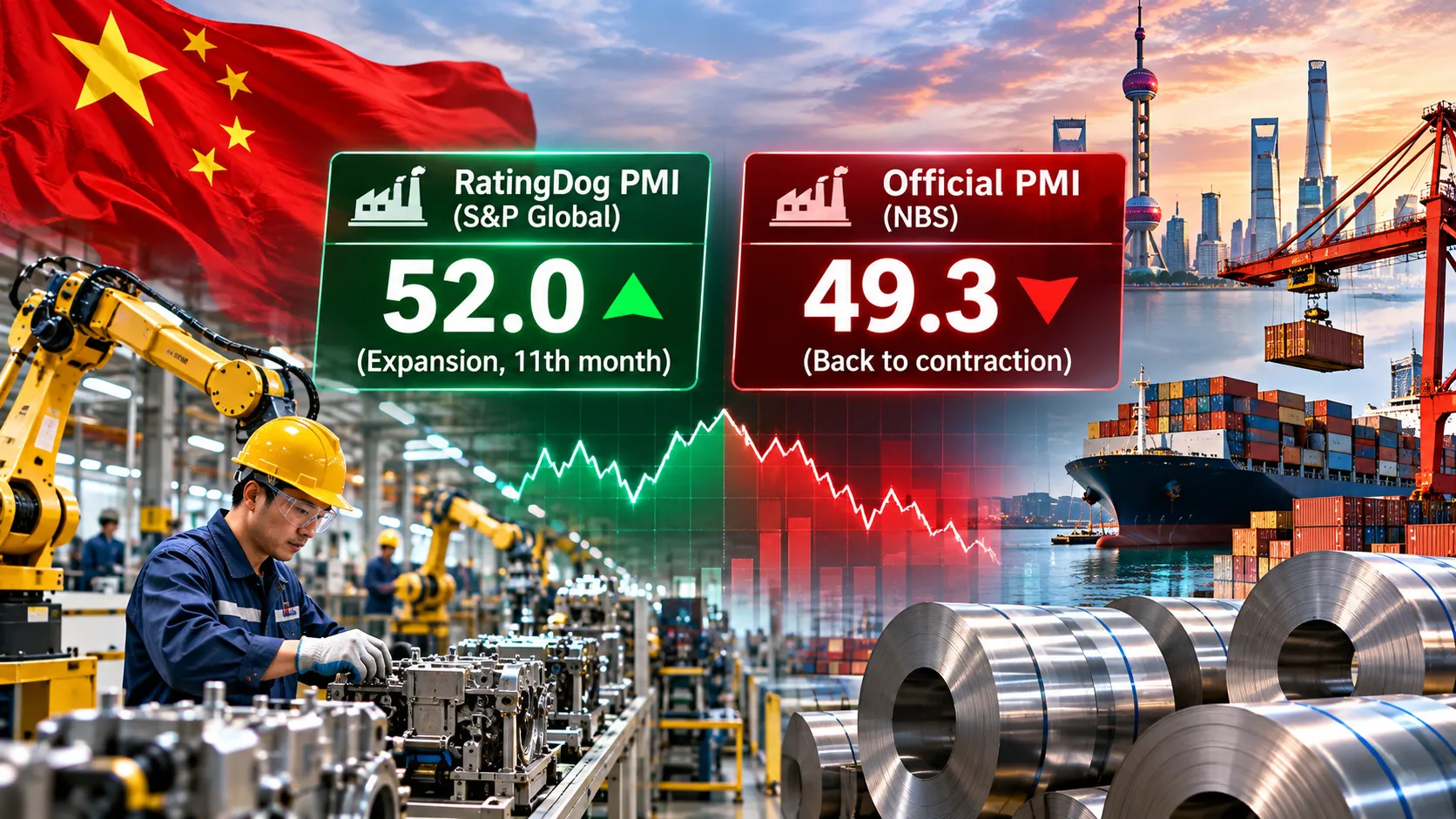
The RatingDog China general manufacturing PMI, compiled by S&P Global, edged down to 52.0 in October 2026 from 52.1 in September, in line with expectations, according to data released on Monday, November 2, and reported by BigGo Finance. It was the 11th consecutive month above the 50 mark that separates expansion from contraction.
By contrast, the official manufacturing PMI published by the National Bureau of Statistics (NBS) on October 31 fell to 49.3 from 50.1, below the expected 49.9, returning to contraction territory.
Inside the private survey
The RatingDog survey showed output growing at the fastest pace since April, according to the report. New orders rose for a 17th consecutive month, and export orders increased for a fourth month, although export growth slowed to a three-month low.
Employment increased for a second straight month, but only marginally. Business confidence remained positive but fell to a nine-month low, suggesting that manufacturers are cautious about the outlook despite current activity.
On prices, input costs rose for a 16th month but at a slower pace. Factory-gate prices were cut for the second time in three months, and export prices fell for the first time since November 2025, according to the report.
Why the surveys differ
The divergence reflects differences in the samples. "The official gauge is dominated by large and state-owned enterprises," while the RatingDog survey has more exposure to smaller, private firms, according to the report. Large state-owned companies are concentrated in heavy industry, such as steel, chemicals and construction materials, which have been affected by weakness in China's property sector and infrastructure spending.
The NBS attributed the decline in the official index to demand being pulled forward ahead of the National Day holiday in early October and to a volatile international environment.
Smaller private firms, often concentrated in consumer goods, electronics and export-oriented manufacturing, may have benefited from strong global demand for electronics and from China's continued export competitiveness.
The deflation concern
The decline in factory-gate and export prices highlights a persistent challenge for China: deflationary pressure. Intense competition in many industries, overcapacity and weak domestic demand have pushed down prices, squeezing manufacturers' profits. Chinese authorities have launched campaigns against "involution," or excessive price competition, particularly in industries such as electric vehicles, solar panels and batteries.
Falling export prices also mean that China is exporting deflation to the rest of the world, making its goods more competitive but intensifying pressure on manufacturers in other countries, including India.
Trade tensions
China's export performance has been resilient despite US tariffs, as Chinese companies have diversified to other markets in Southeast Asia, Latin America, the Middle East and Africa. However, trade tensions remain a risk. China recently proposed export controls on 23 AI technologies, and the United States has maintained restrictions on chip exports to China.
South Korea's data, released on November 1, showed its exports to China rising 133.6% in October, driven by semiconductors, indicating strong Chinese demand for advanced technology components even as broader manufacturing activity is mixed.