Clueso, an artificial-intelligence startup that turns rough screen recordings into polished product videos and documentation, has raised $10 million in a Series A round led by Dharana Capital. The round takes the company’s total funding to $12 million.
New investors Founders Future and Neotribe Ventures joined the round, alongside existing backers Y Combinator and f7 Ventures. Clueso operates from California and Bengaluru, the cross-border model that has become standard for a generation of Indian-origin software founders building for global enterprise customers.
The startup says more than 1,000 companies use its platform, including Atlassian, Zendesk, Gainsight, GlobalPartners, Seismic and Ironclad. It claims customers achieve up to five times higher productivity in producing video content and cut video production costs by as much as 80%.
Three IIT Madras founders and a YC launchpad
Clueso was founded in 2023 by Akash Anand, who is chief executive, along with Prajwal Prakash and Neel Balar. All three are alumni of IIT Madras. The company went through Y Combinator, the Silicon Valley accelerator that has become a key bridge for Indian technical founders seeking US customers and capital.
The problem Clueso targets is familiar to anyone who has worked at a software company. Every new feature, update or workflow requires explainer videos, help-centre articles, onboarding guides and training material. Producing them traditionally means recording screens, writing scripts, hiring voice-over artists, editing footage and then redoing much of the work each time the product interface changes. For fast-moving software companies shipping updates weekly, documentation is almost always out of date.
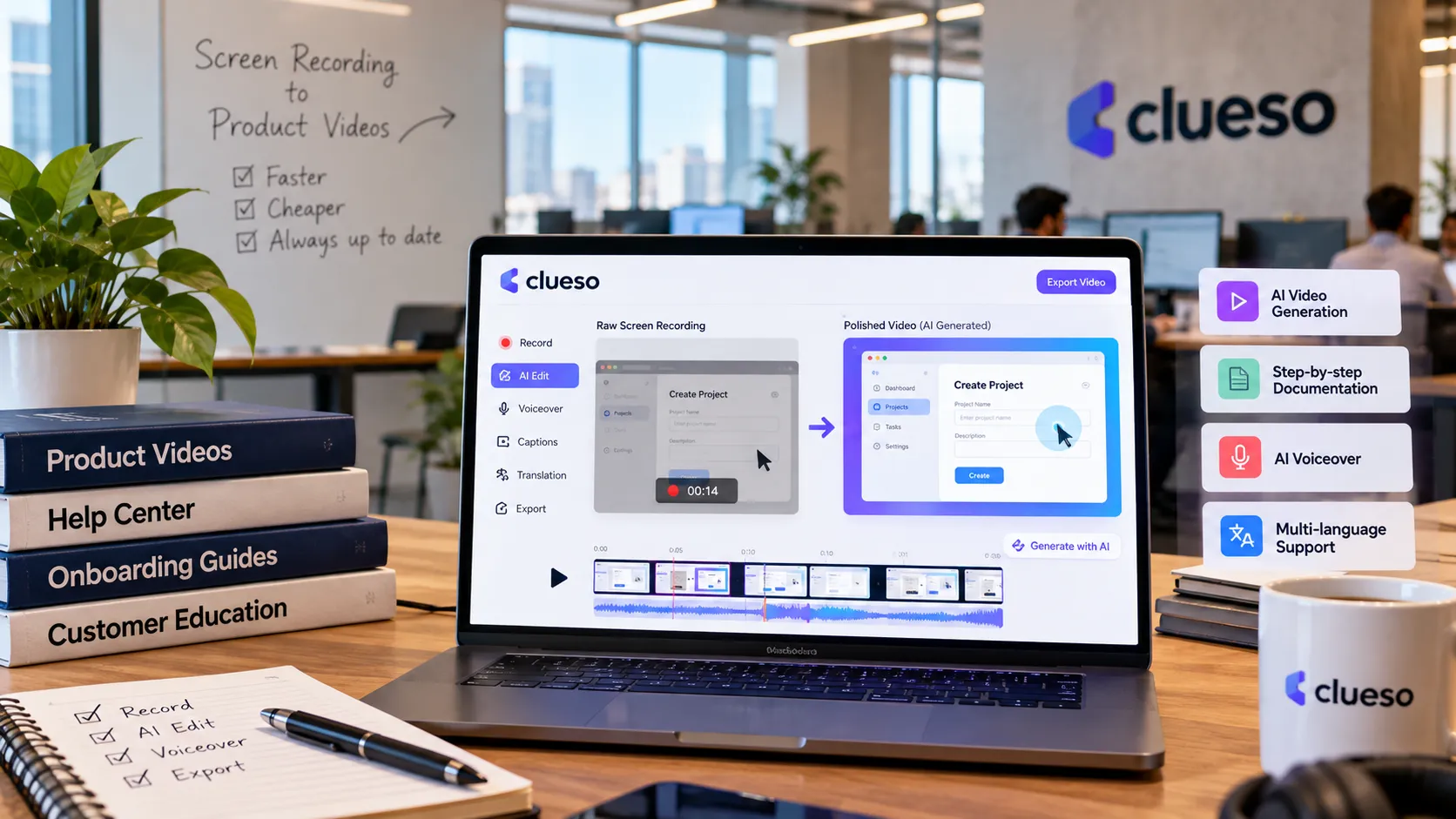
Clueso’s software allows a product manager, support agent or marketer to record a quick, unpolished screen capture. Its AI then cleans up the recording, writes a script, adds a professional AI-generated voice-over, inserts zooms and captions, and can produce matching step-by-step written documentation. Videos can be translated into multiple languages, an important feature for companies supporting global customer bases.
From static clips to ‘living’ content
Dharana Capital’s thesis focuses on how enterprise content is changing. Vamsi Duvvuri, the firm’s founder and managing partner, has described video as becoming “living, context-aware assets”: content that can be updated, regenerated and personalised as products evolve, instead of being recorded once and left to go stale.
That idea matters commercially. Traditional video tools treat each clip as a finished artefact. An AI-native platform can, in principle, regenerate a tutorial when a button moves, produce a version tailored to a specific customer segment, or feed the same knowledge into a chatbot or in-app help system. The more a company’s product knowledge sits inside such a platform, the harder it becomes to switch away, a dynamic investors look for in software businesses.
A crowded and fast-moving market
Clueso is entering one of the most competitive corners of generative AI. Video creation and editing has attracted heavy investment, from avatar-based video generators to screen-recording tools that have added AI editing, as well as large platforms building video features directly into their productivity suites. Foundation-model companies continue to release more capable video-generation models, lowering the barrier to entry.
Clueso’s strategy is to specialise. Rather than competing on cinematic generation, it focuses on product education and documentation for software companies, a narrower market with clear budgets in customer success, support, marketing and enablement teams. Its enterprise customer list suggests the approach is resonating with buyers that value accuracy and brand consistency over flashy effects.
Pricing pressure is a risk. As AI capabilities become commoditised, startups that build thin layers on top of third-party models can find their margins squeezed. Clueso will need to show that its workflow, integrations and data on how products are used give it a durable advantage over tools bundled for free into larger suites.
The India–US playbook
The company’s structure reflects a well-established pattern. Engineering and product development are concentrated in Bengaluru, where talent costs are lower and AI engineering depth is growing, while sales and customer relationships are anchored in the United States, where most enterprise software budgets sit. Indian SaaS companies from Freshworks to Postman have used versions of this model to build global businesses.
For Dharana Capital, the Clueso deal sits alongside its other recent bets on Indian founders building for AI-era markets, including its co-lead of a ₹110 crore round for Bengaluru’s Mesa School of Business announced the same day.
Why customers are buying
The economics of product education explain Clueso’s traction. For a large software company, customer support is a major cost, and every confused user who files a ticket instead of finding an answer adds to it. Clear, current video tutorials and documentation reduce support volume, speed up onboarding and help customers adopt more features, which in turn supports renewals and upsells.
Traditionally, producing that content has required specialist teams or agencies. A single polished explainer could take days to script, record, voice and edit. If an AI workflow compresses that to minutes, a support or product team can document far more of the product, keep it current with every release, and localise it for international markets without multiplying cost.
That is the logic behind Clueso’s claims of up to five times higher productivity and as much as 80% lower video production costs. Those figures are company estimates and will vary by customer, but the direction of travel is clear: AI is turning content production from a project into a continuous, largely automated process.
The roster of customers, which spans collaboration software, customer service, customer success and legal technology companies, also suggests the tool is not confined to a single niche. Each of those sectors ships frequent product changes and supports large user bases, making up-to-date documentation a constant operational need.
What comes next
Clueso has not disclosed a detailed breakdown of how it will use the funds, but Series A capital at this stage typically goes into expanding engineering teams, building deeper integrations with the platforms where software companies host help content, and scaling go-to-market teams in North America and Europe.
The company’s next challenge will be moving from a popular tool used by teams inside large companies to an enterprise-wide platform with larger, multi-year contracts. That transition usually requires security certifications, administrative controls and a sales motion aimed at executives instead of individual users.
Clueso is another example of young founders from top engineering institutes building AI-native software companies from day one, with global customers in mind. If it can turn its early traction with names such as Atlassian and Zendesk into durable enterprise relationships, it could become one of the more closely watched Indian-founded AI application companies of this cycle.