
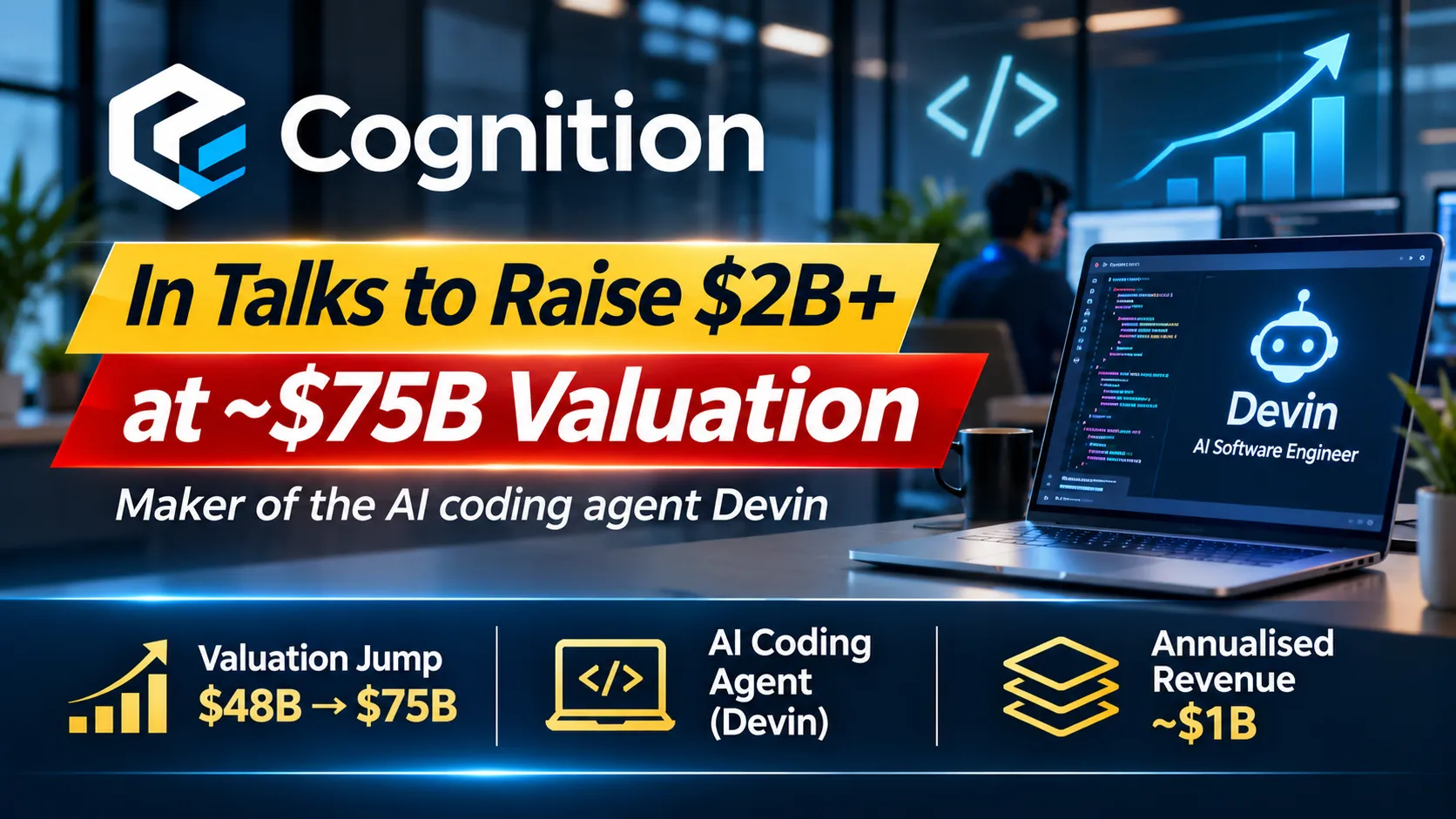
Cognition, the San Francisco-based startup behind the AI coding agent Devin, is in talks to raise new funding at a valuation of about $75 billion, Bloomberg reported on November 21. The talks come even as a broad selloff in AI-related stocks has rattled investors.
The company is seeking to raise more than $2 billion, according to reports. The new valuation would be up from $48 billion in September, when Cognition announced a Series E round. The talks have not closed, and terms could still change.
Investors in the company include Avenir, Accel, Lightspeed, Lux and Bessemer, according to reports.
A meteoric rise
Cognition's valuation trajectory has been among the steepest in the AI industry. The company raised about $1 billion at a $25-26 billion valuation in May 2026. By August, Bloomberg reported it was in talks at $40 billion or more. In September it announced a round at $48 billion. In late October, Business Insider reported that the company was fielding offers valuing it at $70 billion to $80 billion.
The latest reported figure of $75 billion would make Cognition one of the most valuable private AI companies in the world, behind only the largest model developers.
What Devin does
Cognition was founded in 2023 by Scott Wu, Steven Hao and Walden Yan. The company gained widespread attention in early 2024 when it introduced Devin, which it described as an AI software engineer. Unlike earlier coding assistants that suggest lines of code, Devin is designed to take on entire programming tasks: planning, writing code, running tests, debugging and submitting changes.
AI coding agents have become one of the most commercially successful applications of generative AI. Software development is a large and expensive activity, and tools that make engineers more productive or automate routine tasks offer clear economic value. Enterprises have been adopting AI coding tools rapidly.
Cognition has expanded its product line, including through its acquisition of the Windsurf coding editor in 2025. It reported a run-rate revenue of about $492 million in May 2026, and reports have since suggested annualised revenue approaching $1 billion.
The AI coding race
The market for AI coding tools has become one of the most competitive in technology. Rivals include Anysphere, maker of the Cursor code editor, which SpaceX agreed to acquire for $60 billion in April 2026, as well as tools from OpenAI, Anthropic, GitHub (owned by Microsoft), Google and many startups.
The SpaceX-Cursor deal set a high benchmark for AI coding company valuations. Business Insider noted that a $75 billion valuation for Cognition would not be far-fetched in light of that deal.
Competition has also produced public friction. Earlier in November, the bosses of Cognition and rival Factory clashed publicly over an adviser's exit, according to Bloomberg.
Raising money in a turbulent market
The talks are notable for their timing. AI-related stocks have suffered a sharp selloff, with the Nasdaq 100 falling significantly over the week to November 20 and Nvidia experiencing a historic losing streak. Concerns about the financing of AI infrastructure and the sustainability of AI spending have weighed on sentiment.
Yet private investors appear willing to pay high prices for AI application companies with strong revenue growth. Coding tools in particular have shown clear demand from paying enterprise customers, which distinguishes them from more speculative AI applications.
The valuation question
A $75 billion valuation on roughly $1 billion of annualised revenue implies a very high multiple. Investors are betting that Cognition's revenue will continue to grow rapidly and that AI coding agents will capture a large share of the global software development market.
Sceptics point to risks. Competition is intense, and large technology companies with their own AI models can bundle coding tools with other products. AI model costs are significant, and companies that rely on third-party models may face margin pressure. Customer loyalty in a fast-moving market may also be limited.
Implications for India's IT industry
The rise of AI coding agents has significant implications for India. The country's IT services industry employs millions of software engineers and generates hundreds of billions of dollars in revenue, largely from writing and maintaining software for global clients.
AI coding tools could transform this business. They may increase the productivity of Indian engineers, allowing IT companies to deliver more with fewer people. They could also put pressure on pricing for routine development and maintenance work, which has been a core revenue source.
Indian IT companies have been investing heavily in AI capabilities and partnering with AI firms to integrate tools into their services. Indian IT stocks have fallen in recent sessions amid concerns about AI disruption and global technology spending.
For individual developers in India and the diaspora, AI coding agents are changing the skills in demand. Engineers who can work effectively with AI tools, design systems and solve complex problems are likely to be in higher demand than those focused on routine coding.
What comes next
If the funding round is completed, Cognition will have significant capital to invest in research, compute, product development and sales. It may also pursue further acquisitions, as it did with Windsurf.
The round would also strengthen its position in the competitive AI coding market and provide a war chest as it prepares for the next stage of growth, which could eventually include an IPO.
For The Impactful Global Indian's readers, Cognition's rise illustrates both the scale of opportunity in AI and the speed at which AI is reshaping software development, an industry in which India and the Indian diaspora play a central role.
The talent war
Behind the valuations lies an intense competition for talent. AI coding companies are competing with the largest technology firms and AI labs for researchers and engineers who can build and improve models and agents. Compensation packages for top AI talent have soared, and large funding rounds give startups like Cognition the resources to compete. Many of the engineers building these systems are of Indian origin, and India itself is becoming a significant source of AI engineering talent for global companies.


