
StartupsLatest5 MIN READ

Milan's Complaion Raises €13.5 Million to Take the Paperwork Out of ISO Certification for Europe's Small Businesses

Two-year-old Italian start-up Complaion has raised €13.5 million led by Eurazeo and Italian Founders Fund for a platform that pairs software with human experts to automate ISO certification and new EU rules such as NIS2 and the AI Act.

By Nisha Omkumar · Author29 September 2026New
Milan's Complaion Raises €13.5 Million to Take the Paperwork Out of ISO Certification for Europe's Small Businesses

For a small manufacturer in northern Italy, winning a contract with a large customer often depends on a certificate. Buyers increasingly ask suppliers to prove that they meet international standards for quality, information security or environmental management. Getting that proof can take months of documentation, consultants and audits, a burden that falls hardest on companies without dedicated compliance staff.

Complaion, a Milan-based start-up founded in 2024, wants to make that process faster and cheaper. The company has raised €13.5 million in a funding round led by Eurazeo and Italian Founders Fund, announced on 28 September 2026.

Participating investors include Shapers, 2100 Ventures, Kfund, Sella Direct Ventures, Enzo Ventures, Vento, Ithaca, Eden Ventures and Vesper.

The founding team

Complaion was founded by Edoardo Tarricone, who serves as chief executive, Marco Cortinovis, the chief operating officer, and Alessandro Vaccarino, the chief technology officer. Raising €13.5 million within about two years of founding is a strong result for an Italian business-to-business software company, in a country whose start-up ecosystem is smaller than those of France, Germany and the United Kingdom.

What the platform does

Complaion's platform helps small and medium-sized enterprises (SMEs) obtain and maintain certifications under a range of international standards. These include ISO 9001 for quality management, ISO 27001 for information security, ISO 14001 for environmental management and ISO 42001, the newer standard for managing artificial intelligence systems. It also supports UNI/PdR 125, the Italian reference practice for gender equality in the workplace, which companies can use to obtain certification that brings benefits in public procurement and tax incentives in Italy.

Beyond voluntary standards, the platform supports compliance with major European regulations, including the NIS2 Directive on cybersecurity and the EU AI Act.

The company says its software automates up to 80 per cent of the manual activities involved in compliance and can reduce certification times by up to five times. That includes preparing policies and procedures, collecting evidence, tracking controls and preparing for audits.

Software plus people

Complaion's approach combines automation with human expertise, including support for companies working with auditors. That hybrid model is a deliberate choice in a field where the final judgement rests with accredited certification bodies and regulators.

"In an increasingly digital sector, human expertise must remain central," Tarricone said, adding that the company's mission is "to be the point of reference for all compliance needs".

The balance is important. Pure software tools can generate documents, but SMEs often lack the knowledge to adapt them to their actual operations. Consultants provide that knowledge but are expensive. By using software to handle repetitive tasks and experts to guide judgement calls, Complaion aims to offer a service that is cheaper than traditional consulting and more reliable than a do-it-yourself template.
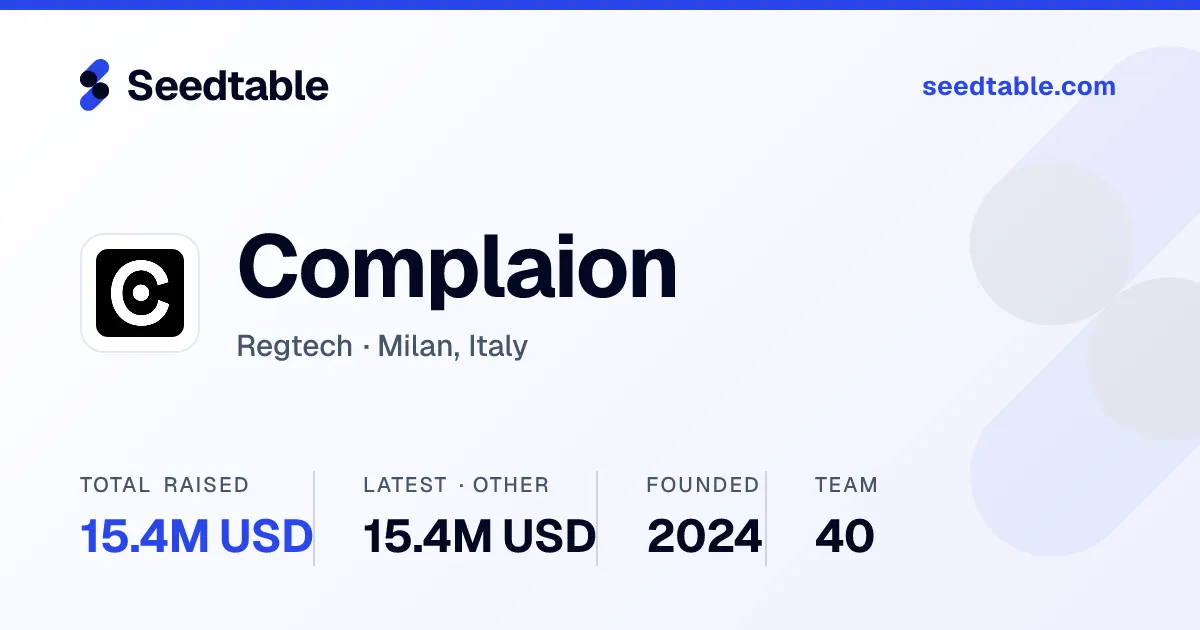
image.png

A market created by regulation

European businesses face an expanding set of compliance obligations. NIS2, which took effect in October 2024, significantly widened the number of companies subject to EU cybersecurity requirements, bringing many medium-sized firms in manufacturing, logistics, food and other sectors into scope for the first time. It also imposed obligations that flow down through supply chains, as larger companies require their suppliers to demonstrate adequate security.


“In an increasingly digital sector, human expertise must remain central.”
— Edoardo Tarricone, Co-Founder and CEO, Complaion

The EU AI Act, which entered into force in 2024 and is being phased in over several years, introduces requirements for companies that develop or deploy AI systems, particularly those considered high-risk. ISO 42001, published in 2023, has emerged as a practical framework for organisations seeking to show that they manage AI responsibly.

Sustainability reporting and environmental standards add a further layer, as large companies push their suppliers to document emissions and environmental practices.

For a large corporation with a compliance department, these requirements are manageable. For an SME with a few dozen employees, they can be overwhelming. That gap is Complaion's market.

Who its customers are

Complaion serves companies across manufacturing, healthcare, construction, logistics, professional services, agri-food, and IT and software. Those sectors are the backbone of the Italian economy, which is dominated by small and medium-sized firms, many of them family-owned exporters that supply larger companies across Europe.

Where the money will go

The company plans to use the new capital to hire specialised professionals, strengthen customer support, develop its platform and expand across Europe. International expansion is a natural step, because the standards and EU regulations it covers apply across the continent, even though each country has its own certification bodies and business culture.

A competitive field

Compliance automation has become one of the most active areas of business software investment. In the United States, companies such as Vanta and Drata have built large businesses helping technology companies achieve security certifications such as SOC 2 and ISO 27001. In Europe, a new generation of start-ups is adapting that model to local regulations and to a customer base dominated by traditional industries rather than software companies.

Complaion's focus on SMEs in industries such as manufacturing and construction, and its support for Italy-specific standards such as UNI/PdR 125, give it a distinct niche. The challenge will be to maintain that focus while expanding into countries with different regulatory priorities and competitors that already have established local relationships.

Lessons for Indian SMEs

The trend is relevant to India's exporters. Indian manufacturers and IT service providers selling to European customers increasingly face the same demands for ISO certifications, cybersecurity compliance and, soon, AI governance. The EU's supply-chain rules mean that obligations placed on European buyers will increasingly be passed to their suppliers overseas.

Indian compliance-technology start-ups have an opportunity to build similar tools for the domestic market and for Indian firms selling abroad, while Indian exporters would benefit from preparing early for requirements that are becoming conditions of doing business in Europe.

What to watch

Complaion's growth will be measured by how quickly it can expand beyond Italy, how many certifications it helps customers obtain, and whether its hybrid model of software and human experts can scale profitably. The pace of European regulation suggests that demand is unlikely to slow. For a start-up that turns regulatory complexity into a service, a steady stream of new rules is not a burden but a business opportunity.

TagsComplaionComplianceRegTechISO 27001ISO 42001ISO 9001NIS2EU AI ActSMEsEurazeoItalian Founders FundMilanEuropean StartupsAutomationB2B SaaS

Reader reviews

Sign in to rate and review this article.
Loading reviews…
