Core4 Engineers is asking investors for ₹54.82 crore at ₹88–93 a share. The company nearly tripled its revenue in FY26, but its book is only 0.08 times covered with one day of bidding left. For a Mysuru company that started out wiring irrigation pumps, the IPO tests whether India's infrastructure boom can carry a small, working-capital-hungry contractor onto the BSE SME board.
The Rs 54.82 crore issue opened on 23 October and closes on 27 October 2026. All of it is fresh capital, so no promoter is selling a single share. On paper the numbers are striking. Total income jumped from ₹34.60 crore in FY25 to ₹91.79 crore in FY26, and profit after tax rose more than threefold to ₹12.37 crore. The first quarter of FY27 (April–June 2026) alone brought in ₹45.77 crore.
The market has not been convinced so far. After three days of bidding, the issue stood at 0.08 times, and the grey market premium is a flat ₹0. TIGI looks at the full picture: business, balance sheet, valuation, risks and the mood of the market. The aim is to explain why the numbers and the demand are telling such different stories.
The issue at a glance
Item | Detail |
Issue size | ₹54.82 crore, entirely fresh issue (58,94,400 shares) |
Price band | ₹88–93 per share; face value ₹10 |
Bidding window | 23–27 October 2026 |
Allotment / listing (tentative) | 28 October / 30 October 2026, BSE SME |
Minimum individual bid | 2 lots = 2,400 shares = ₹2,23,200 at the upper band |
Post-issue market cap | About ₹192.35 crore at ₹93 |
Promoter holding | 82.09% pre-issue, 58.69% post-issue |
Lead manager / registrar | Socradamus Capital / Purva Sharegistry (India) |
Market maker | Mansi Share & Stock Broking; 7,20,000 shares reserved |
Reservation (net issue) | QIB 49.95% (anchors 15,44,400 shares), NII 15.03%, retail 35.02% |
From a Mysuru partnership to a listed EPCC aspirant
Core4 Engineers began on 6 June 2014 as a partnership firm in Mysuru. It registered with the Registrar of Firms, Mysore, on 11 July 2014. Its early work was small and local: electrical distribution and irrigation-pumping contracts of the kind that make up much of Karnataka's government tender market.
The firm became Core4 Engineers Private Limited on 3 February 2022. It later converted into a public limited company ahead of the listing. That is why some IPO portals give 2022 as the incorporation year and others give 2014. The business is twelve years old, but the corporate entity is barely four. Chanakya calls this a limited corporate operating history.
The promoters named in the offer documents are Agrahara Chamaraje Gowda Abhinandan, Hosahalli Appagigowda Savitha, Mahadevappa Tejus and Anala. Before the issue they hold 82.09% of the company, and that falls to 58.69% after it. The company is still headquartered in Kuvempunagar, Mysuru.
As of 30 September 2025, Core4 had 433 people on its rolls, counting employees and project-based workers. Its job listings show hiring for panel production, OHE design and contract billing in Mysuru. There are also accounts and OHE-design roles in Nagercoil, Tamil Nadu, which suggests work is moving beyond Karnataka. HDFC Sky's SWOT notes that the company is concentrated in Karnataka, which exposes it to state-level spending cycles and regulatory change.
What Core4 actually does
Core4 is an engineering, procurement, construction and commissioning (EPCC) contractor with its own small factory. It covers the whole project cycle, from design and procurement through installation, testing, commissioning and operation-and-maintenance contracts. It wins work mainly through tenders from Indian Railways, PSUs, utilities and larger infrastructure contractors. The business runs across six verticals:
Vertical | What it involves |
Railway electrification | 25 kV overhead equipment (OHE), traction substations and related electrical works |
Railway infrastructure | Civil, electrical and mechanical works for station redevelopment and modernisation |
EHT transmission & distribution | Turnkey substations, transformers and lines up to 220 kV |
Water & wastewater | WTPs, STPs and ETPs using MBBR and SBR treatment technologies |
Automation & SCADA | PLC-based control and remote monitoring for infrastructure assets |
HT/LT panel manufacturing | PCC, MCC and APFC panels and compact substations, for its own projects and outside buyers |
The manufacturing arm is the part that sets Core4 apart from a pure contractor. Its in-house unit builds high- and low-tension electrical panels and compact substations. These go into its own projects and are also sold to outside customers. A subsidiary, Core4 Energy Ltd, adds panel-manufacturing revenue of its own.
There are two benefits. First, the company controls the cost, quality and delivery timing of a critical component, and panel delays are a common cause of slipping electrification schedules. Second, product sales give it a second revenue stream that does not depend entirely on winning tenders.
The offer documents seen by TIGI do not disclose an order-book figure or the revenue split by segment. For an EPCC company, those two numbers matter most. Investors should look for them in the red herring prospectus before bidding.
How the company is performing
Core4 is growing very fast and staying profitable, but it is paying for that growth with debt and cash it has not yet collected. FY26 total income rose 165% to ₹91.79 crore and PAT rose 225% to ₹12.37 crore. Both followed two flat years.
₹ crore | FY24 | FY25 | FY26 | Q1 FY27 (Apr–Jun 2026) |
Total income | 33.63 | 34.60 | 91.79 | 45.77 |
EBITDA | 4.96 | 6.71 | 18.30 | 9.08 |
Profit after tax | 2.89 | 3.81 | 12.37 | 6.17 |
PAT margin | 8.6% | 11.0% | 13.5% | 13.5% |
The break in the trend is sharp. Between FY24 and FY25, income barely moved, up 2.9%, even though profit rose by about a third. The jump came in FY26. Then the April–June 2026 quarter produced ₹45.77 crore of income and ₹6.17 crore of PAT, roughly half the previous full year in three months. If that pace holds, FY27 income would be well above ₹150 crore.
Margins have held up through the expansion. EBITDA margin was 20.04% in FY26 and 19.90% in Q1 FY27. FY26 return on equity was 49.70% and return on capital employed was 37.78%, high for a contractor of this size.
The balance sheet tells the other half
₹ crore | 30 Jun 2026 | 31 Mar 2026 | 31 Mar 2025 | 31 Mar 2024 |
Total assets | 145.43 | 116.32 | 67.12 | 31.97 |
Net worth | 37.23 | 31.07 | 18.70 | 6.43 |
Total borrowings | 40.57 | 31.58 | 18.58 | 16.75 |
Debt / equity (x) | 1.09 | 1.02 | — | — |
Total assets have grown more than fourfold in just over two years. Borrowings have more than doubled since FY24 and now exceed net worth. NiftyTrader's risk summary flags negative operating cash flow despite reported profits. That is the classic EPCC pattern: profit is booked as work is billed, but cash arrives only when the government client pays.
One caution on comparisons. Some reviews written on draft-prospectus numbers still quote the six-month figures to September 2025: ₹47.07 crore of revenue and ₹6.05 crore of PAT. They then compare valuation with FY25 earnings. The final offer documents include full FY26 and Q1 FY27 figures, and this story uses those.
Where the money goes
About 91% of the identified IPO proceeds will go into working capital, not new capacity.
Object of the issue | ₹ crore |
Incremental working capital | 40.48 |
Land and existing building for a new manufacturing unit and corporate office | 4.12 |
General corporate purposes | Balance, per RHP |
Identified net proceeds | 44.60 |
A ₹4.12 crore property purchase is a modest capex outlay. It buys a site with a building already on it, which could let Core4 expand panel manufacturing quickly without a long construction phase. Chanakya warns that this sum should not be read as the full cost of getting the new unit running, since machinery and fit-out could add to it.
The ₹40.48 crore for working capital is the main use of the funds. EPCC contractors must buy materials, pay subcontractors and post bank guarantees months before government clients settle their bills. With borrowings already above net worth, raising equity for this gap is cheaper and safer than more bank debt. The working-capital figure was ₹32.68 crore in the draft prospectus and rose in the final documents, which suggests funding needs grew as revenue grew. For shareholders, the question is whether this capital turns into collected cash.
Valuation: cheap or expensive depends on which year you believe
At ₹93, Core4 is valued at about ₹192 crore. That is 15.5 times FY26 earnings on the enlarged share base, or about 7.8 times if the June quarter is annualised.
Measure at ₹93 | Value | Basis |
Post-issue market cap | ₹192.35 crore | 2,06,83,245 shares |
P/E, pre-issue | 11.12x | FY26 EPS ₹8.36 on pre-issue shares |
P/E, post-issue (FY26) | ~15.5x | FY26 PAT ₹12.37 crore ÷ market cap (TIGI calculation) |
P/E, post-issue (annualised) | 7.8x | Q1 FY27 PAT × 4 |
P/BV | 4.43x (Mar 2026); 3.69x (Jun 2026) | Pre-issue net worth |
P/BV, post-issue | ~2.1x | Jun 2026 net worth plus ₹54.82 crore raised, before issue expenses (TIGI calculation) |
On FY26's actual profit, a mid-teens multiple is reasonable but not obviously cheap for an SME contractor with negative operating cash flow. On the annualised June-quarter number it looks inexpensive. But one quarter's run-rate in a lumpy, milestone-billed business is a weak basis for valuation. Older reviews using FY25 profit arrived at about 50 times, which shows how fast the picture has changed.
The only listed peer named in the offer documents is K2 Infragen. It trades at about 3.97 times earnings and 0.58 times book, with a RoNW of 14.83%. Against that, Core4 asks for a large premium, justified by much higher return ratios: FY26 RoNW was 39.81%. Investors are effectively paying for Core4's growth and returns to continue, not for its asset base.
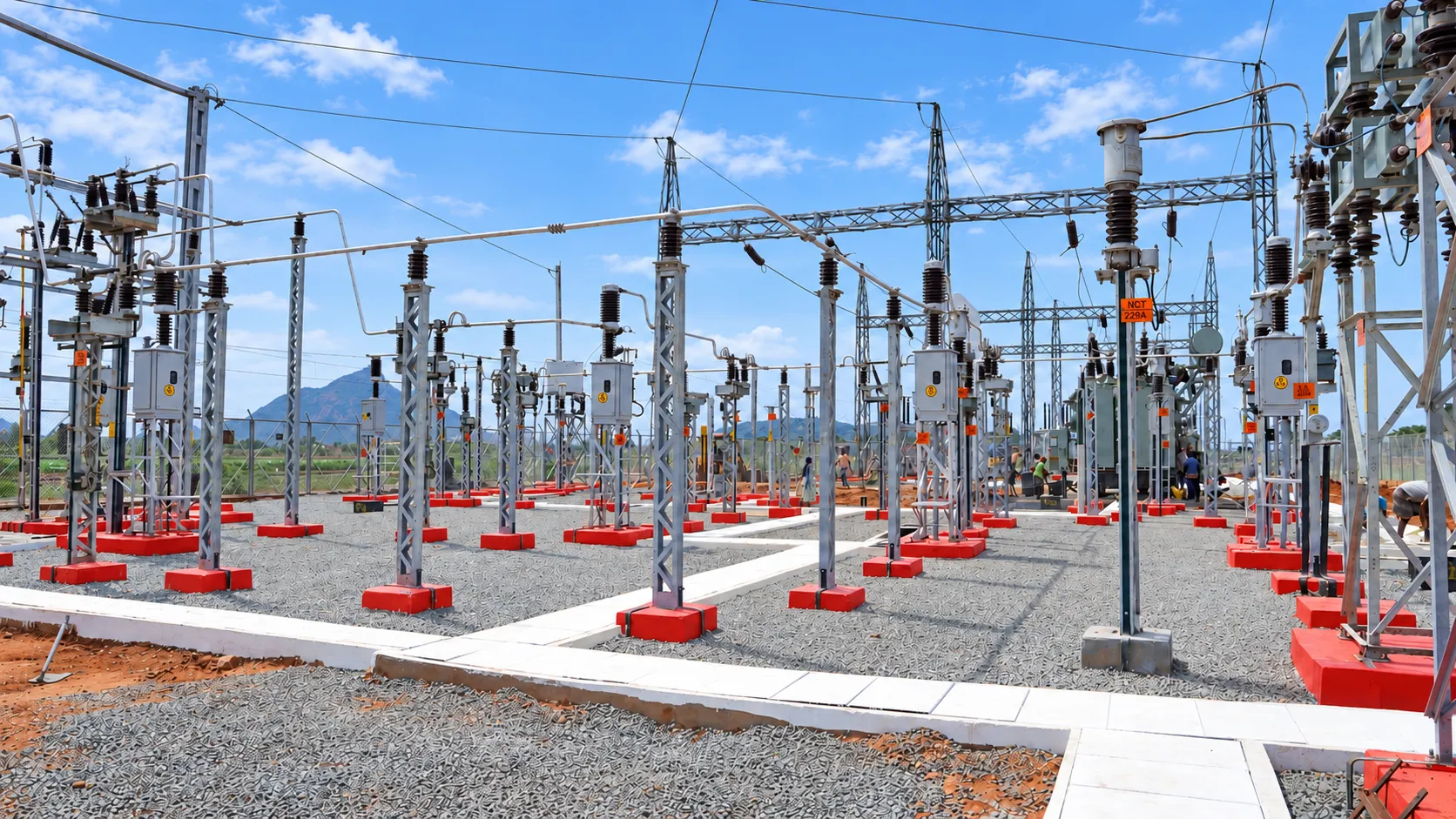
The industry backdrop
All of Core4's businesses sit in areas where public spending has been rising for several years: railways, power grids and urban water. That is the main argument for buying the stock.
In railways, the electrification push is now largely about the remaining routes, doubling and tripling of lines, and upgrading traction substations for heavier, faster traffic. Station redevelopment programmes also need the integrated civil-electrical-mechanical skills Core4 offers. The existing overhead equipment and substation base still needs maintenance and upgrades, and these are recurring revenue opportunities.
In power, distribution reform, grid-strengthening schemes and the integration of renewable capacity all need new and upgraded substations at the 33–220 kV level, exactly the range Core4 works in. Panel makers benefit as well, because every substation, pump house and treatment plant needs HT/LT switchgear and control panels. In water, urban drinking-water and sewage missions have created a steady stream of WTP and STP tenders, many awarded to mid-sized regional contractors.
The caveat is that a rising tide also brings more competitors. Tender-driven markets reward the lowest bidder, and government payment cycles can stretch when budgets tighten. For a company of Core4's size, the sector tailwind is necessary but not enough.
The bull case
Real growth with stable margins. Revenue nearly tripled in FY26 while EBITDA margin held at about 20% and PAT margin rose from 8.6% in FY24 to 13.5%.
Integrated model. In-house HT/LT panels and compact substations reduce dependence on outside vendors, improve control over timelines and add product revenue through Core4 Energy.
Diversified exposure. Six verticals across rail, power, water and automation reduce the risk that a slowdown in any one ministry's budget hurts the whole business.
High return ratios. FY26 ROE of 49.7% and ROCE of 37.8% are well above the listed peer's levels.
All primary capital. The entire ₹54.82 crore goes to the company, and no existing shareholder is exiting. Promoters retain nearly 59%.
Geographic expansion. Hiring in Tamil Nadu points to a footprint moving beyond Karnataka.
The risks investors must weigh
Cash is not keeping up with profit. Operating cash flow is negative despite reported profits. Until receivables convert into cash, earnings are of lower quality.
Rising leverage. Borrowings rose from ₹16.75 crore in FY24 to ₹40.57 crore in June 2026, and debt/equity is now 1.09x.
Lumpy, tender-driven revenue. Project wins, milestone billing and government payment cycles make quarterly results volatile.
Short corporate history. The company has been a corporate entity only since 2022.
Missing disclosures. No order-book figure, client-concentration data or segment revenue split appears in the public summaries reviewed.
Regional concentration. Much of the work is in Karnataka, which exposes the company to one state's budget and payment behaviour.
SME-market structure. The minimum ticket is over ₹2.2 lakh, trading happens in 1,200-share lots, liquidity is limited and exits can be hard.
Chanakya rates the balance sheet two stars out of five and the overall risk as high.
What the market is saying
Demand has been very thin: the issue was 0.08 times subscribed going into the final day, and the grey market premium is ₹0.
Category (Day 1 close) | Subscription |
QIB | 0.00x |
Small HNI | 0.10x |
Big HNI | 0.02x |
HNI total | 0.05x |
Retail / individual | 0.14x |
Total | 0.08x |
The day-one book drew only 118 applications. By Monday, 26 October, the overall figure was still 0.08 times. The grey market, an unofficial and unregulated indicator, has priced the shares at par throughout, implying no expected listing gain.
Timing may be part of the problem. Core4 opened in the same week as the Jio Platforms mega-IPO, which closed 22.19 times subscribed on 23 October and absorbed a large share of retail and HNI money. SME issues often see most bids arrive on the final day, so the closing numbers will matter. Still, a book this empty with a day to go is a weak signal.
Independent reviewers are lukewarm rather than negative. Chanakya Nipothi rates the issue three out of five and says "Selective Apply", conditional on earnings verification and cash-flow assessment. InvestorGain's team also gives it three out of five.
TIGI's take
Core4 Engineers is a real business growing fast in the right sectors, but it is priced on growth that its cash flows have not yet confirmed. Investors should treat it as a high-risk, selective bet, not a listing-gain trade.
The positives are clear: revenue nearly tripled, margins held up and even improved, return ratios are high and every rupee raised goes to the company. A Mysuru contractor that builds its own panels and works across rail, power and water is well placed for India's infrastructure cycle.
The concerns are just as clear. Borrowings now exceed equity. Operating cash flow is negative. The order book and client concentration are not visible in public summaries. The market has so far stayed away, and in SME IPOs, weak demand at the issue often means weak liquidity after listing.
Five things to check before bidding:
1. The final-day subscription, especially whether QIBs and big HNIs show up.
2. The order book and its execution timeline in the RHP.
3. Trade receivables and operating cash flow for FY26 and Q1 FY27.
4. Client concentration: how much revenue comes from the top five customers.
5. Whether you can hold a ₹2.23 lakh minimum position that may be hard to sell after listing.
For long-term investors comfortable with SME risk, a small allocation is defensible if those checks pass. For anyone hoping for a quick listing pop, the current demand gives little support.
Disclaimer: This article is for information only and is not investment advice. TIGI is not a SEBI-registered investment adviser. Figures come from publicly available IPO summaries of the offer documents as of 26 October 2026; read the red herring prospectus and consult a registered adviser before investing.
Sources: InvestorGain, Chanakya Nipothi, HDFC Sky, NiftyTrader, Outlook Business, Alice Blue, Value Research.